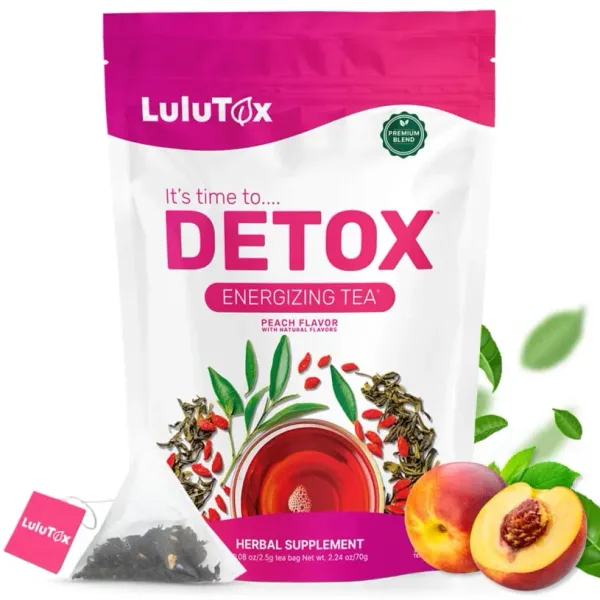
A tea bag is not a liver or a kidney
A tea bag is a steeped cup. Your liver and kidneys already clear metabolic waste, every day, whether or not you drink one. Lulutox is the cup — not those organs, and not a treatment. Nothing on this page is medical advice. No tea bag replaces the organs that filter blood. A herbal blend is not a treatment for liver disease, kidney disease, or a digestive diagnosis. Persistent bloating, pain, or a change in bowel habit belongs with a clinician, not with a checkout.
What the listing actually offers is narrower and easier to check: a box of 30 tea bags, nine named herbs, a 5–7 minute steep, and one cup a day. “Detox” on the carton is marketing. The page cites no study of this blend. Two of the named plants — senna leaf and licorice root — matter more for safety than the word “superfood.” Green tea adds caffeine the listing does not quantify. Those four facts, not the carton slogan, are the spine of this review.
The National Center for Complementary and Integrative Health page on detoxes and cleanses is the public context for the slogan. It describes detox diets and kits as products that often lack evidence for the sweeping claims they make, and it reminds readers that the body already has organs for that work. This review cites that page as category context. It does not treat Lulutox as having been studied there. The listing did not present a trial of this 30-bag box as a liver or kidney therapy, and this site will not invent one.
People shop “detox tea” for bloating, for a reset after a heavy week, for weight, or for a morning ritual that feels like care. Only the last of those is a job a cup can honestly take. Bloating that persists is a symptom. Weight is not a documented endpoint on this listing. A reset is a feeling-word. A morning ritual is a bag, a kettle, and a calendar that now includes senna. Keep the jobs separate. The 4.2 on this page is a score for a documented herbal cup with a laxative in it, not a score for shrinking a waist or sparing a liver.
If a clinician has already named a liver, kidney, or bowel condition, this box is not a parallel plan. Show the ingredient list to that clinician or to a pharmacist before you add a daily senna cup to a chart. If no clinician is in the picture and you still want a flavored morning cup, the rest of this page is about what the bag contains, what it costs on the listing, and what the listing will not tell you in milligrams.
Detox is a carton word, not a lab result
Cartons love the word because it sounds like work the drink is doing inside you. In laboratory English, detoxification is chemistry the liver performs on specific substances. In wellness English, detox is a week of tea, a darker stool, a trip to the bathroom, and a sense that something happened. Those two Englishes should not share a shopping cart without a warning label. Lulutox’s carton uses the wellness English. This review stays in the checkable English: named plants, a steep time, a once-daily cup, a laxative, caffeine of unknown milligrams.
A darker cup or a busier morning after senna is not proof that “toxins” left. Senna is a stimulant laxative; the listing itself says senna is a laxative. Bowel contents moving is the expected class effect of that plant, not a lab panel. If the carton lets you read the bathroom trip as evidence of clean blood, that is the slogan doing work the chemistry does not support. This page will not help the slogan.
No study of this blend is cited on the listing this review used. Single-herb research on milk thistle, or on green tea, or on ginger, is not a study of nine plants plus four unnamed others in unspecified amounts. Borrowing a paper about one plant to bless a tea bag is a category error. This review will mention public pages on senna, licorice, and green tea so you can take questions to a pharmacist. It will not pretend those pages measured Lulutox.
“100% natural organic herbs” and “13 superfoods” are additional carton clothes. Natural is not a dose. Organic, if accurate for the farms, is a growing claim, not a safety claim. Superfood is a magazine word. None of those clothes tell you how many milligrams of senna are in a bag. The missing milligrams are the story. The clothes are the window display.
Nine named plants, four still missing
The listing calls the formula 13 superfoods made from 100% natural organic herbs, but it names only nine. It does not publish an amount for any of them, so there is no way to compare the dose in a bag with amounts used in research on a single herb. If you have a known plant allergy, the unnamed four are a reason to read the box label or ask the manufacturer before ordering. A website that will not name 4 of 13 is not a complete ingredient panel.
| Green tea | Named; caffeine per cup is not stated |
|---|---|
| Senna leaf | A laxative — the listing itself says so |
| Licorice root | Named; the FAQ flags possible medication interactions |
| Dandelion root | Named; the cons warn of more frequent urination |
| Milk thistle | Named; no dose or study of this blend is cited |
| Nettle leaf | Named; no dose is published |
| Peppermint leaf | Named; also shapes the flavor |
| Ginger root | Named; no dose is published |
| Lemongrass | Named; no dose is published |

Peppermint, ginger, and lemongrass are the flavor story. They may be why a cup tastes like a cup instead of like a pharmacy. Flavor is allowed. Flavor is not a reason to skip the senna line. People who want a peppermint tea without a stimulant laxative already have grocery-store options that name every leaf. Lulutox is a blend that includes senna on purpose. Drink it as that blend, or pick a different shelf.
Milk thistle is a name with a long herbal reputation and, on this listing, no milligrams. Nettle is the same. Dandelion is named and then, in the cons, tied to more frequent urination. Reputation plus a cons line is still not a dose. If a paper you read used 300 milligrams of a standardized extract, that paper is not this bag. This bag is a tea. Steeping 5–7 minutes extracts whatever it extracts. The listing does not tell you what that is in milligrams.
Nine names are still better than zero. This review’s 4.2 credits the nine, especially senna and licorice, because a reader can take those words to a pharmacist. It subtracts for the four blanks and the missing amounts. A complete panel would have been a cheap thing for a manufacturer to print. The page this review read did not print it.
A stimulant laxative in a morning mug
Senna leaf is a natural laxative, as the listing states. Public pages agree on the class: senna is a stimulant laxative, sold in the United States as an over-the-counter drug for constipation when it is labeled as one. In a “detox tea,” the same plant often arrives without a Drug Facts box, wearing a superfood costume. The costume does not change the class. The MedlinePlus page on senna is a plain-language document a reader can take to a pharmacist. It is not a review of Lulutox. It is the class the listing invited into the cup.
The page’s own cons warn that prolonged overuse can cause reliance. That warning is the listing talking against its own daily-habit pitch. A manufacturer that suggests 2–4 weeks of consistent use is also the manufacturer that warns about reliance from prolonged overuse. Those two sentences should be read together. Four weeks of a stimulant laxative is not a trivial habit. It is a calendar you should not extend just because six boxes are cheaper per cup.
A daily laxative is not the same as “gentle detox.” Gentle, on a carton, is a tone. Stimulant, in pharmacology, is a mechanism: the bowel is being pushed. Cramping, urgency, and a day planned around a bathroom are ordinary class effects. They are not proof the tea is working as a cleanse. They are proof senna is in the bag. If you already use a senna tablet, stacking a senna tea is a double, and the listing did not publish a combined dose because it did not publish a dose at all.
Children, the very old, and people with bowel disease are not the shopper this review will walk into a stimulant laxative tea. The listing says to ask a doctor if you are pregnant, nursing, on prescription medicine, or living with a chronic digestive condition. This page repeats that and adds: if you already chase constipation with another product, do not add this cup as a silent extra. Pharmacists exist for that stacking question. The 4.2 score does not answer it for you.
Licorice and a prescription list
Licorice root may interact with certain medications. The FAQ says so without listing which ones — bring your prescription list. The NCCIH page on licorice root is public context: licorice (especially glycyrrhizin-containing forms) has a documented interaction story with some drugs and with blood pressure, and it is not a casual daily herb for everyone. This review cannot say how much licorice is in a Lulutox bag, because the listing did not say. Unknown amount plus a flagged interaction is a pharmacist visit, not a shrug.
People on heart, blood-pressure, diuretic, or corticosteroid medicines are the readers who should not treat “herbal tea” as automatically idle. Those classes are examples a pharmacist will recognize; they are not a complete list this site invented as Lulutox-specific. The listing’s FAQ already admitted interactions exist. The work left is to name your pills out loud across a counter. That conversation costs nothing. A surprise after a week of cups can cost a week.
Deglycyrrhizinated licorice is a different object from whole licorice root. The listing says licorice root. It does not say DGL. Do not import a DGL safety story onto this bag. Do not import a candy-licorice story either. The plant in a tea bag is a plant. The FAQ already treated it as a drug-interaction plant. Believe that FAQ enough to ask.
If the pharmacist says the cup is a bad match for a medicine you cannot stop, believe the pharmacist. The 30-day refund line, incomplete as its mechanics are, is still a better next step than negotiating with a carton. This review’s job is to make that ask feel ordinary, not dramatic. Ordinary is how people actually bring lists into pharmacies.
Green tea without a milligram
Green tea contains caffeine. The listing does not say how many milligrams are in a cup. Count this toward your daily total if you also drink coffee, and avoid it late until you know how you respond. The NCCIH green tea page notes caffeine as a real constituent, not a rumor. Without a milligram on the Lulutox panel, you cannot subtract it from a 400-milligram daily budget with any precision. You can only know that the budget is not zero.
A morning cup stacks with morning coffee. Sensitivity is personal: some people will not notice; some will feel a second jitter. Neither reaction is a detox. If you are limiting caffeine for sleep, pregnancy, or a clinician’s instruction, an unquantified green tea is a fog, not a plan. Ask the manufacturer for a milligram if you need a number. This page will not invent 20 or 50 milligrams to make the fog look like data.
Decaf is not described on the listing this review used. Do not assume the green tea in the blend is decaffeinated because the carton says detox. Detox and decaf are different words. If caffeine must be zero, this box as documented is the wrong box until a milligram of zero is printed.
Late-day steeping is the sleep experiment. The listing prefers morning or before a meal. That preference also happens to be the senna preference: you want the laxative window in daylight. Caffeine and senna both argue for morning. If you only remember one scheduling fact from this review, remember morning, and remember a bathroom you control.
Dandelion, extra trips, and a water glass
The cons list frequent urination from diuretic herbs and potential dehydration, which is why the brewing instructions pair the tea with plenty of water. Combined with a daily laxative, that is the practical trade-off: the listing credits dandelion with easing bloating, and the extra bathroom trips can come from the same cup. This review is not treating that credit as an outcome we measured. It is treating the cons list as the more useful document, because a cons list that mentions dehydration is a cons list you should believe enough to pour water.
Bloating that eases after a laxative and a diuretic herb may be a lighter bowel and a lighter bladder, not a “de-puffed” medical state. If you wanted less bloat after salty food, a bathroom week can feel like success. If you wanted a liver number on a lab printout to move, this cup is not that lab. Keep the success in the household column. Leave the lab column empty unless a clinician ordered a test for a real reason.
Dehydration plus senna is a miserable pair: cramping on too little water. The instructions’ “plenty of water” is doing real work. Plenty is not a milliliter on this listing either, so use ordinary sense — water through the day, not a single heroic liter at once unless a clinician has you on a specific plan. People on fluid-restricted diets should not invent “plenty” without the clinician who restricted them. That case is already in the “ask a doctor” bucket.
Nettle and dandelion sometimes travel together in folklore as “draining” herbs. Folklore is not a dose. The listing named both and quantified neither. The cons line about urination is the only operational hint. Use the hint. Do not add a third diuretic tea on the same day to “help.” Stacking unmeasured diuretic herbs is how a gentle-looking morning becomes a dizzy afternoon.
The unnamed four and a plant allergy
Four of the advertised 13 are not identified on the page. Allergy is the hard case for that gap. A person who avoids chamomile, or fennel, or a ragweed-related plant, cannot check a blank. Email the manufacturer, read the physical box if it names more than the site, or skip the order. “Natural” does not mean “you already tolerate it.” People with plant allergies already know that. Cartons hope they forget.
The gap also blocks a complete pharmacist check. A pharmacist can talk about senna, licorice, and caffeine in the abstract. A pharmacist cannot rule out an unnamed fourth, fifth, sixth, and seventh plant. “Is this safe with my ACE inhibitor?” is a better question than “Is detox tea safe?” It is still an incomplete question until 13 names and 13 amounts exist. This review’s 4.2 already prices that incompleteness.
If a later version of the listing names all 13 and prints milligrams, that would be a new document. It is not the document this page used. We will not fill the four blanks with guesses from other brands’ “13-superfood” teas. Other brands are other bags. Until those names exist, treat the carton math — 13 minus 9 — as a live gap, not as a rounding error. Four unnamed plants are four chances to be wrong about an allergy, an interaction, or a religious dietary rule you actually keep.
Organic claims, if they matter to you, belong on a certification you can check, not only on an adjective. This review did not audit a farm. It records the listing’s language and moves on. Safety here is senna, licorice, caffeine, pregnancy, and the unnamed four — not a soil story. A certified-organic senna leaf is still senna. A certified-organic blank is still a blank. Certification, even when real, does not name the four plants the page left out, and it does not print the milligrams the page also left out.
One cup, one bag, thirty days in a box
Steep one bag in hot water for 5–7 minutes. Drink one cup a day, preferably in the morning or before a meal. The listing does not suggest a second cup. Drink water through the rest of the day, as the instructions advise. The manufacturer suggests using it consistently for 2–4 weeks alongside a balanced diet. That timeline is the seller’s. Because senna is a laxative, a morning cup also means planning where you will be for the next few hours, at least until you know how your body responds.

Five to seven minutes is a steep, not a boil-until-dark contest. Darker is not more detox. Darker may be more bitter and, possibly, more of whatever senna extracts in that window. The listing did not say to double-steep the same bag. One bag, one cup. A second bag is a second dose of an unquantified laxative. The page did not suggest it. This review does not either.
Before a meal, on the listing, is a timing hint, not a weight-loss protocol. Do not skip meals because a carton said “detox.” The manufacturer’s own 2–4 weeks sit “alongside a balanced diet.” Balanced diet is the sentence to believe. A tea that replaces lunch is a different, undocumented product.
Thirty bags is thirty mornings if you obey one-a-day. It is two weeks if you do not. The listing’s one-cup rule is both a safety hint (senna) and a bundle-math hint (a six-box pack is a long senna calendar). Stay on one a day unless a clinician, looking at your list, says otherwise. A review site will not tell you to drink more.
Bathroom timing after the first steep
Stimulant laxatives do not run on a polite delay you can ignore on a commute. Until you know your own window, drink the cup on a morning when you control the next few hours. A first cup on a packed train day is an experiment with the wrong venue. This is not a joke section. It is the operational meaning of senna, which the listing already named as a laxative.
If nothing happens, do not add a second bag at noon to force a story. No bowel movement after one cup is not a license to double an unmeasured dose. If too much happens — cramping, urgency you cannot manage, dizziness — stop and ask a clinician. The 30-day refund line is not urgent care. Dehydration from the cons list is the extra reason to put water next to the cup and to stop if you cannot keep water down.
Work-from-home mornings are the easy venue. Office mornings are not, until you know the window. Travel days are worse: new coffee, less water, airplane toilets. The listing did not write a travel protocol. This review’s protocol is conservative: do not start the box on a travel day. Start it when the bathroom is yours.
Reliance, the cons warning, is the long-end risk of treating senna as a daily personality. Two to four weeks is already the manufacturer’s suggested window. Stretching that window because a six-box bundle is still in the cupboard is how prolonged overuse happens. When the bags run out, notice whether you can skip a morning without feeling stuck. If you cannot, you are in pharmacist-and-clinician territory, not in “order another six boxes” territory.
Bundle arithmetic on thirty bags
One box (30 bags) is listed at $24.99, three boxes at $59.97, six boxes at $99.94. Crossed-out figures and “80% off” badges are the seller’s own reference prices. The page lists free shipping. At one bag a day those totals are about $0.83, $0.67, and $0.56 a cup. The larger bundles only save money if you keep drinking it — and thirty days is far shorter than a six-box supply.
Bundle totals on the listing this review read
One box (30 bags) $24.99, three boxes $59.97, six boxes $99.94. Crossed-out figures and “80% off” badges are the seller’s own reference prices. The page lists free shipping. A 30-day money-back line is stated. The page does not say when the 30 days start, whether opened boxes qualify, who pays return postage, or how to request a return.
A single box is the cheaper way to find out whether the taste, the caffeine, and the senna suit you. Six boxes at $99.94 is a 180-day senna calendar if you stay at one cup — far past the 2–4 week suggestion and into the prolonged-use warning on the same site’s cons list. Saving $0.27 a cup is a bad reason to ignore that warning. Arithmetic should lose to the reliance sentence.
Three boxes at $59.97 is ninety days at one a day, still past 2–4 weeks. The only bundle that matches the manufacturer’s own short window is the single 30-bag box, and even that is at the long end of 2–4 weeks. Shop the small box first. If you still want more later, you will know your bathroom window, your caffeine, and whether licorice is a pharmacist problem. You will also still be able to read the current refund line, which this review could not fully specify.
A 30-day line with missing mechanics
A 30-day money-back line is stated. The page does not say when the 30 days start, whether opened boxes qualify, who pays return postage, or how to request a return. Those missing clauses are the difference between a usable experiment and a slogan. Senna teas get opened. A sealed-only return would make the first cup expensive in a different way. This review cannot tell you which rule applies. Read the current manufacturer terms before you order, and save the confirmation.
If the clock starts at order, shipping time eats the window. If opened boxes do not qualify, the first steep ends the refund. If return postage is on you, $24.99 can shrink. None of those sentences were on the page this review recorded, so none of them are facts this page will assert. They are questions. The partner checkout is labeled “Buy from the official site” because price and terms both move.
Free shipping on the way in is listed. Free shipping on the way back is not listed in the copy we used. Do not assume symmetry. Keep the original carton. A 30-bag box that has been opened still needs a box if a return is allowed. Photograph what you received. Support inboxes forget.
Compared with Keranique’s 120-day empty-bottle sentence or Audien’s 45-day device window, this 30-day line is thinner on paper because the mechanics are missing. That thinness is in the 4.2. A clearer return paragraph would have been easy to print. It was not printed on the page we had.
Questions a pharmacist can actually answer
Ask before the first cup
- Senna leaf is a natural laxative, as the listing states. The page’s own cons warn that prolonged overuse can cause reliance. A daily laxative is not the same as “gentle detox.”
- Licorice root may interact with certain medications. The FAQ says so without listing which ones — bring your prescription list.
- Green tea contains caffeine. The listing does not say how many milligrams are in a cup. Count this toward your daily total if you also drink coffee, and avoid it late until you know how you respond.
- Pregnant, nursing, on prescription medicine, or living with a chronic digestive condition — the page says ask a doctor first.
Public pages this review pointed at
- NCCIH on detoxes and cleanses
- MedlinePlus on senna
- NCCIH on licorice root
- NCCIH on green tea
- The Lulutox listing’s own named herbs, cons list, brewing directions, and bundle totals
A pharmacist does not need this review. They need your list and the nine names. Say “senna tea with licorice and green tea, milligrams unknown, four plants unnamed.” That sentence is complete enough to get a useful “no,” a useful “watch blood pressure,” or a useful “one cup for two weeks then stop.” It is also complete enough to get “I cannot clear unnamed plants.” That last answer is a reason to skip, not a reason to argue with the carton.
Doctors, for pregnancy, nursing, and chronic digestive disease, are the listing’s own referral. This review will not substitute a tea ritual for that referral. If you came here because bloating, pain, or a bowel change has lasted, skip the cart. Those signs are why clinics exist. A $24.99 box is not a workup.
Weight is not a line on this carton
Detox teas are often shopped as a weight shortcut. The Lulutox listing this review used does not print a pound figure, a week-by-week loss chart, or a calorie count for the cup. This page will not borrow someone else’s before-and-after. A stimulant laxative can make the scale move because the bowel is emptier. That is not fat leaving. It is contents leaving. The scale will usually move back when you eat and drink like a person again.
If weight is the job you wanted the box to do, you are in the wrong aisle. Diet, movement, medicines, and conditions that a clinician names are the actual list. A $24.99 tea is not on that list as a documented tool. Using senna to chase a number is also how people slide into the prolonged-overuse warning the listing already printed. The 4.2 does not include a bonus for a smaller jeans size, because no such size was measured here.
Appetite is another rumor around bitter morning cups. This listing did not document appetite as an endpoint. If you eat less because senna cramping made lunch unappealing, that is a side effect, not a feature. Eat the balanced diet the manufacturer mentioned. Do not treat nausea or urgency as a lifestyle hack.
Readers who already have an eating-disorder history should not add a laxative tea as a “reset.” That is a clinician-and-support conversation, not a checkout. This review will be blunt: senna is the wrong tool for that history. Skip the box.
Taste is not printed, and mint will not hide senna
Peppermint, ginger, and lemongrass are the flavor names. Senna and licorice will still be in the liquor. This review did not taste the cup and will not invent a tasting note. What it can say is that herbal laxative teas as a class are often bitter, sweet-woody, or both, and that a mint leaf is not a disappearing spell. If flavor is why you buy tea, a grocery peppermint without senna is the honest mint purchase.
Honey, lemon, and milk are not on the listing’s directions. Adding them does not make the milligrams appear. Adding milk does not cancel caffeine. Adding lemon does not cancel licorice interactions. Sweeteners are a kitchen choice. They are not a safety plan. If you need the cup to taste like dessert in order to drink a laxative every morning, that is a signal to revisit whether you want the laxative at all.
Temperature is 5–7 minutes in hot water, not a cold-brew protocol the listing printed. Do not assume a refrigerator jar overnight is the same extraction. It is a different, undocumented cup. Stick to the steep the page wrote, at least for the first box, so that whatever you experience can be compared with the directions you followed.
If the first cup is undrinkable, you have your answer on taste, and you still have senna in you for the rest of that morning. Do not chug a second bag to “get used to it.” One bag was the instruction. Spit-and-dump is not a documented method either; if you cannot swallow it, you have still opened the box, which is why the missing opened-box refund rule matters.
A grocery peppermint is a different shelf
Nothing stops a reader from buying peppermint, ginger, or lemon grass as separate teas that name every plant and omit senna. Those grocery boxes will not carry a detox slogan, and they will not include a stimulant laxative unless they say so. Lulutox’s distinctive documented fact is the senna-plus-licorice-plus-green-tea combination inside a 13-superfood costume with four blanks. If you do not want senna, you do not want this SKU. The mint is a decoy.
Milk thistle teas sold as single-herb products are also a different shelf, with their own unlabeled-dose problems. This review is not a milk thistle review. It is a reminder that one named plant in a nine-plant bag is not a milk thistle product. People who came for milk thistle should buy a product that is milk thistle, or talk to a clinician about whether they should buy any of it. Borrowing the name from Lulutox’s list is not a protocol.
Coffee is the other morning comparison. If the job is a warm cup and a small caffeine push, coffee already has milligrams on many shop menus. Lulutox has unknown milligrams plus senna. That is not an upgrade. It is a different object. The 4.2 exists because the object is documented as a one-bag herbal cup with named risks, not because it beats coffee at coffee’s job.
Keep the shelves straight and the skip box stays easy. Liver symptom: clinician. Constipation you want a labeled OTC senna for: a labeled OTC senna, with Drug Facts. A flavored sip: grocery tea. Lulutox sits in the leftover space where someone wants a ritual and is willing to take senna, licorice, and mystery plants along for the ride. That leftover space is small. It should stay small.
Week two is still the manufacturer’s window, not a lifestyle
The seller’s 2–4 weeks sit next to a cons warning about reliance from prolonged overuse. Week two is inside that window. Week eight, on a six-box calendar, is not. This review keeps repeating the calendar because bundle pages are designed to make you stop seeing it. Ninety bags is a lifestyle. Two to four weeks is a short trial. Only the trial matches the manufacturer’s own suggestion.
What you should know by week two: whether the taste is tolerable, whether caffeine stacks badly with coffee, whether senna’s window is manageable, whether urination and water intake are a problem, whether a pharmacist already said stop. If any of those is a no, use the 30-day line if the current terms still offer one, and do not open box two. If all of those are a cautious yes, you are still not obligated to buy a 180-day supply. You can stop at the seller’s four weeks like an adult reading a cons list.
Bowel habit after you stop is the observation the reliance warning is about. If stopping is difficult, that is data for a clinician, not a coupon for another bundle. Stimulant laxatives as a class have that reputation. Lulutox did not invent it, and Lulutox did not disclaim it; the cons list put it on the page. Believe the cons list when the carton is still talking about superfoods.
A balanced diet, the manufacturer’s companion sentence, is still required at week two. The tea does not replace fiber, water, or food. If week two is tea and very little else, you have built a different, undocumented product and a better reason to stop. This site will not give that version a score. The 4.2 is for the cup as directed: one bag, water, diet, short window.
Hotel kettles and a laxative you already started
Once senna is a morning habit, travel is a logistics problem. Hotel kettles vary. Shared bathrooms on trains do not. The listing did not write a travel protocol, and this review will not invent a “travel pack” the box did not describe. What it will say is operational and conservative: do not take the first-ever cup on a travel day; if you are already inside the 2–4 week window and you know your timing, still pack water, still count caffeine against airport coffee, and still skip a morning rather than double-steep a bag in a rush.
A box in a suitcase is 30 bags of a stimulant laxative plus licorice plus unnamed plants. Keep it where a child cannot treat it as candy tea. Keep the bag count honest so you do not “catch up” missed mornings with two bags. Missed mornings are missed. They are not a debt. The manufacturer’s one-cup rule does not include a make-up exam.
Crossing time zones moves “morning.” The laxative window follows the cup, not the clock on your phone. If you land at 10 p.m. local and think “I haven’t had my cup,” you are about to schedule a night bathroom in a new bed. Skip. Resume when morning is morning again and a bathroom is yours. Nothing on the listing requires a perfect streak. Superfood cartons imply streaks. Senna does not need one.
If travel is most of your next month, this may not be the month for the box. The 30-day refund line, with its missing mechanics, is a poor companion to a month of hotel rooms. Start the experiment at home. That sentence is the entire travel section, restated. Home is where you learn whether Lulutox is a cup you can live with. Airports are where you learn whether you packed enough underwear. Those should not be the same lesson.
Where 4.2 sits on this blend
We give Lulutox Detox Tea 4.2 / 5. Nine of the herbs are named, including the two that need a safety check. The routine is one bag. A cup costs well under a dollar at the listed bundle totals. A 30-day refund line is offered. Those are the reasons the score is not lower.
The score stops there because “detox” is a slogan, four of the advertised 13 ingredients are unnamed, caffeine is not quantified, and senna makes this a daily laxative. If you want a herbal morning cup and will ask a pharmacist about senna and licorice first, start with one box. If you want a treatment for bloating, digestion, or weight, this is not one. Six-box arithmetic that drags senna past the listing’s own 2–4 weeks is a reason to stay on the small box, not a reason to chase $0.56 a cup.
4.2 is an editorial score for the product as documented, explained on our review methodology page. It is not a user-rating average and not a liver finding. The partner link is a checkout. The organs that already do the work this carton named are not for sale.
Hold the 4.2 next to a kettle, not next to a slogan. One bag. Five to seven minutes. Morning. Water. A pharmacist if you take pills. A clinician if you are pregnant, nursing, or already dealing with a bowel or organ problem. A single $24.99 box if you still want the cup after those sentences. Not six boxes. Not a second bag at noon. Not a weight story. Not a liver story. The listing already gave you senna, licorice, green tea, and four unnamed plants. That is enough information to decide. It is also enough information to walk away. Current totals can move; the partner link is there so you can read the page that exists the day you pay, not only the page this review recorded.
Before you steep the first bag
Green tea, peppermint leaf, licorice root, nettle leaf, dandelion root, ginger root, senna leaf, lemongrass, and milk thistle. The marketing calls the formula 13 superfoods. Four of those 13 are not identified on the page, and no amount is published for any herb.
Green tea naturally contains caffeine; the listing does not state how much a cup has. Senna leaf is a laxative — the listing itself says so. Licorice root may interact with some medicines; the FAQ flags that without naming which drugs.
One box (30 bags) is listed at $24.99, three boxes at $59.97, and six boxes at $99.94. The page lists free shipping and a 30-day money-back line. It does not say when the 30 days start, whether opened boxes qualify, or who pays return postage.
No. A tea bag is a steeped cup. The liver and kidneys already clear metabolic waste. The listing cites no study of this blend as a treatment for liver disease, kidney disease, or a digestive diagnosis. Persistent bloating, pain, or a change in bowel habit belongs with a clinician.
Steep one bag in hot water for 5–7 minutes. Drink one cup a day, preferably in the morning or before a meal. The listing does not suggest a second cup. Drink water through the rest of the day, as the instructions advise. The manufacturer suggests using it consistently for 2–4 weeks alongside a balanced diet.
Because senna is a stimulant laxative, a morning cup also means planning where you will be for the next few hours, at least until you know how your body responds. The page’s own cons warn that prolonged overuse can cause reliance. A daily laxative is not the same as gentle detox.
Bring the nine named plants and your prescription list. Senna, licorice, and green-tea caffeine are the three the listing itself singles out. The FAQ flags licorice interactions without naming drugs. Pregnant, nursing, on medicine, or living with a chronic digestive condition: the page says ask a doctor first.
No. The listing names nine plants and does not publish an amount for any of them, so there is no way to compare the dose in a bag with amounts used in research on a single herb. Four of the advertised 13 superfoods are unnamed on the page.
At one bag a day the listed totals are about $0.83, $0.67, and $0.56 a cup. The larger bundles only save money if you keep drinking it, and thirty days is far shorter than a six-box supply. A single box is the cheaper way to find out whether the taste, the caffeine, and the senna suit you.
Nine of the herbs are named, including the two that need a safety check. The routine is one bag. A cup costs well under a dollar at the listed bundle totals. A 30-day refund line is offered. The score stops there because detox is a slogan, four ingredients are unnamed, caffeine is not quantified, and senna makes this a daily laxative.