Perceived mild-to-moderate is the whole category
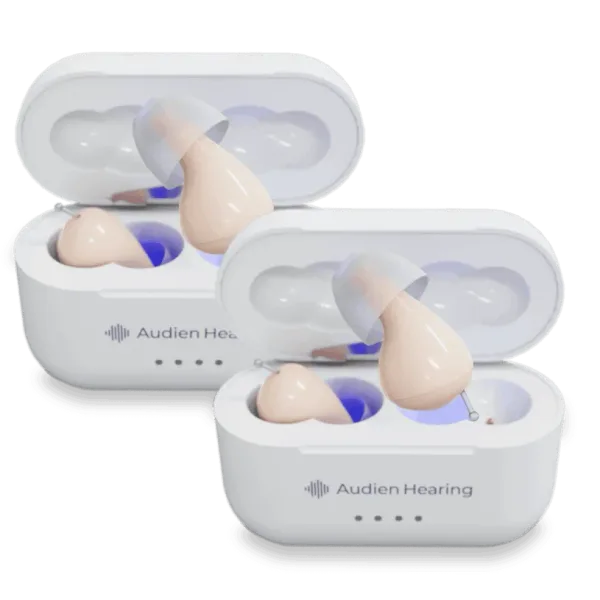
The fork on Atom Pro is an over-the-counter pair you seat yourself versus an audiologist who measures the loss, programs the aid, and sees you again. The manufacturer’s listing puts Atom Pro in the first lane as an FDA-registered OTC device. That is why a checkout exists and an appointment does not. The word that does the work is “perceived.” Nobody on the other end of the order form has seen an audiogram.
In 2022 the U.S. Food and Drug Administration opened an over-the-counter lane for adults who judge their own hearing as mild to moderate. The FDA’s OTC hearing-aid page is the public document for that lane. It is a category rule, not a product review, and it is not a finding that any particular pair will match a programmed aid. It is the reason a company can sell a hearing aid without a fitting appointment. It is also the reason a buyer can enter the category by mistake.
Mild-to-moderate, in that rule, is not a feeling that the television is a little loud. It is a range of loss the rule was written around. Severe and profound loss sit outside it. Children sit outside it. A perforated eardrum sits outside it. The listing for Atom Pro follows that map: adults, perceived mild to moderate, in-ear tips you choose yourself. If your actual loss is elsewhere on the map, the registration does not stretch to cover you. Registration is not a diagnosis.
| Product on the listing | Audien Atom Pro |
|---|---|
| Category | Over-the-counter rechargeable hearing aid, FDA-registered |
| Intended users | Adults with perceived mild to moderate hearing loss |
| Form | In-ear; the listing calls it nearly invisible |
| Fit | Included sizing tips; not custom-programmed |
| Sold | Online only |
| Charge | About 3 hours in the USB case; up to 20 hours of use |
| Pair total on the listing | $489, shown against $589, with free outbound shipping |
| Return window on the listing | 45 days, full refund if the devices come back inside it |
The listing does not publish gain, frequency range, or noise-reduction figures. There is no spec sheet to hold against another OTC model. What you can check is the category, the tip fit, the charge cycle, and the return clock. Those four facts are the spine of this review. Everything else — restaurant noise, a second pair, a $20 amplifier — is context around that spine, not a lab result from this site.
Online-only is a distribution fact with a fitting consequence. There is no booth. There is no probe-tube measurement. There is no follow-up visit baked into the $489. The 45 days are the only structured chance the listing gives you to decide whether the tips seat and whether speech is clearer in the rooms you bought the pair for. Treat those days as a fitting period, not as a gift-receipt window you can ignore until month two.
What the 2022 FDA rule opened, and closed
The FDA’s 2022 final rule did two things at once. It opened a path for adults to buy hearing aids without a prescription, an exam, or a fitting by a licensed person. It also drew a line around who that path is for. The agency’s own materials describe OTC hearing aids as intended for adults 18 and older who believe they have mild-to-moderate hearing loss. That sentence is the door. It is also the doorframe.
What the rule did not do is abolish audiology. Prescription hearing aids remain the route for people whose loss is more severe, whose ears need medical clearance, or whose devices need programming to an audiogram. The National Institute on Deafness and Other Communication Disorders page on hearing aids still describes professional fitting as the usual path for many users. OTC did not replace that path. It added a shelf next to it.
FDA-registered, on a product page, is easy to read as FDA-endorsed. Registration and clearance are not a gold star on speech-in-noise performance. They are a regulatory status a reader can check. This review treats Audien’s “FDA-registered OTC device” line as a category claim, not as a score. We did not audit the registration file. We did not invent a 510(k) number the listing did not print. If you want the current status, look it up on the agency’s side, not on a checkout banner.
The rule also did not require manufacturers to publish full acoustic datasheets in consumer copy. That is why Atom Pro can sit in the OTC lane without a gain curve on the landing page. Buyers who want those numbers will not find them in the material this review used. The absence is a documentation gap. It is not proof that the device has no internal processing. It is proof that you cannot compare published numbers that were never published.
Self-fitting is the practical meaning of the opened door. You decide you are in the mild-to-moderate lane. You order. You try tips. You live with the seal. If you guessed the lane wrong, the 45 days are the documented way back. The rule made that guess legal for adults. It did not make the guess accurate. An audiogram is still the tool that closes the guess. This review scores the product inside the lane it claims. It does not score the wisdom of skipping a test if you do not already know the range of your loss.
Tips in the canal, not a programmed aid
Each earpiece sits in the canal, held by a soft tip. You pick a size, press it in, and live with that seal. There is no clinic visit that shapes the shell or writes a program for your audiogram. The listing describes the look as nearly invisible; how much shows still depends on your ear and the tip that actually stays put. “Nearly invisible” is a look claim. It is not a claim that the device will stay seated through a meal.
Try each included size on each ear. Left and right often disagree. A loose tip lets the device walk while you talk or chew. A tip that hurts is too large. Ongoing soreness or any discharge is a reason to stop and ask a clinician — and to use the return window rather than wait it out. Pain is not a break-in period the listing documents. Discharge is not a fitting quirk. Both are stop signs.
The listing does not state how many tip sizes ship in the box. This review will not invent a count. What you can do, with whatever set arrives, is keep the unused sizes until the 45 days are over. Swapping on day 40 is still inside the window the listing printed. Throwing the extras away on day two is how people get stuck with a seal they hate and a calendar that is about to close.
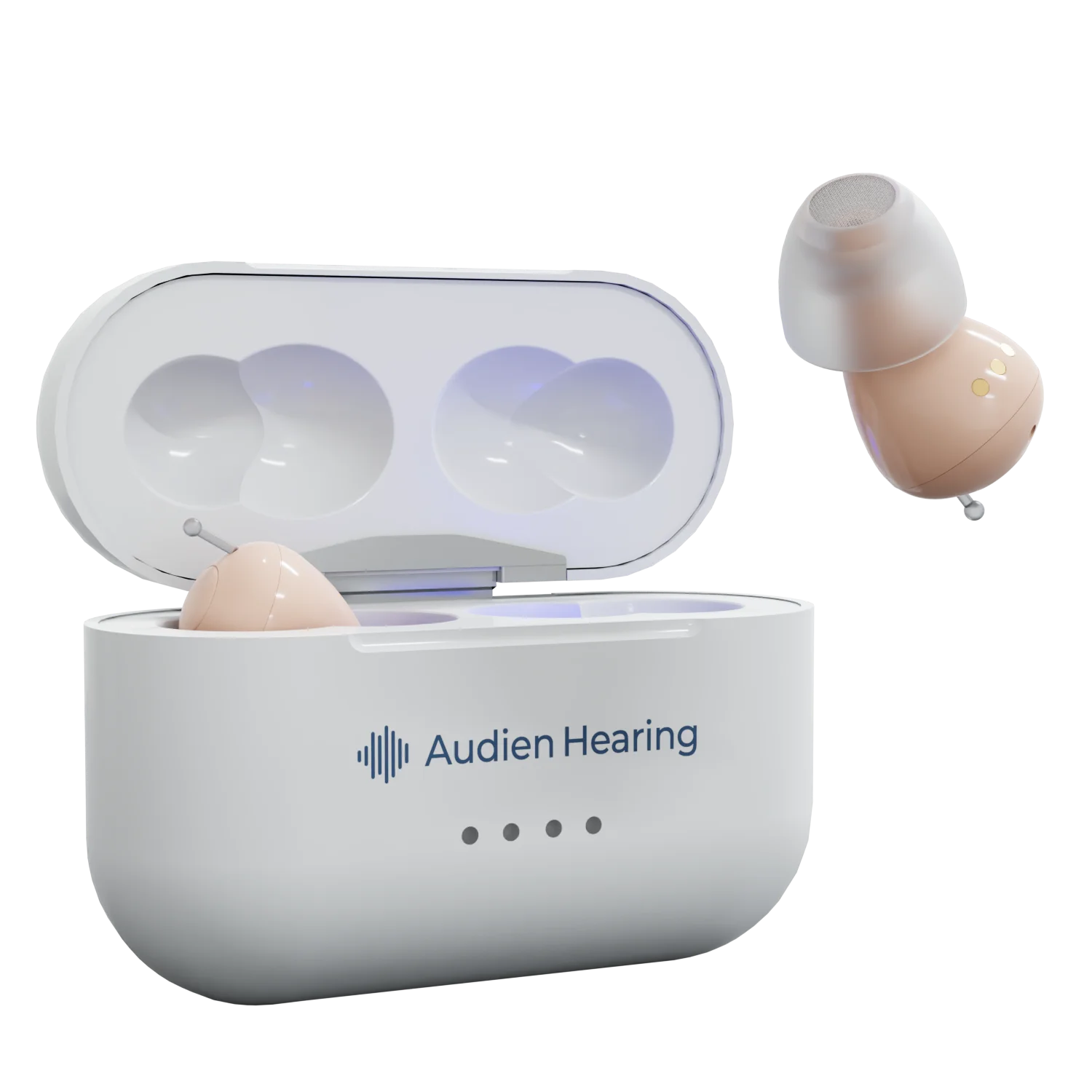
Talking, chewing, and a wide yawn are the motions that unseat a shallow tip. If the device walks during a phone call, the size is wrong or the canal shape is not a match for a universal dome. A programmed custom shell exists for that mismatch. Atom Pro is not that shell. Returning the pair because the tip will not stay is a legitimate use of the 45 days. Forcing a painful size because you already opened the box is not a requirement the listing prints.
Wax and moisture will collect on a canal tip. The listing, in the material this review used, does not publish a cleaning protocol or a replacement schedule for the tips. Ask the manufacturer for the current care sheet before you invent a routine with alcohol or a pin. A damaged tip is a seal problem, and a seal problem is a reason the device walks. Keep the case; it is also the charger.
A closer match is an adult who already notices trouble with conversation, the TV volume, or everyday sounds such as doorbells, and who will work through tip sizes without an appointment. That sentence is the positive case. It is not a promise that conversation, television, or doorbells will then be easy. It is a description of the buyer who is at least in the right store.
Left ear, right ear, and a seal that has to last dinner
Universal tips assume two canals that will accept the same idea of “medium.” Real ears often do not. The instruction to try each included size on each ear is not a nicety. It is the entire fitting method Atom Pro ships. If the left wants a smaller dome and the right wants a larger one, that is a normal outcome, not a defective box. Mix the sizes. Keep the leftovers. The listing did not print a rule that both sides must match.
A seal that lasts dinner is the test that a five-minute insert will miss. Chewing moves the jaw. Talking moves the canal wall. A sip from a glass tilts the head. If the device walks during that stretch, speech processing never gets a chance to matter, because the microphone is no longer aimed at the world you intended. Re-seat. Try the next size. If every size walks, the 45 days exist so you can send the pair back instead of inventing tape, which this listing does not describe as a method.
Feedback — a whistle when a hand or a hug comes near the ear — is a common complaint class for canal devices when the seal leaks. This review did not find a feedback figure on the Atom Pro listing it used, so it will not invent one. If you hear a whistle, treat it as a seal and insertion problem first: size, depth, whether the tip is torn. If it continues through every size, that is another data point for the return, not a puzzle you are required to solve without a clinician.
Insertion depth is the other half of size. Too shallow, and the device shows and walks. Too deep, and comfort collapses. The listing’s “nearly invisible” line pushes buyers toward deeper insertion than they may like. Comfort still wins. An invisible device you remove after twenty minutes is a visible case on a table. Use a mirror for the first days if you need to, then use the day, the meal, and the commute as the real judges. If one ear accepts a seal and the other never does, that mixed result is still a reason to talk to a clinician about the stubborn side rather than to keep paying for a pair that only works in profile photos.
Twenty hours on a charge, three hours in the case
There are no disposable hearing-aid cells to buy. Both devices dock in the included USB case. The listing rates a full charge at about 3 hours and use at up to 20 hours. “Up to” is a ceiling, not a diary of your waking day. If you wear the pair from breakfast through a late commute, twenty hours is enough in theory. If you forget the case at home, the theory does not help.
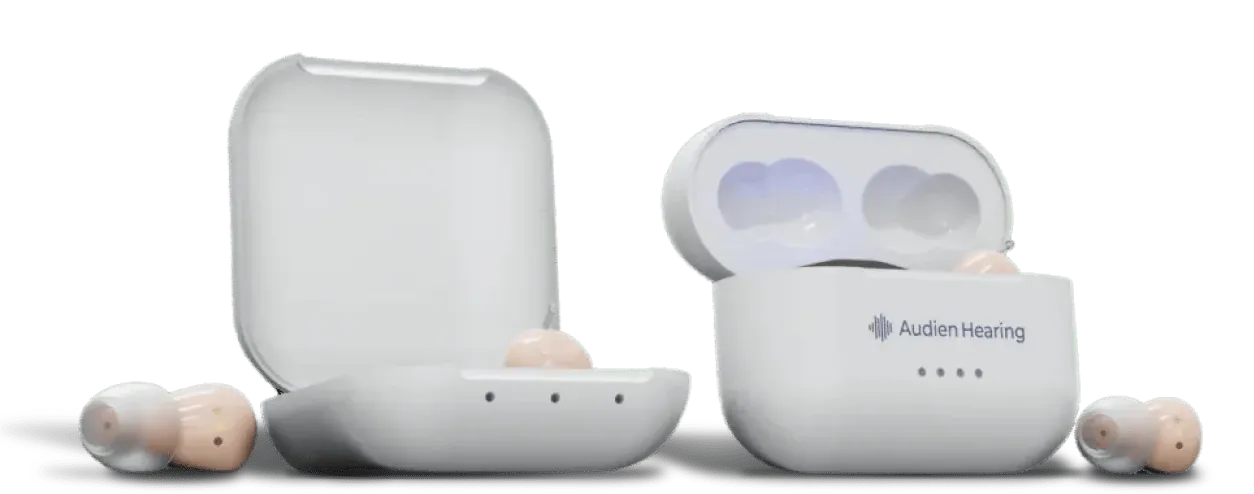
Docking overnight covers the 3-hour charge. That is the simple routine the product is built around. Miss a night, and you are spending the next day against whatever remained in the cells. The listing does not say how long a partial charge takes, or whether a 20-minute dock is useful. It does not say how capacity holds up after months of daily charging, or whether a worn battery can be swapped. Ask the manufacturer if you plan to keep a pair for years. This page will not invent a cycle life.
USB is an ordinary cable class. The listing does not, in the copy this review used, name a wattage, a proprietary brick, or whether a laptop port is enough. If the case arrived with a cable, use that cable until you know otherwise. The case is also the storage. Pocketing loose canal devices is how tips pick up lint. The overnight dock is both power and a lid.
Travel days put the 3-hour charge on a hotel clock. If you land late and skip the dock, the next morning’s “up to 20 hours” may already be a leftover. A second pair in a bundle, sold at $883.50 or $1,178, is sometimes pitched as a spare. A spare pair only helps if you charged it. An uncharged spare is two cases to remember. Bundles are a later section; the charge cycle is the reason a spare is not free convenience.
Rechargeable OTC aids as a class trade the drugstore battery run for a nightly ritual. That trade is the product. People who dislike docking will dislike this pair even if the tip fits. People who already charge earbuds will find the ritual familiar. Familiar is not a clinical finding. It is a household fact about USB bricks on a nightstand.
Speech in noise the listing does not promise
What the copy says about speech
Audien’s copy says digital processing is tuned for speech rather than making every sound louder. That is a design claim on the listing. It is not a published signal-to-noise ratio, not a restaurant trial, and not a promise that a busy dining room will become easy. This review did not measure speech-in-noise. It records the sentence the manufacturer printed and refuses to upgrade it.
A busy restaurant is still the hardest room for any aid. Clinking plates, overlapping talk, and a HVAC drone are a different problem from a doorbell in a quiet hall. With no custom program, Atom Pro has only its built-in noise processing. Built-in is a factory setting. It is not your audiogram. If restaurants are the reason you are shopping, an OTC self-fit pair is a hope, not a documented fix. The 45 days are when you find out whether the hope holds in the rooms you actually enter.
Television at your usual volume is the easiest home check before the return window closes. If the set is already loud because you have been compensating, turn it back toward a level other people in the house can stand, then see whether speech on the screen is clearer with the tips seated. That check is not a lab. It is a use of the 45 days. If the set still has to sit at the old volume, the pair is not doing the job you bought it for, and the listing’s refund sentence is the next document to read.
Doorbells, kettles, and turn signals are simpler sounds than consonants in a crowd. An aid can make those simpler sounds easier without solving a restaurant. The listing does not separate those jobs in a table. Buyers should. If the job is “I miss the doorbell,” a canal tip that stays put may be enough. If the job is “I miss half the table at dinner,” you need a conversation with an audiologist, not a louder hope from a checkout.
The missing gain and frequency figures matter most here. Without them, you cannot tell whether the device emphasizes the band where your loss sits. Two people can both be “mild to moderate” and still need different curves. Programming exists for that. Atom Pro does not offer it. The 4.6 on this page already withholds a fifth star for that documentation gap. Speech-in-noise is the everyday name of the gap.
Children, drainage, and a perforated drum
See an audiologist or doctor first
- Severe or profound loss — outside what the listing designs the device for.
- Anyone under 18 — the OTC category is written for adults.
- Ear drainage or a perforated eardrum — a canal device is not an exam.
- A hearing profile that needs custom programming — Atom Pro has none.
- You do not know how much hearing you have lost. A test closes the gap the word “perceived” leaves open.
The FDA’s OTC materials are explicit that these devices are for adults. A child’s ear canal is not a smaller adult canal, and a child’s loss is not a DIY project. If the pair is being considered for someone under 18, stop. The category is not written for them. An audiologist and a physician are the documented next step, not a self-fit tip from a mailer.
Drainage and a perforated eardrum are medical signs, not fitting preferences. Putting a canal device into an ear that is draining, or into an ear whose drum is not intact, is outside what this review will treat as a reasonable home experiment. The listing’s skip territory and the FDA’s own caution point the same way: get a clinician. The 45-day window is not a treatment plan for an infected or injured ear.
Sudden loss, one ear that dropped quickly, dizziness with the loss, or pain are also clinician territory even when they are not printed as a bullet on the product page. This review is not a complete otology checklist. It is a reminder that “perceived mild to moderate” is a self-judgment for a gradual, bilateral, ordinary-sounding difficulty — conversation, television, doorbells — not a workaround for an ear that changed overnight.
Custom programming is the other skip. If you already have an audiogram that shows a shape a generic curve will not match, or if you have tried OTC devices and still cannot catch speech, Atom Pro does not add a programmer. It adds another universal tip. Spend the 45 days only if you are actually in the self-fit lane. If you already know you are not, the pair total at $489 is the wrong bill.
The 45 days are your fitting period
A pair is listed at $489 against a $589 figure on the same page, with free outbound shipping. Those dollars are the listing’s numbers, not an offer from this site, and they can move. The 45-day money-back window is the other number that matters, because a self-fit canal aid cannot be judged in a parking lot. You need evenings, a meal, a commute, and a television program you already know.
Figures on the listing this review read
Those pair totals are what the manufacturer’s page showed. The same page states a 45-day money-back window and a full refund if the devices come back inside it. It does not say whether the 45 days start at order or at delivery, who pays return shipping, whether unused tips and the case must come back, or whether one pair from a bundle can be returned alone.
Keep the box. Write down the delivery date. Confirm the return steps before you are near day 45. If the clock starts at order rather than delivery, shipping time is already eating the fitting period. The listing did not settle that question in the copy this review had. Conservative reading says: start your own count on the order date and still try to learn the current rule from support before you need it. Hope is not a start date.
Return shipping, if it is on you, is a cost the $489 does not include. Outbound shipping is listed as free. Inbound is the open item. A full refund “if the devices come back inside” 45 days is the listing’s sentence. Coming back means a carrier, a label, and time. Start that process with days to spare. A device that leaves your house on day 45 may not count as back on day 45. The listing did not define the postmark.
Unused tips and the case are part of the product. If the return rule requires the kit complete, a lost dome is a problem. Keep every size in the original box. Do not toss the case because a drawer seemed simpler. The case is also the charger; returning “the hearing aids” without it may not be the return the listing described. Ask before the week you intend to send the pair back.
A second pair is not a spare ear
Two-pair and three-pair bundles also appear on the listing, at $883.50 and $1,178. A second pair only saves money if a second person also fits the mild-to-moderate description — or if you want a spare and can live with the extra outlay. Those are different jobs. A household of two adults in the OTC lane is the first job. A backup for one adult is the second. Neither job is a reason to buy a pair for a child or for someone with drainage.
Bundle math is only math if both pairs stay. The listing does not say whether one pair from a bundle can be returned alone. If the answer is no, a household experiment in which one person keeps and one person sends back may not exist. Confirm that rule before you pay $1,178 to “try it for the family.” Trying, on this product, is the 45 days. The bundle multiplies the cash at risk until the rule is in front of you.
$883.50 for two pairs is less than two times $489 ($978), which is why the listing can call it a bundle. The saving is real as arithmetic on those printed numbers. It is not a reason to put a second adult into a canal tip if that adult has not judged their own loss as mild to moderate. A gift pair for a parent who has not agreed to the ritual — nightly dock, tip experiments, restaurant disappointment — is how unused devices sit in a case until the window closes.
A spare pair for one person sounds like insurance against a lost earpiece. It is also two charge cycles, two cases, and twice the chance of mixing tips. Until the listing publishes a replacement-earpiece price, a spare pair is the only documented way to have a backup, and it is an expensive backup. Ask the manufacturer about single-side replacement before you assume the bundle is the spare-parts department.
Figures the listing does not print
Gain, frequency range, maximum output, and noise-reduction numbers are how two hearing aids are compared on paper. The Atom Pro listing this review read does not print them. Tip count is not stated. Battery cycle life is not stated. Ingress protection against water is not stated. Bluetooth, if any, is not in the documented copy this page used, so this review does not claim an app, a streaming mode, or the absence of one as a measured fact. Absence on the page is absence in the review.
| Item | Status in the copy we had |
|---|---|
| Gain / frequency range / noise reduction | Not published |
| Number of tip sizes in the box | Not stated |
| Battery replacement after wear | Not stated |
| Charge time for a partial dock | Not stated |
| Return clock start (order vs delivery) | Not stated |
| Who pays return shipping | Not stated |
| Single pair return from a bundle | Not stated |
| Single-earpiece replacement price | Not stated |
Those blanks are why a reader cannot build a comparison table against another OTC model from this page alone. They are also why the 45 days carry so much weight. When paper is thin, time in the ear is the remaining instrument. Use it. Do not wait until day 44 to seat the first tip.
Warranty beyond 45 days is another blank in the material used here. A money-back window is not the same as a one-year hardware warranty. If a longer cover exists, it was not in the copy this review is willing to cite. Ask before you treat $489 as a device you can send for repair in year two. This site will not invent a term.
A cheap amplifier is still the wrong object
Personal sound amplifiers — the $20-class gadgets sold next to batteries in a pharmacy aisle — are not hearing aids. The FDA has said so in public consumer materials: they are not intended to compensate for hearing impairment in the way a hearing aid is. Atom Pro is sold as an FDA-registered OTC hearing aid. That puts it in a different regulatory bucket from a cheap amplifier. Different buckets are not the same as equal performance. They are the reason this review does not treat a $20 gadget as a substitute comparison column.
The listing cites a prescription range of $2,000–$7,000 as context for the $489 pair. Those high figures are the manufacturer’s cited range, not a survey this site ran. Prescription aids at that end of the market usually include programming, follow-up, and custom tips or molds. You are not owed that bundle at $489. You are owed the OTC object the listing actually sells: a self-fit canal pair with a case, a 45-day window, and almost no acoustic datasheet.
Stepping from a $20 amplifier to Atom Pro can still be the right class change for an adult who belongs in the OTC lane. It can also be a lateral move if the real need is programming. Class is not outcome. This review’s 4.6 is a score for the OTC object as documented. It is not a score that says “better than an amplifier in a restaurant.” We did not run that test. We are not allowed to pretend we did.
Prescription programming remains the route built for complex or severe loss. If an audiologist has already told you that you need a programmed device, Atom Pro is not a discount version of that sentence. It is a different sentence. Pay $489 only if you are choosing the OTC sentence on purpose.
Television volume as a home check
The listing will not sit with you on the couch. The 45 days will. A television program you already know is a better check than a showroom demo, because you remember how much of the dialogue you had been missing. Seat the tips. Use a volume other people in the room can live with. Listen to speech, not just to the theme music. Music is easier than consonants.

A second check is a conversation in your own kitchen, then a conversation in a louder place you actually go — a store, a cafe, a place of worship. One good room is not the job. If you only check the quiet kitchen, you will learn about the quiet kitchen. The restaurant gap described earlier will still be waiting. Do the louder check while you still have days on the clock.
A third check is comfort over a full waking day, not a ten-minute insert. Canal tips that feel fine at the table can ache at hour six. Soreness that climbs is a stop sign, not a toughness contest. Swap sizes. If every size aches, you may not be a universal-tip ear. That is a reason to return the pair, not a reason to wait for a callus the listing never promised.
Write down what you tried. Memory at day 40 is worse than a note on day two. Which size in which ear, which rooms were better, which rooms were not: that list is how you decide whether to keep a $489 pair. It is also how you talk to an audiologist later if you return the pair and step into the prescription lane. The notes are yours. This site does not collect them.
What “nearly invisible” does not settle
The listing calls the in-ear body nearly invisible. Visibility is a social worry for some buyers and a non-issue for others. Either way, the claim is about how much plastic shows once a tip is seated, not about whether the tip stays seated, and not about whether speech gets easier. A small device that walks out of the canal during lunch is very visible. A small device that hurts will be removed, and then it is not invisible. It is in a case.
Hair, glasses arms, masks, and phone hands all meet an in-ear aid. The listing does not publish a compatibility note for those objects. If you wear glasses, notice whether the arm and the aid fight for the same real estate once the tip is in. If you still wear a mask on some days, notice whether the loop pulls the device. Those checks belong in the 45 days. They are not defects this site measured. They are ordinary collisions between a canal product and a face that already wears other things.
Color and finish were not specified in a way this review can cite as a choice menu. If only one color ships, “nearly invisible” is doing aesthetic work that a second color cannot help. Ask the current listing if finish options exist. This page will not invent a palette. Discreet is a preference. Fit is a requirement. Prefer the requirement when the two disagree.
Other people noticing the aid is also not a hearing outcome. Some buyers want to hide the device because of stigma. Some want it seen so family will stop shouting. Atom Pro’s look claim serves the first group only if the tip actually disappears in that ear. The second group may not care. Neither group should confuse a look sentence with a speech sentence. The 4.6 on this page is not a style score.
The living room is the booth you actually get
A clinic booth is quiet, calibrated, and owned by someone who will write down thresholds. Your living room is none of those things. OTC is the decision to use the living room anyway. That decision is legal for adults in the mild-to-moderate lane. It is still a decision to go without the booth. This review keeps saying so because checkout pages tend to skip it.
In a booth, someone else is responsible for whether the aid is too loud, too weak, or wrongly shaped. In a living room, you are. If a sound is sharp, you take the device out. If speech is still muddy, you try another tip or you start a return. There is no hidden menu on Atom Pro, in the copy this review used, that lets you draw a new curve. Self-fit, here, means self-limited. The limits are tip size, insertion depth, and whether you keep the pair.
Family members will have opinions. They heard the old television volume. They may declare the pair a success because the set is quieter, even if you still miss consonants. They may declare it a failure because they can see a tip. Use their ears as one data point. Use yours as the point that counts. The listing sold the pair to the person with the perceived loss, not to the household critic. The 45-day clock, however, does not care who is criticizing. It only cares whether the devices come back in time.
If you do go to an audiologist later, bring the pair and the notes from your home checks. A clinician can tell you whether you were never in the OTC lane, or whether a programmed device is the next object, or whether a medical issue is in the way. That visit is not a failure of Atom Pro. It is the other half of the 2022 rule: the shelf exists, and the clinic still exists. People use both, in either order. This review does not punish a buyer for using both. It punishes a listing, in the score’s missing fraction, for implying the shelf is the whole store.
Years of daily charging the page does not describe
Hearing aids, as a class, are worn most waking days. A rechargeable pair that lasts two years and a pair that lasts six are different purchases at $489. The Atom Pro listing this review read does not say how many charge cycles the cells are specified for, whether the cells can be replaced, or what a repair costs after the 45 days. Daily USB docking is the documented ritual. Longevity is not a documented number.
That silence matters more than it would for a gadget you use on weekends. If the cells sag after a year, you are shopping again, and the $2,000–$7,000 prescription range the listing cites sometimes includes service that this OTC pair has not promised. Ask the manufacturer about battery replacement and about any hardware window longer than 45 days. Until those sentences exist in front of you, do not treat $489 as a device with a known lifespan. Treat it as a device with a known return clock and an unknown later life.
Lost earpieces are the other longevity problem. Canal devices are small on purpose. Small things go into sinks, into couches, into hotel bedding. Without a published single-side replacement price, loss of one side may mean buying a pair. The bundle prices then look like spare-parts pricing, which is a painful way to buy spares. A clip, a cord, or a brightly colored grip can be a buyer’s own insurance; the listing did not, in the copy we used, include one. Your 45 days are also a time to learn whether the pair stays in the ear or in the furniture.
Moisture, sweat, and steam are ordinary enemies of in-ear electronics. The listing did not print an IP rating in the material this review used. Do not assume a shower is safe. Do not assume a downpour is safe. Ask before you invent a waterproof story. Dry the tips as the manufacturer directs, once you have those directions. This page will not write a care ritual the listing omitted.
The 4.6 we publish for Atom Pro
We give the Audien Atom Pro 4.6 / 5. The OTC lane is documented. The charge routine is simple. The in-canal body is discreet if the tip fits. $489 a pair is a fraction of the $2,000–$7,000 prescription range the same listing cites, and the 45-day window is long enough to judge the seal at home. Those are the reasons the score sits where it sits.
The score stays under 5 because the listing publishes almost no acoustic figures, tip count is not stated, and the device is the wrong tool the moment the loss leaves the mild-to-moderate lane. An amplifier that costs $20 is also the wrong tool — it is not a hearing aid. Prescription programming is the route built for complex or severe loss. Speech-in-noise is not a promise on the page. Return-clock details are missing. Those gaps are priced into the missing 0.4.
4.6 is an editorial score for the product as documented, explained on our review methodology page. It is not a user-rating average and not a speech-in-noise result. It should not be quoted as proof that a self-fit tip will replace an audiologist. Adults who already know they sit in the mild-to-moderate lane, who will work through tip sizes, and who will use the 45 days as a fitting period are the readers the documents support. Everyone in the skip box is not.
The score also assumes you will read the current listing the day you pay. Free outbound shipping, the $489 pair total, the bundle figures, and the 45-day sentence were true of the page this review recorded. They are not a contract this publication can enforce. If the return clock or the pair total has moved, those new sentences are the ones that govern the box on your table. Keep the confirmation. Keep the box. Use the days.
Before you seat an Atom Pro tip
No. The listing sells it as an FDA-registered over-the-counter hearing aid for adults with perceived mild to moderate hearing loss. You order it online and fit the included tips yourself. If you are not sure your loss sits in that range, a hearing test answers that before you pay.
The listing rates a full charge at up to 20 hours of use and about 3 hours in the included USB charging case. It does not say how capacity holds up after months of charging, or whether a worn battery can be replaced.
The listing states a 45-day money-back window and a full refund if you return the devices inside it. It does not say whether the 45 days start at order or delivery, who pays return shipping, whether unused tips and the case must come back, or whether one pair from a bundle can be returned alone.
No. Fit is the included sizing tips. There is no clinic visit that shapes the shell or writes a program for your audiogram. If your hearing profile needs custom programming, this is the wrong device.
Severe or profound loss sits outside what the listing designs the device for. Anyone under 18 is outside the OTC category, which is written for adults. Ear drainage or a perforated eardrum needs a clinician, not a mail-order tip. If you do not know how much hearing you have lost, a test closes the gap the word perceived leaves open.
A pair is listed at $489 against a $589 figure on the same page, with free outbound shipping. Two-pair and three-pair bundles also appear at $883.50 and $1,178. Those bundle totals only save money if a second person also fits the mild-to-moderate description, or if you want a spare and can live with the extra outlay.
No. Audien’s copy says digital processing is tuned for speech rather than making every sound louder. A busy restaurant is still the hardest room for any aid, and with no custom program the device has only its built-in noise processing. The listing does not publish gain, frequency range, or noise-reduction figures.
Try each included size on each ear. Left and right often disagree. A loose tip lets the device walk while you talk or chew. A tip that hurts is too large. Ongoing soreness or any discharge is a reason to stop and ask a clinician, and to use the return window rather than wait it out.
No. An amplifier that costs $20 is not a hearing aid. Atom Pro is sold as an FDA-registered OTC hearing aid. That registration is a category fact a reader can check; it is not a promise that the device will match a programmed prescription aid.
The OTC lane is documented. The charge routine is simple. The in-canal body is discreet if the tip fits. $489 a pair is a fraction of the $2,000–$7,000 prescription range the same listing cites, and the 45-day window is long enough to judge the seal at home. The score stays under 5 because the listing publishes almost no acoustic figures, tip count is not stated, and the device is the wrong tool the moment the loss leaves the mild-to-moderate lane.