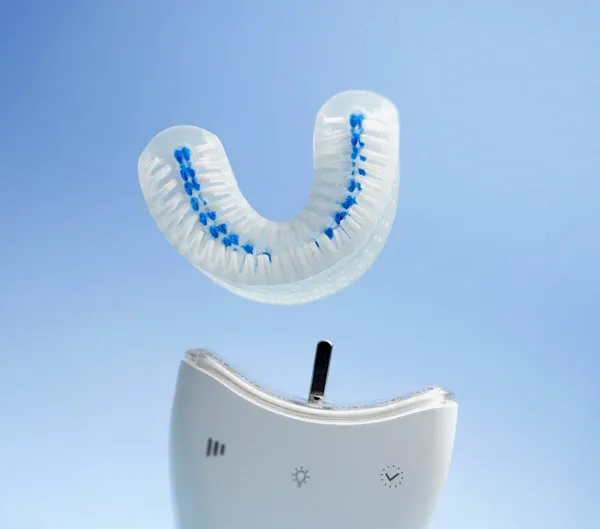
Thirty seconds is the timer, not a plaque paper
Usual advice for a manual toothbrush is two minutes. The American Dental Association’s public brushing page still puts that clock on a single head you move around the mouth — two minutes, twice a day, with fluoride toothpaste — and it does not rewrite that clock for a U-shaped mouthpiece. You can read the two-minute line on MouthHealthy’s brushing topic. Autobrush’s cycle is a quarter of that duration because the mouthpiece is built to cover front, back, and chewing surfaces at once. The auto timer ends the run. That is duration. It is not a laboratory result about plaque.
Coverage and removal are easy to mash together in a product photo. Coverage is geometry: a U of nylon sits over an arch so more than one surface is touched in the same thirty seconds. Removal is what a plaque index would measure after a defined protocol. The listing sells the first of those as the reason the clock is short. It does not, on the pages this review used, publish a methods table, a sample size, or a linked paper that would let a reader treat thirty seconds as a finding. Call the timer a cycle length and the object matches the copy. Call it a plaque paper and the copy overreaches.
You still have to move the mouthpiece gently side to side. That motion is the main learning curve, and it is already in the manufacturer’s own use notes. A U that sits still on the same two teeth for half a minute is not doing the job the geometry implies. The listing does not describe a pressure sensor, so the handle gives no buzz, no light, and no stop if you press too hard. The timer stops at 30 seconds whether or not every surface was reached, whether or not the size was right, and whether or not the bristles ever sat on the last molar.
Figures the brand cites, and what this page does not
The manufacturer cites five clinical studies at Salus Research, which it describes as an ADA-accredited facility, reporting up to 5.1× better cleaning than manual brushing, up to 82% more plaque removal, and up to 45% less gingivitis after 30 days. Those reports are not linked here. Every figure is an “up to” — the best result named, not a typical one. This review did not verify the studies. Treat them as the brand’s citations. They are not a score, and they are not a reason to skip a dental exam.
Put toothpaste on both sides of the mouthpiece. Autobrush foaming paste is intended for that shape; other paste works if you pre-foam it so it spreads instead of sitting as a ribbon on one face. Choose a mode on Sonic Pro, seat the U over the teeth, and move it gently. The timer does the rest of the clock. Nylon is the manufacturer’s argument against cheaper U-brushes that use silicone. This page does not cite the test behind that argument, and it does not reprint a wear study that would tell you how many cycles a head lasts before the tapers flatten.
A short cycle can be the right object for someone who will not stand at a sink for two minutes with a single head. It can also become a ritual that ends before the back teeth were ever in the U. Nothing in the handle closes that gap. If gums bleed, if a tooth hurts, or if you have not had a cleaning in years, the next appointment is still a chair — the ADA’s public pages on gum disease and cavities put those problems with a dentist, not with a timer.
The ADA seal as the listing describes it
The manufacturer says Autobrush is the only ADA-Accepted U-shaped toothbrush. ADA acceptance is a status a reader can confirm with the American Dental Association. This review does not reprint a certificate, and it does not expand the seal into a plaque-removal finding we have in hand. The right check is the Association’s own Seal program, not a sales banner. Start at the ADA Seal of Acceptance program page and search the product name the way you would search any other accepted brush. If the listing and the ADA directory disagree, believe the directory.
What the Seal is, in public terms: a voluntary program. A company submits a product and the claims it wants to make. ADA reviewers look at safety and at whether the submitted evidence supports those claims. A Seal on a toothbrush is not a license to treat decay, and it is not a substitute for the two-minute habit the Association still publishes for ordinary brushing. The ADA toothbrush topic is the place for that category language. This page will not stretch a manufacturer’s “only U-shaped” line into a ranking of every U-brush on the market.
What the listing actually names, then: a patented U-shaped nylon head (58,000 tapered bristles per head, per the spec sheet), sonic vibration up to 30,000 pulses per minute on Sonic and Sonic Pro, a 30-second auto timer, and — on Sonic Pro — three cleaning modes plus blue and red LEDs described as non-UV. Those are product claims on the spec sheet. They are not a substitute for a dental exam. A bristle count is a manufacturing number. Pulse rate is a motor number. Neither number is a plaque index.
Acceptance, if it is current on ADA’s side, still lives inside the claims the company submitted. It does not travel to every sentence on a landing page. “Up to” plaque figures, gingivitis percentages, and a 30-day window are the manufacturer’s citations to Salus Research. They sit next to the Seal language on the sales page. They are not the same document. A reader who wants both should look up the Seal and, separately, ask the brand for the papers. This review has neither a PDF nor a trial registry ID to attach to those percentages.
A dentist or orthodontist is still the next step when
- Gums are sore, bleeding, or receding. The red LED is described as supporting gum health, not as a treatment.
- You have braces or other hardware. The manufacturer says the brush is safe around brackets and wires if you move it gently; your orthodontist knows the hardware.
- A child cannot be sized from this page. Confirm the head with the manufacturer’s sizing guide, and have an adult watch the side-to-side motion until it is a habit.
- Limited mobility or sensory needs: the design aims at independent brushing; a dental team can say whether that covers enough for a particular person.
Oral-care products on this site stay in the YMYL column. A U-brush does not take over decay, infection, or gum disease. Those stay in a dental chair. The Seal, if you confirm it, is a product-acceptance mark for the claims that were filed. It is not a diagnosis of your mouth, and it is not a reason to delay a cleaning because a timer is shorter than two minutes.
Nylon U-mouthpiece, three handles, blue and red LEDs
Manual is battery-free: the nylon mouthpiece and the 30-second idea, with nothing to charge. Sonic adds vibration and a musical timer. Sonic Pro — the model this review centres on — adds three cleaning modes, blue and red LEDs, and what the manufacturer calls the most powerful motor in the lineup. It is rechargeable and cord-free in use. The page does not state battery life, charge time, or how many 30-second cycles a charge covers. If those numbers matter to a travel bag, you will have to get them from the manufacturer before you order, because this review will not invent them.
A mouthpiece has to fit. The wrong size leaves bristles off the teeth. This page does not list size ranges or age bands, so check the manufacturer’s sizing guidance before you order, especially for a child whose mouth is still growing. Kids’ Sonic Pro models with character designs and musical timers are sold separately. The manufacturer says it designed Autobrush for more independent brushing for children, seniors, and people with cerebral palsy, autism, or limited mobility. Independent is not unsupervised. A U that is too wide, too tall, or too stiff for the person holding it is just a noisy tray.
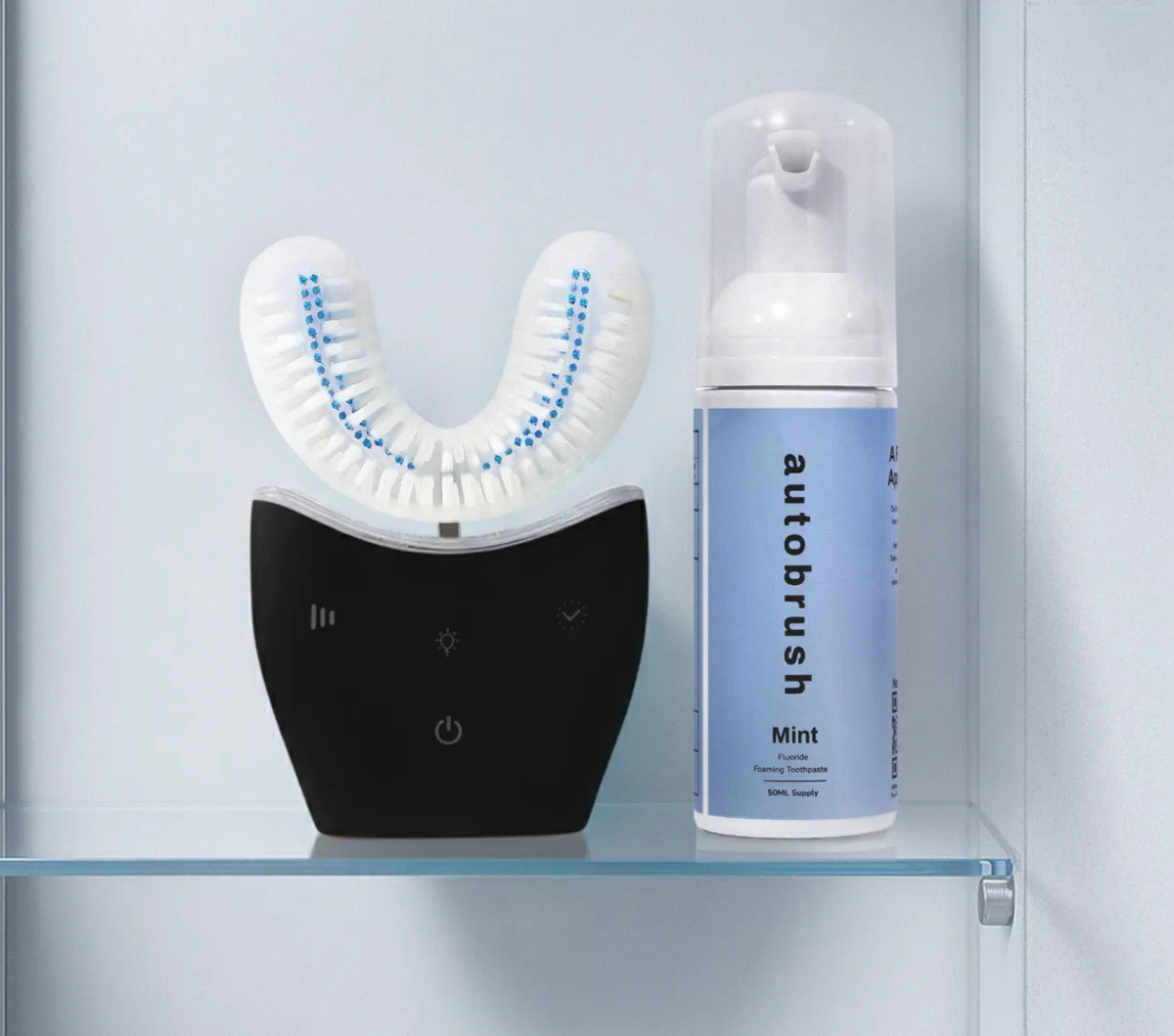
Blue light, the manufacturer says, works with whitening agents; red light “supports gum health”; both can run together; both are non-UV. Those are the brand’s descriptions. This page does not cite a study for either mode. The LEDs are a convenience add-on, not a treatment for stained enamel or gum disease. Whitening agents still have their own labels. Gum inflammation still has a chair. If a sales sentence reads as if a colored diode were doing periodontal work, read it back as marketing language on a handle, not as a procedure.
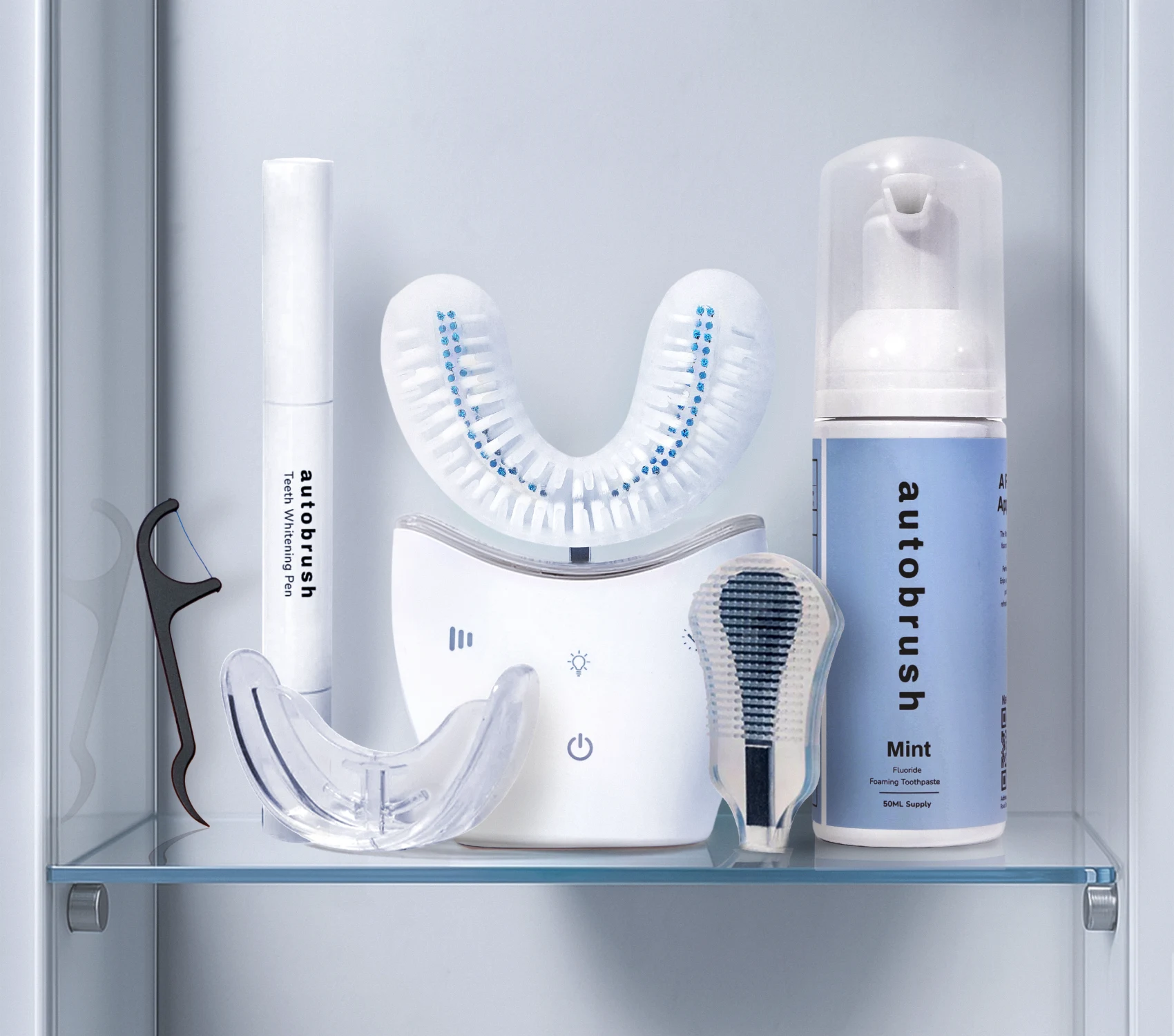
The Sonic Pro bundle also ships accessories such as foaming toothpaste and whitening pens. Those extras are part of a kit photo, not a second score. Foaming paste is the texture the mouthpiece is built around; a regular ribbon of paste can sit on one face and miss the other. Whitening pens are a separate cosmetic object with their own directions. This review does not assign them a shade-change number, and it does not treat them as a dental bleaching visit.
Nylon versus silicone is the material argument the brand wants you to remember. Tapered nylon is what the spec sheet counts — 58,000 tapers on a head — and silicone is what the copy treats as the cheaper U-brush default. A count is not a softness rating, and a material name is not a wear curve. Replace the head on the schedule the manufacturer sells (the refill cart is every 60 days on the subscription we recorded) rather than waiting for a study this page does not have. A flattened U is a geometry problem: the surfaces that were supposed to be touched in one cycle are no longer where the tapers sit.
Side-to-side motion the handle will not police
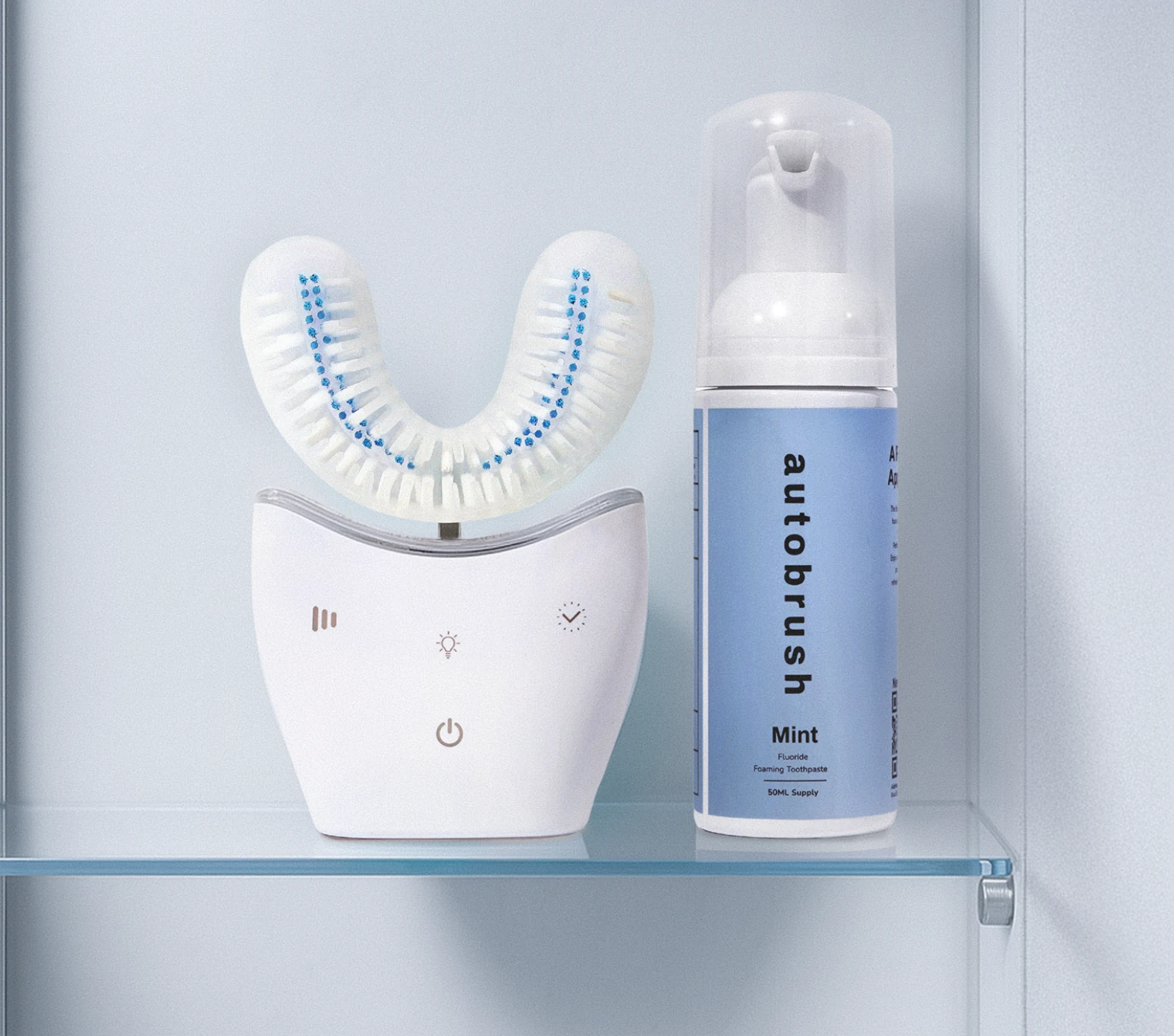
The use sequence on the listing is short enough to memorize and easy to rush. Load both faces of the U. Pick a mode if you bought Sonic Pro. Seat the mouthpiece so the arch is actually in the nylon, not hovering in front of the incisors. Move gently side to side until the timer ends. That is the whole motorized ritual. What the handle will not do is tell you that the last molar never entered the U, that you bit down hard enough to flatten the tapers, or that thirty seconds started before the paste had anywhere to go.
Single-head brushes have spent a decade adding pressure sensors, quadrant pings, and app graphs. Sonic Pro, on the copy this review used, has a timer and lights. It does not describe a pressure sensor. Hard brushing is still a way to irritate gums; the ADA’s public brushing page still warns against a heavy hand on a manual brush, and a U does not repeal that caution. Gentle is the word the manufacturer already uses around braces and wires. Use that word for an unbraced mouth too.
Modes on Sonic Pro are three cleaning settings plus the LED pair. This page does not have a table that maps each mode to a pulse rate, a decibel level, or a recommended mouth. “Most powerful motor in the lineup” is a comparison inside Autobrush’s own handles — Manual, Sonic, Sonic Pro — not a comparison to every sonic brush in a drugstore aisle. If you need the quietest setting for a sensory-sensitive user, you will have to ask the brand which mode that is. Inventing a ranking would be a different review.
Paste placement is the other small step people skip. Both sides of the U need product. Foaming paste is sold as the match for that shape. Other toothpaste is allowed if you pre-foam it. A pea of ordinary paste on the front face only will not migrate to the tongue-side bristles because you hoped it would. The timer will still end. The uncovered face will still be the uncovered face.
When the cycle stops, you are done with the handle for that session. Floss, interdental brushes, and a tongue scraper are not in this SKU. The manufacturer is selling a mouthpiece, not a full hygiene tray. If your dentist has you in a fluoride rinse or a prescription paste, keep that plan. A 30-second U does not absorb those instructions, and it does not make a missed cleaning into a solved problem.
Kids' Sonic Pro, sizing, and unsupervised brushing
Character designs and a musical timer are how the kids’ Sonic Pro models are sold — separately from the adult Sonic Pro this review centres on. A song that ends with the cycle can help a child stay with the U for the full thirty seconds. It does not size the mouthpiece. It does not watch whether the U is seated. It does not replace an adult in the doorway. The manufacturer’s own language about independent brushing is aimed at children, seniors, and people with cerebral palsy, autism, or limited mobility. Independent, again, is not unsupervised.
This page does not list size ranges or age bands. That omission is a real buying limit. A U that is too large will sit on lips and miss molars. A U that is too small will leave a whole quadrant outside the nylon. Confirm the head with the manufacturer’s sizing guide before you pay, and confirm it again if you are buying for a child whose mouth is still growing. A refill subscription that ships the same head every 60 days will not notice that the arch changed.
Braces and other hardware stay with the orthodontist. The manufacturer says the brush is safe around brackets and wires if you move it gently. That is a use note, not a clearance for a particular appliance. Some hardware is sharp. Some elastics catch. Some aligner attachments sit where a U wants to land. Ask the person who bonded the brackets, not a review that cannot see the mouth.
Seniors and people with limited grip are the other half of the independence pitch. A rechargeable, cord-free Sonic Pro is easier to hold than a floss threader. It is also easier to press too hard if the handle is the only feedback. Battery life is unpublished here, so a care aide who needs a known number of cycles per charge should get that number from the brand. Manual, the battery-free handle, is the lineup’s answer if charging is the barrier — with the same 30-second idea and the same nylon U, and without vibration or LEDs.
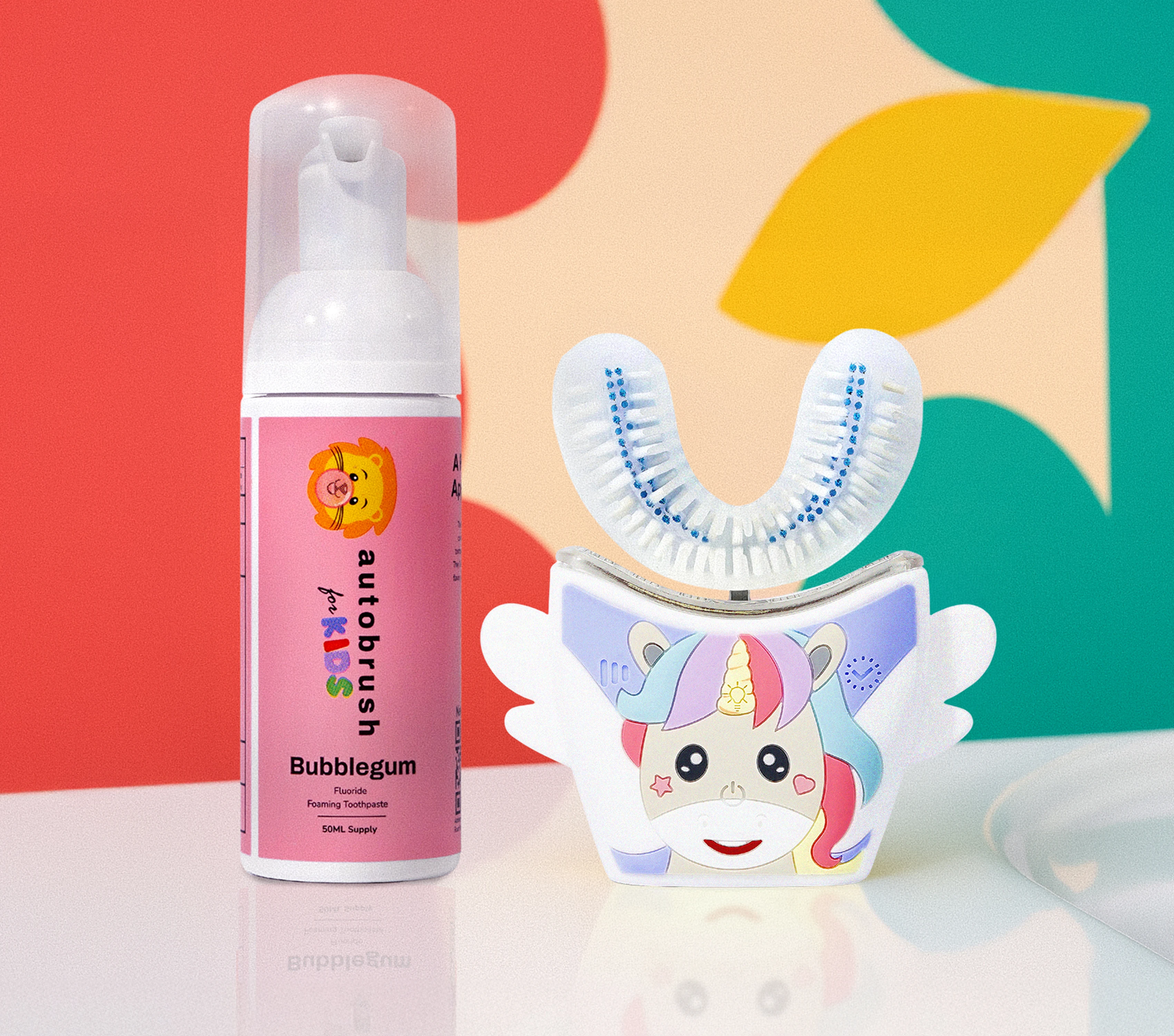
If a child cannot spit reliably, if they pocket paste, or if they have a condition that makes a mouthful of foam unsafe, this is a clinician question first. Foaming paste and a sealed U change how much product sits in the mouth at once. This review will not write a pediatric protocol. It will say the obvious thing: the listing is a consumer brush, and a dental team that already knows the child is the right place to ask whether a U belongs in that sink.
The $108 plan, the $139 bundle, and $45 heads
The handle is a one-off. The mouthpiece is what you keep paying for. On the manufacturer’s site at our last update, subscribe-and-save was $108 to start, with $45 refills every 60 days (one brush head, two toothpastes, and a gift, with free shipping). One-time Sonic Pro was $139. Six refill shipments a year at $45 is roughly $270 a year on top of the $108 start. Those are listing figures, not a live offer from this site, and they move.
Figures we can stand behind
Those dollar amounts are what the listing showed. The page does not say whether the $108 includes the first refill, or what a single replacement head costs without a subscription. Free shipping applies on orders over $99 or with a subscription. The lifetime cover on the handle applies only while you stay subscribed to brush-head refills — cancel, and on the terms as described, that cover goes with it. A 30-day money-back window is listed separately; the page does not say whether it runs from order date or delivery, who pays return shipping, or whether a used mouthpiece can be returned. For a product that goes in your mouth, ask before you open it.
Read the cart as two products glued together. The $139 one-time path is the higher start and, on the copy we have, no refill cadence baked in. The $108 subscribe path is the lower start and a $45 shipment every 60 days. If you keep the subscription for a year, the refill line is the larger number — about $270 — and the handle discount is the smaller one. If you cancel after the first month, you have a handle whose lifetime cover, as described, no longer applies, and you still need heads from somewhere. This page does not have an à-la-carte head price to plug into that fork.
The refill carton is not only a U. It is listed as one brush head, two toothpastes, and a gift. If you already have paste you like, you are still paying for the two tubs. If you wanted only a head, the listing we recorded did not show that SKU. Gifts are promotions; they are not part of the score. Free shipping on the subscription, or on carts over $99, is the freight line as written. Returns are a different sentence, and outbound free shipping is not a promise that a used U ships back at the brand’s expense.
Lifetime cover that travels with the refill cart
Lifetime is a long word on a handle that is only covered, as the listing describes it, while you stay subscribed to brush-head refills. Cancel the $45 cadence and, on those terms, the cover goes with it. That is not a hidden footnote in this review; it is the condition that makes the word usable. A reader who wants a handle warranty that survives a cancelled box needs to ask the brand whether any residual cover exists. This page will not invent one.
What “lifetime” attaches to, on the copy we have, is the handle — the motorized or battery-free body — not an endless stack of nylon U’s. Heads are consumables. They arrive every 60 days on the subscription. They wear. They are the $270-a-year line. Do not read a lifetime sentence as free heads for the life of the user. Do not read it as a plaque guarantee. It is a hardware cover with a subscription tether.
The 30-day money-back window is listed separately from that cover. Separate usually means a short satisfaction window on a new order, not a lifetime of returns. The listing we used does not say whether the clock starts at order or at delivery, who pays return postage, or whether a mouthpiece that has been in a mouth can still go back. Those are the questions to send before you peel a seal. A U is a hygiene object. Many brands will not take a used one back. This review cannot see the current returns form, so it will not pretend the answer is generous.
Keep the packing slip, the order date, and the delivery scan. If you are buying for a child and the size is wrong, the 30-day window is the undo — if a used head is accepted, which this page cannot confirm. If you are buying Sonic Pro to see whether a 30-second cycle fits your morning, the same window is the undo. After that, you are in refill math and, if you stayed subscribed, in the lifetime-cover condition. After you cancel, you are in neither.
What two minutes still means on a single head
A U-brush is a category choice, not a repeal of ordinary brushing advice. MouthHealthy’s two-minute, twice-daily line is written for a brush you move. Autobrush’s thirty seconds is written for a mouthpiece that is supposed to touch more surfaces at once. Both can be true as descriptions of objects. Only one of them is a public-health recommendation from the ADA. This review will not tell you the ADA has shortened two minutes to thirty because a brand sold a U. It will tell you to keep the dentist’s instructions if those instructions are two minutes with a single head, or if they include floss, or if they include a prescription paste.
People who already skip the second minute on a manual brush are the audience the short cycle is aimed at. A finished timer is a finished timer. That can be the difference between some brushing and none. It can also be the difference between a thorough two minutes you used to do and a thirty-second pass you now treat as complete. The handle cannot know which person you are. The score on this page is not a permission slip to drop floss, drop cleanings, or drop a fluoride paste your dentist named.
Single-head sonic and oscillating brushes still occupy the drugstore aisle with two-minute timers and, often, pressure sensors. This review is not a comparison table and will not pick a winner. The honest category sentence is simpler: a U trades motion-around-the-mouth for a seated mouthpiece plus a short clock. You pay for that trade in heads — $45 every 60 days on the subscription we recorded — and in fit risk, because a U is a size. A single head is a smaller object that you walk from tooth to tooth. If you cannot confirm a size, the smaller object is the one that still works.
Whitening, gum-health LEDs, and “up to” plaque multiples sit on the Sonic Pro page as extras. None of them is the ADA’s two-minute instruction. None of them is a treatment for stained enamel, gingivitis, or decay. If you want a whiter smile, the dentist’s options and the over-the-counter peroxide labels are the documents to read. If you want healthier gums, bleeding on brushing is a reason to book a chair, not a reason to turn on a red diode. The manufacturer already describes that diode as supporting gum health. Support is not treatment. This page will keep that gap open.
Travel is the last ordinary use case. Sonic Pro is rechargeable and cord-free in use. Charge time and cycle count per charge are unpublished here. Manual needs no cable. A U takes more case volume than a folding travel brush. TSA does not care which you packed. Your sink at a hotel might. If the mouthpiece is the only head you own and it is sitting in a wet case, you do not have a backup single head unless you packed one. The listing does not sell that pairing. This review will not invent a travel kit.
What the spec sheet counts and what it leaves blank
A review that stays inside verifiable lines has to separate a counted part from a blank cell. The spec sheet this page already used names a patented U-shaped nylon head, 58,000 tapered bristles per head, sonic vibration up to 30,000 pulses per minute on Sonic and Sonic Pro, a 30-second auto timer, and — on Sonic Pro — three cleaning modes plus blue and red LEDs described as non-UV. Those are the numbers and nouns a reader can look for on the manufacturer’s materials. They are also the edge of what this review will repeat.
Blank cells matter as much as filled ones when you are choosing a brush that sits in a wet case. Battery life is blank. Charge time is blank. Cycles per charge are blank. Size ranges are blank. Age bands are blank. A single replacement head, sold alone, is blank. Whether the $108 subscribe start includes the first refill is blank. Whether the 30-day window runs from order date or delivery is blank. Who pays return shipping is blank. Whether a used mouthpiece can be returned is blank. Each blank is a question for the brand, not a hole this page will fill with a guess.
Pulse rate is the easiest number to misread. “Up to 30,000 pulses per minute” is a motor ceiling on Sonic and Sonic Pro. It is not a plaque index. It is not a decibel rating. It is not a claim that every mode on Sonic Pro runs at that ceiling. Manual, the battery-free handle, does not get that pulse line because it has no motor. If you need the quietest object in the lineup, Manual is the one that does not vibrate. If you need the motor the manufacturer calls the most powerful, Sonic Pro is the named handle. “Most powerful in the lineup” is an inside-the-brand comparison. It is not a ranking against every sonic brush in a pharmacy.
Bristle count is the other easy misread. Fifty-eight thousand tapers is a manufacturing count on one head. It does not tell you how long a taper stays pointed. It does not tell you how the U sits on a crowded arch or on a mouth with missing teeth. Nylon is the material the brand prefers to name against silicone U-brushes. This review will not invent a wear week when the tapers flatten. The refill cadence the manufacturer already sells — every 60 days on the subscription we recorded — is the replacement rhythm on the page. Treat that rhythm as the practical answer, not as a lab curve.
LEDs are specified as blue, red, combinable, and non-UV. Non-UV is a safety-adjacent word on a consumer handle; it is not a treatment protocol. Blue is described as working with whitening agents. Red is described as supporting gum health. Support is the manufacturer’s verb. This page will not upgrade it to treat, heal, or reverse. If a tooth is stained because of tetracycline, smoking, or thinning enamel, a diode on a toothbrush is not the document to read. If gums bleed, the document is a periodontal exam. The skip list earlier on this page already puts sore, bleeding, or receding gums in a chair. The spec sheet does not undo that list.
Accessories ride along on the Sonic Pro bundle: foaming toothpaste and whitening pens, as the listing describes the kit. A bundle photo is not a second score. Paste is the texture that matches the U. Pens are a cosmetic extra with their own directions. Neither one is a bleaching visit. Neither one is a reason to skip fluoride toothpaste your dentist already named. If the refill carton includes two toothpastes every 60 days, you are paying for those tubs whether or not you wanted them. The listing we recorded did not show a heads-only refill. That absence is part of the $45 line.
A U is a wet hygiene object, not a one-and-done gadget
People treat electric handles as appliances and forget that the part in the mouth is a brush. A U-shaped nylon head sits against saliva, paste, and food. It needs the same unsentimental replacement logic as any other head, except the geometry is larger and the price is bundled. On the subscription we recorded, that logic is $45 every 60 days for one head, two toothpastes, and a gift. Six of those shipments is about $270 a year. The handle’s $108 or $139 is the smaller number once the year is underway.
Sixty days is the brand’s cadence, not a culture result this page grew in a dish. If the U looks splayed, smells off, or no longer reaches the last molar because the tapers folded, do not wait for day 60 out of loyalty to a calendar. If the U still looks new on day 59 and you are trying to stretch a box, this review has no wear study that says you must swap on the day the carton arrives. The practical sentence is dull: replace the mouthpiece when the manufacturer’s schedule or the visible wear says so, and do not invent a third schedule from a review that never held the object.
Storage is ordinary and easy to get wrong. A sealed wet case is a warm room for a nylon U. Rinse both faces. Shake the water out. Let it dry where air actually moves. The listing does not publish a UV-sanitizer claim for the handle, and this page will not add one. Kids’ character heads and adult heads should not be shared. A U that has been in one mouth is a personal-care object. The 30-day return questions — used or unused, who pays postage — exist because this is a hygiene SKU, not a sweater.
Sharing a handle with swap-on U’s is a household idea the listing does not specify. Sonic Pro is one rechargeable body. Heads are the part that changes. If two people want two sizes, you need two heads that actually fit, not one U and optimism. The subscription as written ships one head every 60 days. That is a one-mouth cadence unless the brand sells a second size on the same cart, which this page does not document. Ask before you assume a family plan.
Charging sits in the same “ordinary object” column. Sonic Pro is rechargeable and cord-free in use. Manual needs no cable. Because charge time and cycle count are unpublished here, a care setting that needs a known overnight charge should get that number from the manufacturer. Do not park a wet handle on a charger in a puddle. That is not a brand-specific insight. It is how rechargeable bathroom objects fail. This review will not invent an IP rating. If water resistance is the reason you click buy, ask the brand for the rating it actually prints.
Whitening pens and foaming paste in the bundle create a small pharmacy on the sink. Read each label. A pen is not a tray from a dentist. Foaming paste is not a prescription fluoride. If someone in the house is a child who cannot spit, paste volume inside a U is a clinician question, as this page already said. If someone is using a whitening product that already irritates gums, stacking a blue LED and a pen is not a protocol this review will write. Cosmetic extras stay optional. The score is on the Sonic Pro handle and the U, not on a pen.
The mouths the copy aims at, and the mouths it cannot see
Marketing for a U-brush talks to people who are tired of two minutes, tired of missing the back teeth, or tired of standing with a child who will not open for a single head. The listing also names seniors and people with cerebral palsy, autism, or limited mobility as the independence case. Those are audience labels on a sales page. They are not assessments of a particular grip, a particular sensory profile, or a particular arch. A dental team that already knows the person is still the right place to ask whether a seated U covers enough surfaces for that mouth.
Rushing adults are the cleanest match for the timer as written. You already know you quit at forty seconds on a manual brush. A handle that stops at thirty and claims coverage by geometry is the bet. The bet fails if you will not move the U side to side, if the size is wrong, or if you treat the beep as a medical result. The bet holds up as a product description if you wanted a short whole-mouth cycle and you will keep buying heads. That is the adult case the 4.7 is written around.
Parents buying a character Sonic Pro are in a different case. The song is a timer you do not have to watch. The U is a size you do have to get right. An adult still needs to see the first weeks of seating and motion. A child with braces needs the orthodontist’s word, not a review’s. A child who pockets paste needs a clinician’s word. This page will keep repeating those limits because a cartoon handle photographs like a toy and is still a brush in a mouth.
Limited mobility is the case that most needs a real occupational or dental opinion. A large handle and a seated U can be easier than floss. They can also be heavier, louder, or more startling than a soft manual brush. Sonic Pro has a motor and lights. Manual does not. If vibration is the problem, Manual exists in the same nylon-U family. If charging is the problem, Manual exists. If the problem is that no U size matches the arch, this product is the wrong shape, and a single head on an adapted grip may still be the object a therapist already recommended.
Orthodontic hardware is a named use on the listing — safe around brackets and wires if you move it gently — and it is still a local decision. Ceramic brackets, lingual wires, aligner attachments, and palatal expanders are not interchangeable. A U that snags an elastic is a problem the timer will not report. Take the mouthpiece to the next adjustment visit if you are unsure. A photo of a smiling model with a U is not a clearance.
Active disease is the case this review will not soften. Sore, bleeding, or receding gums; a tooth that hurts; a loose tooth; pus; swelling — those are chair problems. MouthHealthy’s gum-disease and cavity pages put them there. A red LED that “supports gum health” does not move them into a consumer checkout. If you have not had a cleaning in years and you want a U because two minutes feels like a lot, book the cleaning first. The brush will still be for sale after the exam. The exam will not be easier after months of covering blood with a short cycle.
The 4.7 we publish for Sonic Pro
We give Autobrush Sonic Pro 4.7 / 5. The nylon U, the 30-second timer, and an ADA-acceptance claim a reader can check with the ADA are the parts of the listing that hold up as product description. For adults who rush a two-minute brush, and for families who will size and supervise a child’s mouthpiece, that is a coherent design. The score lives on our methodology page as an editorial mark, not as a user average and not as a plaque finding.
Points stay under 5 because study figures are the manufacturer’s “up to” numbers without linked reports, because the handle has no pressure sensor, because battery and sizing numbers are missing from the pages we used, and because refills run to about $270 a year on the subscription. The lifetime cover disappears if you stop subscribing. If you will not keep buying heads, or you cannot confirm the size, a single-head brush used for the full two minutes is the simpler object.
What the 4.7 is not: a clinical endorsement, a claim that thirty seconds equals two minutes of plaque removal, or a promise that blue and red LEDs change enamel or gums. Decay, infection, and gum disease stay in a dental chair. A U-brush does not treat them. Confirm the Seal on ADA’s directory if that mark is why you clicked. Confirm the current cart if $108, $139, and $45 are why you clicked. Those totals move.
Questions the timer still leaves open
No. Thirty seconds is the built-in auto timer on the handle. The manufacturer’s case is that brushing every surface at once covers in 30 seconds what a single head covers in two minutes of moving around the mouth. That is a claim about coverage. It is not, by itself, a plaque-removal result.
The manufacturer says Autobrush is the only ADA-Accepted U-shaped toothbrush. ADA acceptance is a status a reader can confirm with the American Dental Association. This page does not reprint a seal certificate, and it does not treat manufacturer “up to” plaque figures as a finding we verified.
The manufacturer’s site listed Sonic Pro at $108 on a subscribe-and-save plan and $139 as a one-time purchase. Refills were $45 every 60 days — about $270 a year. The lifetime cover applies only while you stay subscribed to brush-head refills. A 30-day money-back window is listed separately.
Manual is battery-free: the nylon mouthpiece and the 30-second idea, with nothing to charge. Sonic adds vibration and a musical timer. Sonic Pro adds three cleaning modes, blue and red LEDs described as non-UV, and what the manufacturer calls the most powerful motor in the lineup. It is rechargeable and cord-free in use.
No. Blue light, the manufacturer says, works with whitening agents. Red light is described as supporting gum health. Both can run together and both are called non-UV. Those are brand descriptions. This page does not cite a study for either mode, and neither diode is a treatment for stained enamel or gum disease.
The listing does not describe a pressure sensor. The timer stops at 30 seconds whether or not every surface was reached. You still have to move the mouthpiece gently side to side. Gentle is also the word the manufacturer uses around braces and wires.
Kids’ Sonic Pro models with character designs and musical timers are sold separately. The manufacturer talks about more independent brushing. Independent is not unsupervised. This page does not list size ranges or age bands, so confirm the head with the manufacturer’s sizing guide and have an adult watch the motion until it is a habit.
Put toothpaste on both sides of the mouthpiece. Autobrush foaming paste is intended for that shape. Other paste works if you pre-foam it so it spreads instead of sitting as a ribbon on one face. The Sonic Pro bundle also ships accessories such as foaming toothpaste and whitening pens.
Battery life, charge time, and how many 30-second cycles a charge covers are not stated on the pages this review used. Size ranges and age bands are also unpublished here. Get those from the manufacturer before you order, especially for a child whose mouth is still growing.
No. Decay, infection, and gum disease stay in a dental chair. A 30-second mouthpiece does not treat them. Sore, bleeding, or receding gums, tooth pain, and hardware you have not cleared with an orthodontist are reasons to stay in-chair.