
Pain and infection still belong in a dental chair
If a tooth hurts, feels loose, or sits in inflamed gum, a mailer kit is the wrong next appointment. Peak Smile sells a cosmetic cover. The manufacturer is explicit that the product does not replace care for decay, gum disease, or bite problems. That limit is the first filter, not a footnote. The American Dental Association’s public pages put cavities and gum disease in a chair with a dentist. A snap-on tray does not move them into a checkout.
The listing names Dr. Megi Zeqollari, DMD, as a clinical advisor who reviews design philosophy, fit standards, and buyer guidance. She is not your dentist. The order flow does not create a dentist–patient relationship, and it does not diagnose the mouth you will send in putty. A title on a sales page is a production credit. It is not an exam, a radiograph, or a treatment plan. If you need those, you already know the building that has a chair.
Stay in-chair and skip the kit
- Tooth pain, loose teeth, active infection, or untreated gum disease.
- You want porcelain bonded to enamel, not a tray you take out at night.
- A known allergy to dental resin materials.
- Oral disease the manufacturer says these covers do not replace.
A closer match is someone whose dentist has already cleared active disease and who wants a removable cover for stains, small gaps, chips, or missing teeth in the smile zone. The manufacturer’s screening rule is at least four healthy teeth left to support the appliance — a listing check, not a diagnosis of your case. Four teeth is a minimum the brand wrote down. It is not a promise that four teeth in your mouth are the right four, or that they can take the load of a full-arch tray. If you are unsure, the brand offers to review a smile photo before you order. Send the photo. Do not treat a pass on a photo as a clean bill of health.
Infection does not become cosmetic because you would rather not hear a drill. A cover that clips over an abscess hides the look and leaves the biology. The same is true for untreated decay under a stain, for periodontal pockets that bleed, and for a bite that already hurts. This review will keep those sentences near the top because snap-on ads photograph like a smile makeover and ship like a hobby kit. The kit is the second object. The chair is the first.
Allergy is the quieter skip. Dental resins are a family of materials. The listing does not publish a full monomer table on the pages this review used. If you already react to acrylic appliances, denture bases, or nail products in the same chemical neighborhood, ask the brand for the material names on Essential and Premium before you pay. “FDA-cleared dental resin” on Premium is a regulatory phrase about a device category. It is not a personal clearance for your immune system.
Snap-on resin leaves the enamel uncut
Bonded porcelain is a chairside job: enamel is reduced, a lab shell is cemented, and you cannot pop it off to sleep. Peak Smile is a custom tray that clips over the teeth you already have. No drilling, no adhesive, and no permanent enamel removal, according to the manufacturer. The trade is permanence. Take the cover out and the underlying teeth look as they did. That is the whole category, and it is the sentence that should decide the purchase before shade or tier does.
While worn, the listing says the set can conceal stains, gaps, chips, or missing teeth. That is an appearance change for the hours it sits in the mouth. It does not rebuild a tooth, close a bite, or treat whatever caused the chip. Call it a cosmetic cover and the product matches the copy. Call it a veneer in the dental-office sense and the copy overreaches. Dentists use “veneer” for a shell that is bonded to prepared enamel. MouthHealthy’s veneers topic is written around that bonded object. A mailer tray is a different appliance that borrowed the noun.
Wear notes on the same listing: both tiers are designed for all-day use, most everyday foods are described as fine, and very hard, sticky, or chewy foods should come off the set so the resin lasts. Remove the appliance before sleep and clean it. Orders include a mirrored carrying case and 36 cleaning tablets. A cover that sits over teeth all day will stain or smell if that cleaning is skipped. Thirty-six tablets are a finite stack. This page does not publish the reorder price for a second box, so do not treat the included count as a lifetime supply.
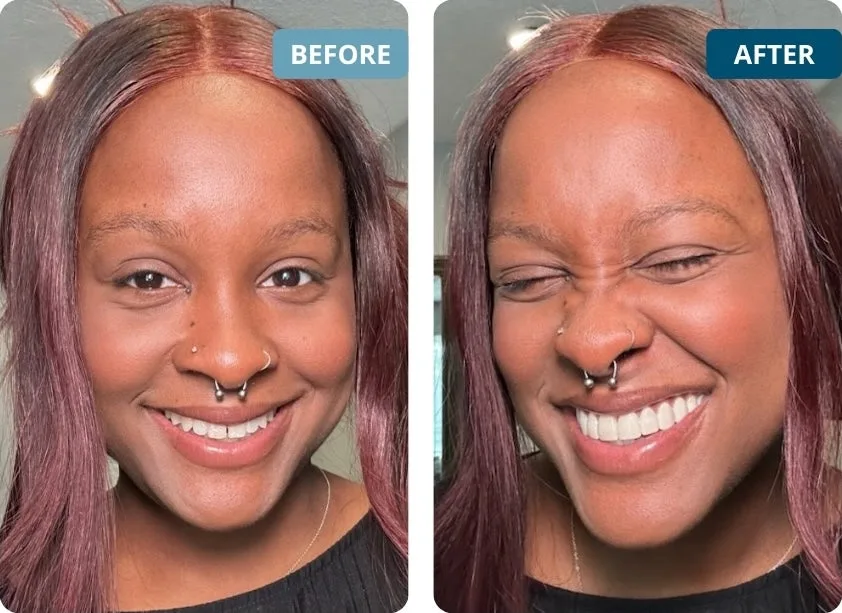
Missing teeth in the smile zone are the claim that most needs a careful reading. A tray can mask a gap while you wear it. It does not become a denture with a published occlusal scheme, and it does not become an implant. The four-healthy-teeth rule is the brand’s way of saying the appliance needs abutments. If the gap is a recent extraction, if the socket is still healing, or if the opposing tooth has super-erupted, a photo review is not a surgical consult. Stay in the chair for the gap. Use the cover later if the dentist says the remaining teeth can take a clip-on.
Chips get the same reading. A custom contour can wrap a chipped incisor so the camera sees a continuous edge. The chip is still there when the tray comes out. If the chip is from a fracture that opened pulp, or if it is sharp enough to cut the tongue, the cover is the wrong first object. If the chip is old, painless, and already cleared, a removable mask is a cosmetic choice with a known undo: take it out.
What a bonded porcelain appointment actually changes
This is not a competitor table. It is the category sentence buyers mash together when both products are sold under the word veneer. A bonded porcelain veneer, as dental associations describe the appointment, starts with a plan, often a reduction of enamel so the shell has room, then a temporary, then a cementation you do not reverse at the sink. The tooth is permanently different. The shade is mixed in a lab against the neighboring teeth. Insurance, when it pays at all, treats that work as dentistry. The ADA-facing explainer is the MouthHealthy veneers page already linked above — preparation, bonding, and a shell that is meant to stay.
A snap-on cover starts with putty in a mailer. No enamel is cut, on the manufacturer’s description. No cement. No temporary. No dentist of record unless you already have one. The shade is a preset — BL1, B1, A1, and G2 on Premium — not a custom mix against a single lateral incisor. The undo is physical: unclip, clean, sleep without it. The cost on the October 3 screen started at $279.99 for an Essential arch. That number is not a porcelain fee, and it is not a reason to skip the chair if the mouth needs the chair.
People choose bonded work when they want a change that survives a meal, a night, and a decade of coffee, and when they accept that enamel will be prepared. People choose a mailer when they want a change they can take off, when they do not want enamel touched, and when they will live with speech, meal, and cleaning limits that a cemented shell does not have. Those are different jobs. Selling them as the same job is how a reader ends up with a tray in a case and a still-stained tooth in the morning, surprised.
There is a third object in the same neighborhood that this review will name only to keep the nouns honest: a temporary “Hollywood” snap-on sold as one-size plastic. Peak Smile is not that object. It is custom-formed from an impression, in two named material tiers, with a photo check and a remake policy. The custom part is why the wait is weeks. The one-size part is why drugstore boil-and-bite trays fit like a costume. Do not read this page as a defense of every snap-on on a marketplace. Read it as a review of this mailer.
Composite bonding in a chair is another neighbor. A dentist adds resin to a chip or a gap and shapes it. Enamel may be roughened; the add-on is still a dental procedure. Peak Smile does not add material to the tooth. It sits over the tooth. If what you wanted was a closed diastema that stays when you floss, bonding or orthodontics is the category. If what you wanted was a closed look for a few hours, the tray is the category. The listing already says the set can conceal gaps while worn. While worn is the clause that does the work.
Documents this review used
- The Peak Smile listing and the partner checkout recorded on for tiers, shades, fit policy, and totals.
- MouthHealthy on veneers for the bonded-porcelain appointment this mailer is not.
- Cavities and gum disease on MouthHealthy for why pain and infection stay in-chair.
Copolymer Essential and the CNC-milled Premium cut
Most mail-in snap-on brands sell one material. Peak Smile splits the line. The impression process, the 60-day fit policy, and the three-year material cover against eligible defects are the same on both tiers. What changes is how the resin is formed and how sculpted the teeth look. That split is the reason this review has a tier section at all. It is not a reason to treat Premium as dentistry and Essential as a toy. Both are removable covers.
Peak Essential is custom-formed from dental-grade copolymer. The listing calls it flexible and lightweight, with smooth contours and a listed lifespan up to three years with care. Shades are BL1, B1, and A1. Flexible is a feel word. Lightweight is a feel word. Up to three years is a care-dependent estimate on the listing, not a wear study this page verified. Smooth contours means the teeth are less individually carved than on the milled tier — a visual limit, not a medical one.
Peak Premium is precision CNC-milled from a stronger FDA-cleared dental resin. The listing describes a more structured feel, individually defined contours, enhanced stain resistance, and a listed lifespan of three to five or more years. Premium adds G2 (Hollywood white) beside B1 and A1. CNC-milled is a manufacturing method. FDA-cleared is a device-category phrase the brand applied to that resin. Enhanced stain resistance is a comparison to Essential on the same listing, not a lab number reprinted here.
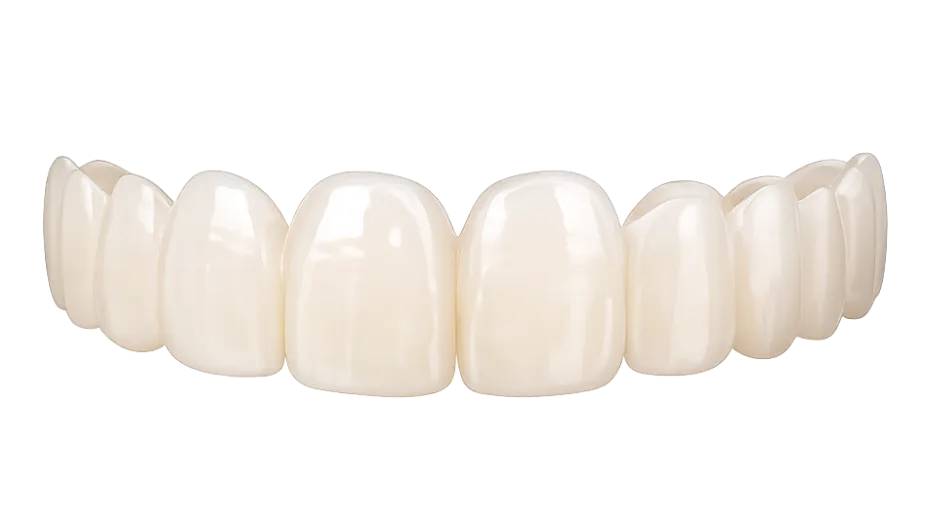
Pick Essential when the job is a removable mask at the lower recorded total and you will accept a smoother, less carved look. Pick Premium when you want the milled contour and the extra shade, and you will pay the step up the October 3 screen recorded — $469.99 for a single Premium arch against $279.99 for Essential. Those totals are the decision, not a promise that Premium will look like chairside porcelain. Individually defined contours are still contours on a tray you take out.
Lifespan language is the part readers treat as a warranty. Essential: up to three years with care. Premium: three to five or more years. The three-year material cover against eligible defects is a separate sentence and applies to both tiers. Everyday wear, staining, and damage from misuse are not the same as a defect claim. A lifespan estimate that assumes care is not a refund clock. If you grind, if you sleep in the tray against the listing, or if you chew ice on it, you are outside the care the estimate assumed. This page will not invent a night-guard claim for either resin.
FDA-cleared on Premium is easy to inflate. Clearance for a dental resin is not an approval of a smile makeover, and it is not a finding that the tray treats disease. Essential’s “dental-grade copolymer” is a material name without that clearance phrase on the copy we used. Do not read the absence as unsafe and the presence as a medical device prescribed for you. Read both as the brand’s material story. If you need the 510(k) number or the exact resin trade name, ask the manufacturer. This review does not have those identifiers in hand.
Photo review sits between the putty and the mill
You are not leaving a chair with a finished set. The manufacturer’s sequence is a mailed mold, a remote quality check, then lab production. Plan around that if an event date is fixed. A wedding in three weeks is the wrong calendar for a process the listing itself puts at about four to six weeks from order to door, before any remake.
Kit dispatch is listed for the next business day, with free U.S. shipping on the kit and the return label. Impressions take about ten minutes with video instructions; video-call support is offered if you get stuck. Ten minutes is the brand’s clock for a careful putty sit, not a guarantee that your first try is usable. Putty that moved, a tray that lifted, a void over the molars — those are why the next step exists.
You upload photos so the team can check whether the mold is usable — typical review within about one business day after upload — before you send the putty back. If the impressions are not usable, the brand states it will help you submit a new set before veneers are made. That is the load-bearing sentence in the workflow. A mill that starts from a bad mold makes a confident, unusable tray. The photo step is the cheap undo. Use it. Do not mail a mushy impression because you were in a hurry to hit an event date.
Production is listed at up to 21 days after approved impressions arrive. Optional 15-day priority production is listed for an extra fee — $75 on the October 3 screen. The typical total, kit to door, is about four to six weeks from the order date. Included with orders: a mirrored carrying case, 36 cleaning tablets, and custom dental models. Models are the stone or printed copies of your arches. They are not a second set of veneers. Keep them if a remake later needs a reference; this page does not say the brand requires you to mail them back.
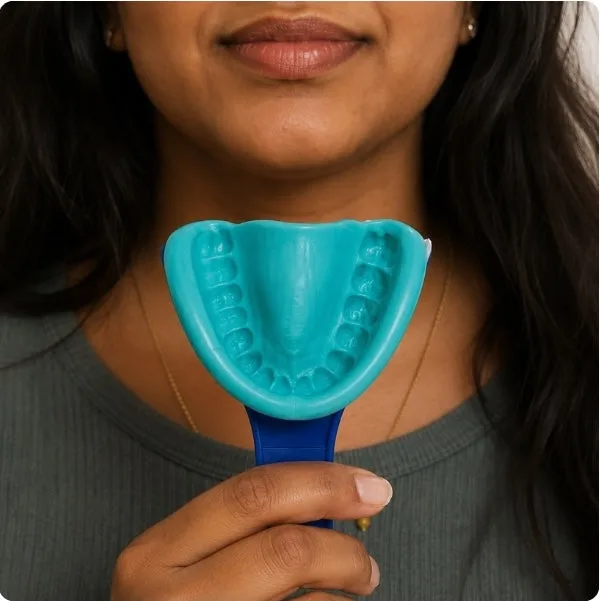
Fit is the main risk with mail-in covers. On the checkout we recorded on , every order included a 60-day fit policy with up to three complimentary remakes, plus a three-year material cover against eligible defects on both tiers. Each remake still depends on usable impressions — another reason the photo step matters. A remake is not a new diagnosis. If the first set does not seat because the mouth changed — an extraction, a new crown, swelling — putty from last month is the wrong start. Tell the brand. Tell your dentist. Do not grind a tray into a sore abutment because the remake count is not yet at three.
Video-call support is offered if you get stuck on the impression. Use it before you ruin the only putty in the box, if the box is a single kit. This page does not publish how many impression sets ship in the first carton. If you are all thumbs with trays, ask that question before the kit leaves their dock. A failed mold that has to be re-requested is calendar time you cannot buy back with the $75 priority fee, because priority starts after approved impressions arrive.
Shades BL1, B1, A1, and the G2 add-on
B1 Natural White is the manufacturer’s most recommended everyday shade on both tiers. BL1 and G2 are the brighter cosmetic picks; A1 is the warmer one. Essential offers BL1, B1, and A1. Premium offers G2, B1, and A1. G2 is the Hollywood-white add-on that sits only on the milled tier. Shade previews on checkout are guides. Final color depends on approved impressions, lighting, and the selected shade. Support can change the pick before production starts. After the mill starts, you are in remake territory if the white is too white.
Chairside porcelain is mixed against a neighbor tooth under a color-corrected light. This mailer is a preset. If you need a single lateral to disappear into a custom glaze, you want a dentist. If you want a brighter even surface for the hours the tray is in, a preset can be enough. Bright is also how snap-ons read as fake in daylight. The brand already steers everyday wear toward B1. That steer is the most useful shade sentence on the listing. Hollywood white is a photo shade. Warm A1 is the one that sits closer to many unrestored arches. This review has no spectrophotometer reading to add.
Lighting will lie to you on the preview. Bathroom yellow, phone flash, and a filtered selfie are not the light the tray will live in. If you can, look at the preview on two screens and ask support which shade they would pick from the smile photo you already sent. The photo review is a mold check first; it can also be the moment to say “not G2.” Say it before production. The 60-day remake policy is a fit policy. Do not assume a shade regret is a complimentary remake unless the brand says so in writing. This page does not have that promise in the checkout notes we recorded.
Stain resistance is described as enhanced on Premium. Enhanced is a comparison, not a coffee-score. Both tiers will pick up pigment if you live in the tray through red wine and skip the tablets. The listing already tells you to clean the appliance and to sleep without it. Those two habits do more for color than a mill path. Thirty-six tablets are the included stack. When they are gone, you need a cleaner the brand accepts. This review will not invent a household substitute. Ask them what the tablets are and what else is allowed.
October 3 checkout for Essential and Premium
These are the U.S. dollar totals the partner checkout showed on . Strike-through retail figures and promotions can move. Read the current screen before you pay.
| Essential, one arch | $279.99 (listed against $499.99) |
|---|---|
| Essential, top and bottom | $479.99 (listed against $799.99) |
| Premium, one arch | $469.99 (listed against $799.99) |
| Premium, top and bottom | $749.99 (listed against $1,199.99) |
| Priority production | 15-day option listed at +$75 |
Figures we can stand behind
Those five lines are what the checkout showed that day. The same screen listed installment examples through Afterpay, Affirm, PayPal, Zip, and Shop Pay, including “as low as” $23 a month on a single Essential arch and $40 a month on Essential top and bottom. Approval, interest, and the final schedule belong to those providers, not to this review. Treat BNPL as a loan, and factor the four-to-six-week wait plus any remake window into the payment calendar.
A single Essential arch at $279.99 is the entry this review recorded. Top and bottom together at $479.99 is less than two singles would have been at the one-arch sticker, which is how the listing priced the pair. Premium’s single arch at $469.99 sits near Essential’s pair. That is the step the milled resin and the G2 shade are asking you to take. Priority at $75 buys a shorter production queue after approved impressions — 15 days instead of up to 21 — not a shorter putty step, not a shorter photo review, and not a shorter remake if the first set fails.
Installment copy is easy to treat as a lower price. It is the same $279.99 or $479.99, sliced. “As low as” means some applicants see that payment; others see a higher one or a decline. This site does not broker those loans. If a remake lands in week eight and you are still paying week two of a schedule, that is your calendar, not a defect in the 60-day fit policy. Do not finance a cosmetic tray you have not cleared with a dentist if the skip list above already applies.
Remakes, the 60-day window, and everyday wear
Three complimentary remakes in 60 days is a generous-sounding stack until you notice what it is not. It is not a medical redo. It is not a shade-on-demand studio. It is not a new impression kit every time unless the brand decides the old putty is the problem. Everyday wear, staining, and damage from misuse are carved out of the defect story. A tray you chewed ice in is a misuse story. A tray that never seated on the molars because the mold was short is a fit story. Keep those files separate when you write support.
Sixty days is a clock. This page does not say whether it starts at order, at kit delivery, or at veneer delivery. Ask. If it starts at order and you spent four weeks in putty and production, the wear-in window on your face is shorter than the banner. If it starts when the set arrives, you have two months to decide whether remake one, two, or three is needed. Write the delivery date on the case. Photograph the first seating. Those two habits are how a fit claim stays documentable.
The three-year material cover against eligible defects is the longer sentence. Eligible is the word that does the work. A defect in the resin is not the same as a change in your mouth. A new crown, a chipped abutment, weight loss in the face, or a night of grinding can make a once-good tray feel wrong without the plastic having failed. The cover as described is on the material. The 60-day policy is on the fit. After day 60, fit complaints without a material defect may be a paid conversation. This review cannot see the after-window price list.
Complimentary remakes still consume calendar. Each one needs usable impressions and another production pass. If you are counting backward from a date, three remakes can blow the date. Priority production, if it is even offered on a remake, was a $75 line on the original checkout — this page does not confirm it applies to remakes. Ask before you assume a failed first set can be rushed for the same fee.
Custom dental models that ship with the order are useful here. If a remake needs a physical reference, you have one. If you threw the models out with the box, you threw out a copy of the arches the mill used. Keep the models, the case, and the leftover tablets until the 60 days are over. Hygiene still applies: do not mail a filthy tray back without asking how they want it cleaned. This page does not have the return-sanitation script.
All-day wear, hard foods, and the case on the nightstand
Both tiers are designed for all-day use, on the listing. All-day is not all-night. Remove the appliance before sleep. A tray that stays in overnight is a grinding surface, a dry-mouth trap, and a way to wake with sore abutments. The mirrored case is the object that makes the night rule realistic. If you will not carry a case, you will leave the tray in or wrap it in a napkin. One of those ruins sleep. The other ruins the tray.
Most everyday foods are described as fine. Very hard, sticky, or chewy foods should come off the set so the resin lasts. That is a short barred list with a long tail. Ice, hard candy, taffy, and a baguette heel are the obvious ones. A steak you have to tear, a caramel, a handful of nuts — those are the meals where people keep the tray in because they forgot, then wonder why a tooth-shaped wing snapped. Take it out. Eat. Clean. Put it back. The listing already told you to clean it. The tablets are for the plastic. Your own teeth still need the brush you used before you owned a cover.
Speech is not a numbered limit on the Peak listing the way some clip-on pages number a few days of getting used to the feel. A tray still changes the palate and the incisal edge. Some people lisp for an afternoon. Some people never notice. This review will not invent a day-count the listing did not print. If talking for a living is the reason you want a cover, practice at home before the event. The four-to-six-week wait is your practice window only after the set arrives — which is to say, it is not a practice window if the event is the day after delivery.
Hygiene under a cover is the YMYL sentence this category keeps failing. A tray that hides stains also hides plaque if you stop brushing the real teeth. Decay and gum disease stay in a chair, and they do not pause because the camera sees a continuous white edge. Brush the teeth. Clean the tray. Sleep without it. If the gums start to bleed after you begin all-day wear, stop and call a dentist. The cover is not the treatment. It may be the reason you stopped looking.
Thirty-six cleaning tablets will run out. Daily gentle cleaning is the habit even before they do — rinse, brush the appliance with a non-abrasive cleaner the brand accepts, and do not use household bleach unless they say so. This page does not have a bleach rule. Hot water that warps resin is a known way to ruin an appliance in every denture cup in the country. Do not boil a custom tray. If it warps, you are in remake or repurchase territory, and warp from heat is a misuse story, not a defect story.
A named advisor is not a dentist-patient file
Dr. Megi Zeqollari, DMD, is named on the listing as a clinical advisor for design philosophy, fit standards, and buyer guidance. That sentence is specific and still easy to over-read. An advisor who reviews standards is not the dentist of record for your order. She does not open your file. She does not see your radiographs. She does not pick up the phone when a molar hurts under the tray. The order flow does not create a dentist–patient relationship. This review is repeating that because named clinicians are how mailer kits borrow chairside trust.
Buyer guidance on a site can be a shade FAQ, a putty video, or a photo review by a technician. It can be useful. It is not an exam. The smile-photo offer before you order is a screening the brand chose to provide. A pass means they think they can make a cover. It does not mean your four teeth are healthy. It does not mean your bite can take a full-arch clip-on. If the photo is a filtered selfie, you have also screened the lighting, not the mouth.
Licensed dentistry is local. A DMD on a brand page does not replace the dentist who can legally examine you in your state. If something goes wrong — a trapped ulcer, a broken abutment, an allergic rash — the person you need has an operatory, not a brand inbox. Keep your dentist in the loop before you start all-day wear. Bring the tray to a visit if they want to see how it seats. That visit is not included in $279.99. It is still the cheaper visit if it catches a problem the putty never could.
This site is not a clinical source. Nothing here is dental advice. The 4.6 is an editorial score on a mailer kit with two material tiers, a photo check, and a dated cart. It is not a recommendation to skip care. It is not a finding that snap-on resin is equivalent to bonded porcelain. Those remain different objects, and the chair remains the place for pain, infection, and disease.
Event dates and the four-to-six-week mailbox
A fixed date is the buying condition this mailer handles worst. Kit dispatch next business day, a ten-minute putty sit, a photo review in about one business day, a return label, production up to 21 days after approved impressions, and a typical four-to-six-week kit-to-door total — that chain already fills a month before anyone talks about a remake. Optional 15-day priority at $75, on the October 3 screen, shortens only the production queue after the mold is approved. It does not shorten a bad first impression. It does not shorten a remake. It does not move a wedding that is already inside that window.
Count backward from the date, then add a remake. If the first set arrives in week five and does not seat, complimentary remake one is another production pass. Three remakes in 60 days is a stack of calendars, not a same-week polish. People who buy a mailer six weeks out and treat the first delivery as dress-rehearsal day are buying hope. People who buy twelve weeks out and treat the first delivery as a fitting have room to use the policy as written.
Travel days sit inside the same chain. Free U.S. shipping on the kit and the return label is the freight line as listed. International shipping is not a figure this review recorded, so it is omitted. A delayed inbound kit is a delayed putty day. A delayed outbound mold is a delayed mill. Tracking tells you the box moved. It does not tell you the lab has started. Email updates, if they arrive, are logistics. Fit is still plastic on enamel after the box opens. Weekend and holiday gaps sit inside “next business day” kit dispatch and “about one business day” photo review — those clocks pause when the brand’s dock pauses, and this page will not invent a Saturday mill.
BNPL schedules collide with this calendar. “As low as” $23 a month on a single Essential arch, and $40 on Essential top and bottom, were installment examples on the October 3 screen. Approval and interest belong to Afterpay, Affirm, PayPal, Zip, and Shop Pay — not to this review. If the first payment is due before the set has arrived, you are paying for putty in transit. If a remake lands after the second payment, you are still in the loan. Treat the slice as the same $279.99 or $479.99. Do not treat a low monthly as a smaller product.
Photo day, interview day, and reunion day are the dates people name. None of them change the skip list. Pain, loose teeth, infection, and untreated gum disease still belong in a chair, even if the date is next month. A cover that hides a problem for a camera does not pause the problem. Book the chair first. If the dentist clears the mouth and the date still fits a four-to-six-week wait plus a remake cushion, the mailer is a cosmetic calendar. If it does not, the mailer is the wrong object for that date.
The teeth under the tray still need a dentist
A cover that conceals stains, gaps, chips, or missing teeth while worn also conceals whatever you stop checking. Brush the real teeth. Clean the tray. Sleep without it. If gums bleed after you start all-day wear, stop and book a chair. MouthHealthy still puts cavities and gum disease there. The manufacturer already says this product does not replace that care. This review will not soften the sentence because the October 3 cart started at $279.99.
Four healthy teeth is the brand’s screening minimum, not a diagnosis. The smile-photo offer is a mold-and-aesthetics glance, not a radiograph. Dr. Megi Zeqollari, DMD, is a named advisor on design and guidance, not your dentist of record. If a molar hurts under Essential or Premium, the inbox is the wrong operatory. Keep the dentist who can legally examine you. Bring the tray if they want to see the seat. That visit is not in the $279.99, $479.99, $469.99, or $749.99 lines.
Hard, sticky, and chewy foods come off the set so the resin lasts. Ice and a baguette heel are obvious. A night of sleeping in the tray against the listing is a grinding surface you were told to avoid. Thirty-six tablets run out. Daily cleaning does not. Heat that warps resin is misuse, not a defect under the three-year material cover as this page read it. Everyday wear and staining are already carved out of that cover. Keep the files separate when you write support.
The 4.6 we attach to this mailer
We give Peak Smile Veneers 4.6 / 5. The structure is clearer than most mail-in covers: two named material tiers, a photo check before the mill, and up to three complimentary remakes in 60 days. Essential from $279.99 a single arch, on the October 3 screen, is the entry we recorded. The score lives on our methodology page as an editorial mark, not as a user average.
The score stays under 5 because you are waiting weeks and betting on home putty, Premium is a large step up ($469.99 a single arch that day), shades are presets rather than a chairside match, and no removable cover treats the disease underneath. If pain or loose teeth are already in the picture, this is the wrong product. Decay, infection, and gum disease stay in a dental chair. A snap-on does not treat them.
What the 4.6 is not: a clinical endorsement, a claim that copolymer or milled resin equals bonded porcelain, or a promise that G2 will look natural in noon light. Confirm the current cart. Confirm the 60-day clock’s start date. Confirm the material names if you have a resin allergy. Those checks are the purchase. The smile photo is optional and still not an exam.
Questions before you mail the putty
No. They are custom removable snap-on cosmetic covers made from mailed impressions. The manufacturer states they require no drilling, adhesives, or permanent changes to natural teeth. They can conceal stains, gaps, chips, or missing teeth while worn. They do not treat decay, gum disease, or misalignment, and they do not replace a dentist.
Peak Essential is custom-formed from dental-grade copolymer and is positioned as the value tier. Peak Premium is precision CNC-milled from a stronger FDA-cleared dental resin with more sculpted tooth definition and enhanced stain resistance. Both use the same at-home impression process and include a 60-day fit policy with up to three complimentary remakes.
The partner checkout that day listed Peak Essential at $279.99 for a single arch and $479.99 for top and bottom. Peak Premium listed at $469.99 for a single arch and $749.99 for top and bottom. Optional 15-day priority production was listed at an extra $75. Confirm current totals before you pay.
No, according to the manufacturer. Bonded porcelain is a chairside job that reduces enamel and cements a shell. Peak Smile is a custom tray that clips over the teeth you already have. No drilling, no adhesive, and no permanent enamel removal, as the listing describes it. Take the cover out and the underlying teeth look as they did.
You upload photos so the team can check whether the mold is usable — typical review within about one business day after upload — before you send the putty back. If the impressions are not usable, the brand states it will help you submit a new set before veneers are made. Kit dispatch is listed for the next business day.
Production is listed at up to 21 days after approved impressions arrive. Optional 15-day priority production is listed for an extra fee. The typical total, kit to door, is about four to six weeks from the order date. Plan around that if an event date is fixed.
On the checkout recorded on 3 October 2026, every order included a 60-day fit policy with up to three complimentary remakes, plus a three-year material cover against eligible defects on both tiers. Everyday wear, staining, and damage from misuse are not the same as a defect claim. Each remake still depends on usable impressions.
Remove the appliance before sleep and clean it. Both tiers are designed for all-day use. Very hard, sticky, or chewy foods should come off the set so the resin lasts. Orders include a mirrored carrying case and 36 cleaning tablets.
Skip it for tooth pain, loose teeth, active infection, untreated gum disease, a known allergy to dental resin, or if you want porcelain bonded to enamel rather than a tray you take out at night. The manufacturer’s screening rule is at least four healthy teeth left to support the appliance — a listing check, not a diagnosis.
No. The listing names Dr. Megi Zeqollari, DMD, as a clinical advisor who reviews design philosophy, fit standards, and buyer guidance. The order flow does not create a dentist–patient relationship, and it does not diagnose the mouth you will send in putty.