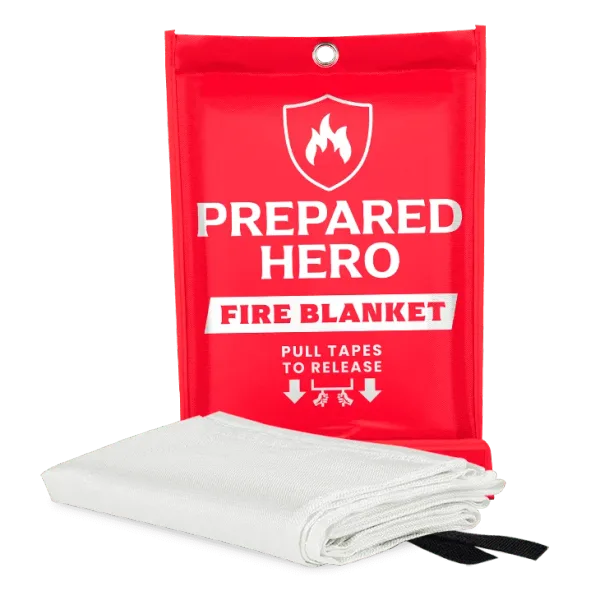
A fiberglass sheet is not a pressurized canister
The buyer choice is a cloth you throw over a small pan fire, or a pressurized canister you aim and sweep. Prepared Hero is the cloth. It is not the canister. The Emergency Fire Blanket lives in a red wall pouch. Pull the tabs, unfold the cloth, and drape it. The brand’s method is oxygen starvation — cover the burning surface so air cannot feed it — not a dry-chemical cloud and not a pin-and-gauge drill. There is no pressure to check and no recharge appointment.
That also sets the ceiling. A maintained extinguisher still covers more fire classes when someone in the house knows the PASS steps. A commercial kitchen still needs the suppression system the code requires. This pouch does not replace either. It is a first-response cloth for a fire that still fits under the fabric. If the flame is already on the wall, the tool in the red pouch is the wrong object. Get out. Call 911.
Pressurized extinguishers have gauges, inspection tags, and chemical agents that make a mess and can corrode surfaces. A fiberglass sheet has none of those. That is the appeal and the limit in the same sentence. You are not buying a mini fire department. You are buying a folded barrier. Treat it that way and the listing is coherent. Treat it as a substitute for every other fire device in the house and the listing is being asked to do work it does not describe.
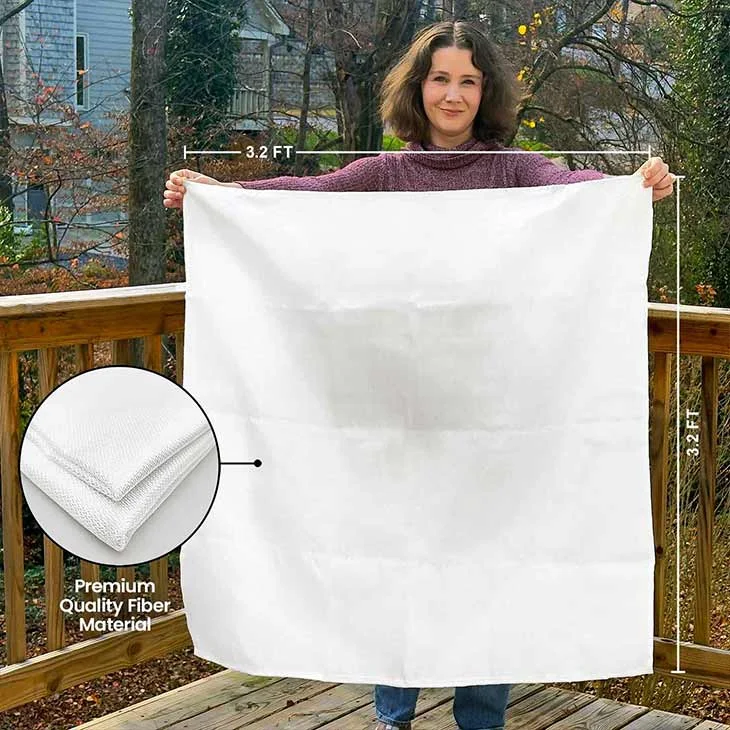
The spec sheet the brand publishes is two layers of woven fiberglass plus an inner fire-retardant film, a 1022°F (550°C) heat rating, CE HS&E, and EN-1869:1997. Those last two are Prepared Hero’s claims; this page does not reprint a certificate. The brand also says the cloth contains no PFOAs, weighs under one pound, has no expiry date, and can be reused if it is undamaged — wipe soot, inspect for holes, fold it back with the tabs hanging out.
Weight under a pound is why the pouch can hang on a cabinet screw without looking like industrial gear. It is also why the cloth is not a welding curtain or a firefighter’s shroud. Those are different products with different ratings. Do not drag this sheet toward a car-engine fire, a propane-tank valve, or an electrical panel because the marketing photo shows a kitchen. The kitchen photo is the intended scale.
Class A, B, and C labels on extinguishers exist because agents and nozzles differ. A blanket does not carry those class letters on this page. Prepared Hero’s own boundary is simpler: smaller than the blanket, including grease, wood, paper, and electrical once heat or power is off. That is a footprint rule, not a chemistry rule. Footprint rules fail when the fire is larger than the cloth. Chemistry rules fail when you spray water on grease. Both failures are avoidable if you leave early.
No expiry date is a storage claim. Fiberglass can still pick up grease film, kitchen dust, and bent tabs if the pouch lives over a fryer. “No expiry” is not “ignore the pouch for a decade and assume the fold is perfect.” Glance at the tabs when you change a smoke-alarm battery. If the pouch is painted over, buried behind a cutting board, or serving as a hook for oven mitts, it is no longer a tool.
Pull tabs, two weaves, and the 1022°F figure
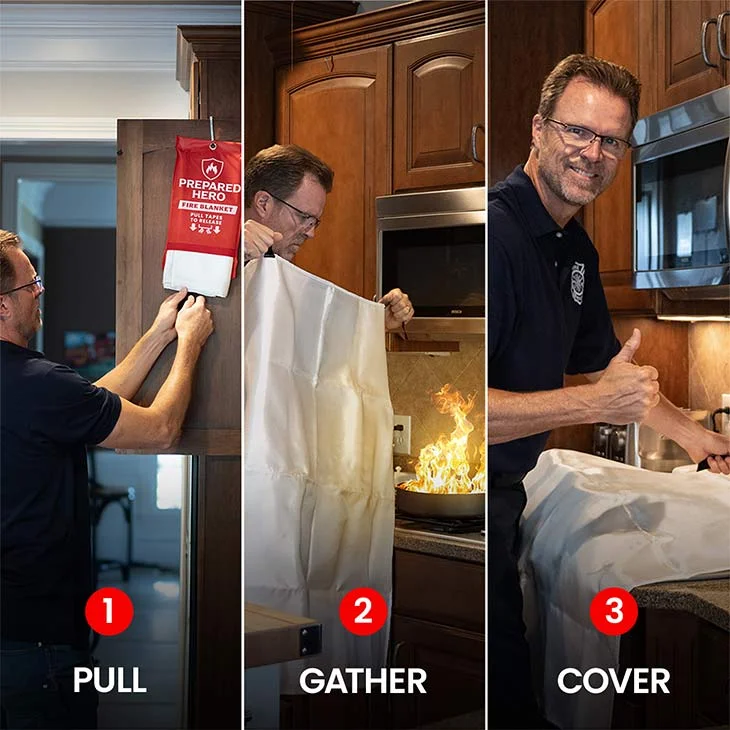
Deployment on the product page is grab both tabs, hold the sheet as a shield, kill the burner if you can reach it without crossing flame, then lay the cloth flat over the whole area. Leave it until the metal cools. Lifting early can let air back in. Two hands on two tabs is the design. One-handed yank that leaves the sheet half in the pouch is not the design.
1022°F is 550°C. Both numbers are on the spec sheet. Cooking-oil fires can exceed everyday “hot pan” intuition; they can also stay in a skillet. A manufacturer temperature figure is not a stopwatch for how long you may stand there. It is a materials rating the brand published. This review does not convert it into a kitchen experiment. If you cannot approach the pan, the rating is irrelevant. Leave.
Two layers of woven fiberglass plus an inner fire-retardant film is the stack. Film can melt or puncture even if the glass yarns survive. After any use, inspect both. A shiny film that is gone in a patch is damage. Reuse, on the brand’s terms, requires an undamaged cloth. When in doubt, replace the unit. A $15.99 two-pack unit from the October 2, 2026 screen is cheaper than a second fire.
CE HS&E and EN-1869:1997 appear together on that spec sheet. European blanket standards exist in the world; a string of characters on a sales page is still a manufacturer citation until the certificate is in view. This publication did not receive that PDF. We are not going to pretend we did. Buyers who need documentation for a workplace or a landlord can email support@preparedhero.com and ask. The address is on the listing.
PFOA-free copy is a chemistry omission the brand chose to advertise. It is not a full materials declaration. Fiberglass itself is the handling issue more than a fluorinated coating: glass filaments can irritate skin. Handle the edges. Wash hands after folding. Do not shake the cloth like a picnic blanket over a child’s head.
Grease that still fits under the cloth
Prepared Hero says the blanket can smother a fire smaller than itself — grease, wood, paper, and electrical once the heat or breaker is off. For a pan flare-up, that means the cloth has to cover the rim, not land as a heap on one side. For an appliance, unplug or kill the breaker first if you can do that without walking through flame.
Limits already on this review, plus one public fire fact
- Cooking equipment is the leading cause of reported home fires and fire injuries in the United States, per the National Fire Protection Association.
- Prepared Hero’s own boundary: smaller than the blanket. Climbing walls, a propane tank, a fuel can, or an electrical panel is an evacuate case.
- Deep-fryer oil you cannot approach safely is outside the product as sold.
- Heavy smoke that hides the exit: leave. Call 911. A cloth is not a structure-fire tool.
Grease fires start when oil gets past its smoke point and then its flash point. A splash of water turns that into a fireball. Public agencies have said so for years. The blanket’s job, if you use it, is to cut oxygen without that splash. Cover, wait, do not peek. Peeking is how air returns. Waiting until the pan is cool is how you avoid a restart. “Cool” means you can put a hand near the metal without flinching — and even then, be slow.
A cookie sheet as a lid is folk advice that sometimes appears next to blanket advice. This review is not going to rank household improvisations. The product you might buy is a purpose-made sheet with tabs. If you do not have it in reach, the NFPA cooking page’s message is still to slide a lid on if you can do it safely, turn off heat, and get out if you cannot. That is education. It is not an endorsement of improvising with a bath towel.
Do not treat the pouch as the plan if
- Flames are already on the wall or ceiling, or you would have to walk through heat to reach them.
- You need a required commercial hood system, or a maintained multi-class extinguisher, as the only tool in the room.
- Nobody in the home has an evacuation route. The blanket is a second move, not the first.
- The fire is a deep fryer, turkey fryer, or outdoor propane setup you cannot cover completely.
What NFPA cooking-fire pages actually tell a home cook
NFPA’s cooking-fire education is not a product review of Prepared Hero. It is the public baseline this page uses so kitchen copy does not outrun fire service guidance. Stay in the kitchen when you fry, boil, or broil. Keep a lid nearby. Keep children and pets out of the three-foot zone around a hot stove. If a fire starts and you cannot control it, get out, close the door behind you if you can, and call emergency services from outside.
The U.S. Fire Administration repeats the same spine on its cooking prevention page: unattended cooking is the dominant story in home-cooking fires. A blanket in a pouch does not watch a burner. A person does. If the household’s real problem is walking away from a skillet, the SKU to buy first is still attention — and a working alarm. The pouch is for the remaining case: you are there, the pan is still a pan, and the fire still has a rim.
NFPA also notes that Thanksgiving and other high-cooking days show spikes. That is calendar risk, not a reason this review invents a holiday discount. The October 2, 2026 pack prices are dated checkout figures, not a seasonal claim. If you hang pouches before a holiday, hang them where the cook can reach them without crossing the room. A 12-pack at $12.99 each only helps if the extra units actually go on extra walls.
Clutter on the stove — packaging, towels, cookbook stands — is a fuel load the blanket does not cancel. Clear the burners. That is free. It is also the kind of sentence fire educators never get tired of repeating because the alternative is a cabinet fire. A fiberglass sheet cannot retroactively un-clutter a range.
People with mobility limits, hearing limits, or who live alone should treat “get out” as the primary plan even more strictly. A cloth that must be pulled with two hands and draped while standing next to heat is a young, able-bodied motion in the marketing photos. This page does not have a mobility study. It has a pull-tab pouch. If that motion is not realistic in your kitchen, do not buy a tool you cannot deploy. Put the money toward alarms, a practiced exit, and a phone.
None of that public guidance is a lab result on Prepared Hero’s weave. Mixing the two is how sales pages over-claim. This review keeps NFPA and USFA in the education column and the spec sheet in the product column. If they ever conflict, leave the house. Do not stay to finish a drape.
Wall-pouch reach from a range, grill, or RV
Hang the pouch where a person can reach it without hunting: inside a cabinet door by the range, near a grill, in a garage or RV. Tabs should stay visible. Heat above a range can still cook a pouch that sits directly on a scorching backsplash; a cabinet door or a side wall a step away is the usual compromise between “close” and “not in the flame.”
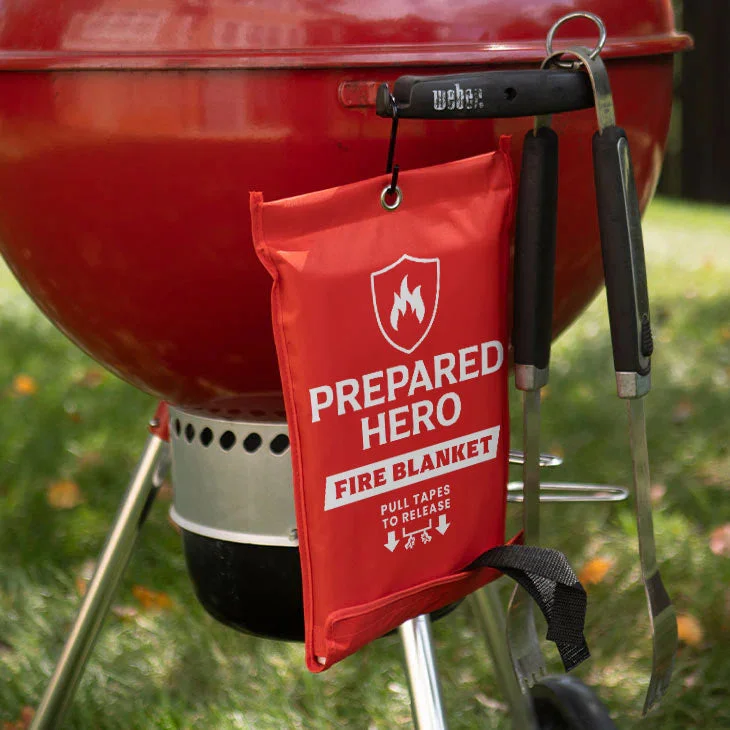
Outdoor grills add wind, grease trays, and propane. A blanket can cover a small grease flare in a tray if the cloth still wins on footprint. A propane-tank valve fire is not a cloth job. Shut off gas only if you can do it without reaching through flame. Otherwise back away. RV kitchens are small, which helps a blanket’s footprint and hurts your exit. Know the door. Know which window is not an exit. Mount the pouch so the first motion is toward air, not deeper into the coach.
Garages collect gasoline, solvents, and chargers. The listing’s garage mention is a location, not a hazmat rating. A gasoline spill fire is larger and faster than a skillet. Evacuate. The pouch on the garage wall is for the small wastebasket or the small bench-top incident that still fits under the sheet — if it does. When it does not, the wall pouch is scenery.
Support on the listing is support@preparedhero.com and +1 888-457-2672. US shipping is described as USPS from US warehouses, typically 2–4 business days. Those are seller logistics lines. They are not a finding that a particular box will land before a weekend cookout. Order with the calendar in view. Tracking is not described in the excerpt we used beyond that USPS window.
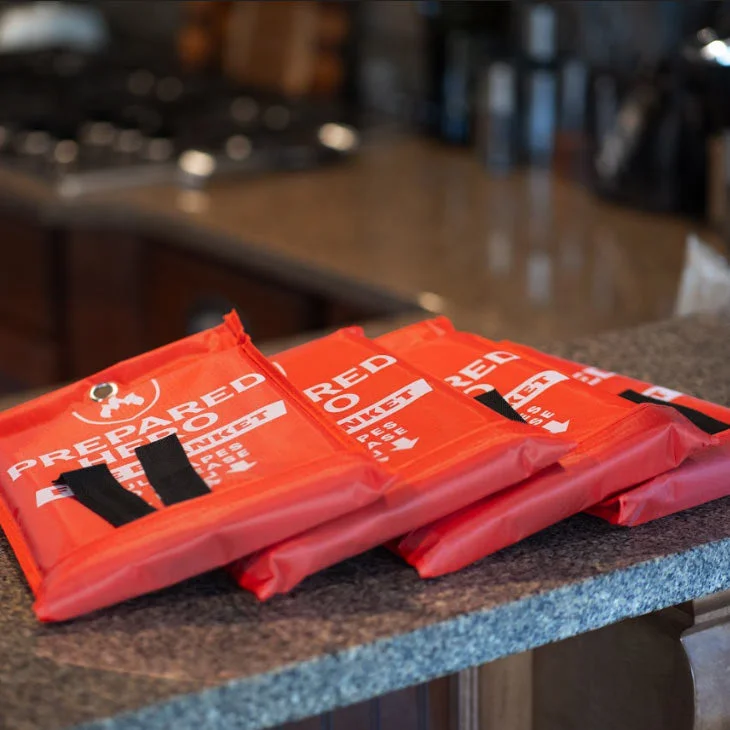
Multi-pack math only works if units leave the box. A 12-pack that stays in shrink wrap in a closet is one pouch plus eleven paperweights. Put one by the range, one by the grill, one in the RV if you have it, and give extras to rooms that actually cook — a basement kitchenette, an in-law suite. Do not store the rest above the oven. Heat and grease live there.
Woven glass on skin and why the edges are the handle
Woven glass can irritate skin. Handle the edges, not a loose fringe. That is already on the product-page deployment copy. Fiberglass insulation in attics comes with the same folklore for a reason: loose filaments itch. A fire blanket is a tighter weave, not a pile of loose pink batts, but the handling rule stands. Do not hug the cloth to your chest as a cape unless you like itching. Use it as a shield, then as a cover.
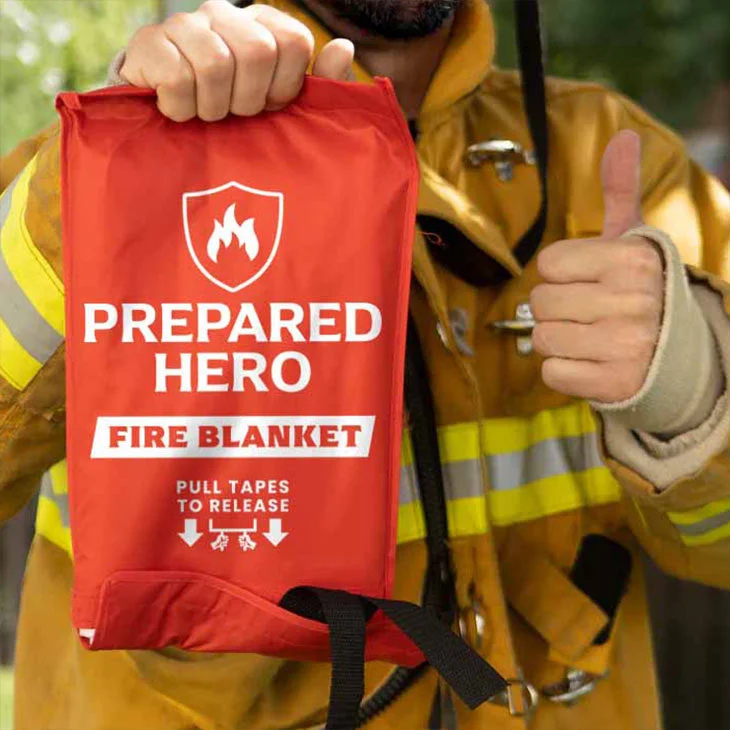
After a drape, the cloth is hot, dirty, and possibly damaged. Let the pan cool. Then lift from the edges. Wipe soot. Inspect for holes. If the film is blistered, retire the unit. If you will fold it back, leave the tabs hanging out of the pouch so the next person does not have to fish. A tab buried inside a folded brick costs seconds you do not have.
Children should not treat the red pouch as a toy. Pull tabs are obvious. A practice pull on a real unit in a bored afternoon ruins the fold and the readiness. If you want a practice motion, talk to a local fire department about education nights. This site is not going to invent a drill with a live pan. Do not.
Pets will not understand a drape. Get animals out with people. A blanket over a pan does not make the kitchen safe for a dog’s nose. Smoke is the hazard in the hallway even when the pan is covered. Close doors as you leave if you can do it on the way out. That is USFA-style advice, not a Prepared Hero feature.
First-aid for fiberglass itch is ordinary: soap, water, not rubbing with a dry towel that drives filaments in. If someone is burned, that is a medical problem. Cool a burn under cool water per first-aid guidance from the Red Cross or a clinician, and do not apply the fire blanket as a bandage. The sheet is for the pan. Skin care is for a person. Mixing those jobs is how listings get sloppy.
Two-packs at $15.99, twelve at $12.99
We recorded these per-blanket totals on the manufacturer’s checkout on . The list figure on that screen was $29.99 each. Promoted tiers included free US shipping that day.
Packs from that October cart
Two blankets at $15.99 each. Four at $15.99 each. Twelve at $12.99 each. A 30-day satisfaction window is named; write support@preparedhero.com or call +1 888-457-2672 if you need the current return steps before a multi-room order. Prepared Hero has said the promoted checkout offer is not the Amazon listing.
Per-unit math: the two-pack and four-pack were the same $15.99 each that day. The 12-pack dropped to $12.99 each — $3 less per cloth if you will actually mount twelve, or if a few houses in a family will take them. If you need two kitchens, the two-pack is the same unit price as four. There is no reason in that day’s grid to buy four instead of two unless you have four walls. Struck-through $29.99 is the seller’s compare-at line, not a price this site charged.
The 30-day satisfaction window is named without the unused-goods fine print this review found on some other products in the catalog. Still read the live terms. Fire-safety goods that have been opened and mounted may or may not return cleanly. Ask support before you order a 12-pack if returns matter. This page does not invent a restocking fee because the listing we recorded did not state one.
EN-1869 as a manufacturer citation, not a certificate in this tab
EN 1869 is a real European standard number used for fire blankets in that market. Seeing it on a U.S. landing page is a citation. It is not the same as this review hosting a test report. CE marking is likewise a manufacturer’s declaration system in its home jurisdiction. HS&E as written on the spec sheet is the brand’s extra letters. None of those strings are independent lab results we verified.
If a workplace, school, or insurer asks for documentation, forward the question to support@preparedhero.com. Keep the reply. This site will not stand in as your compliance file. Home kitchens are not usually asked for EN paperwork. They are asked, by fire educators, to keep an exit and a working alarm. Paperwork is a bonus for people who need it. It is not a reason to stay in a burning room.
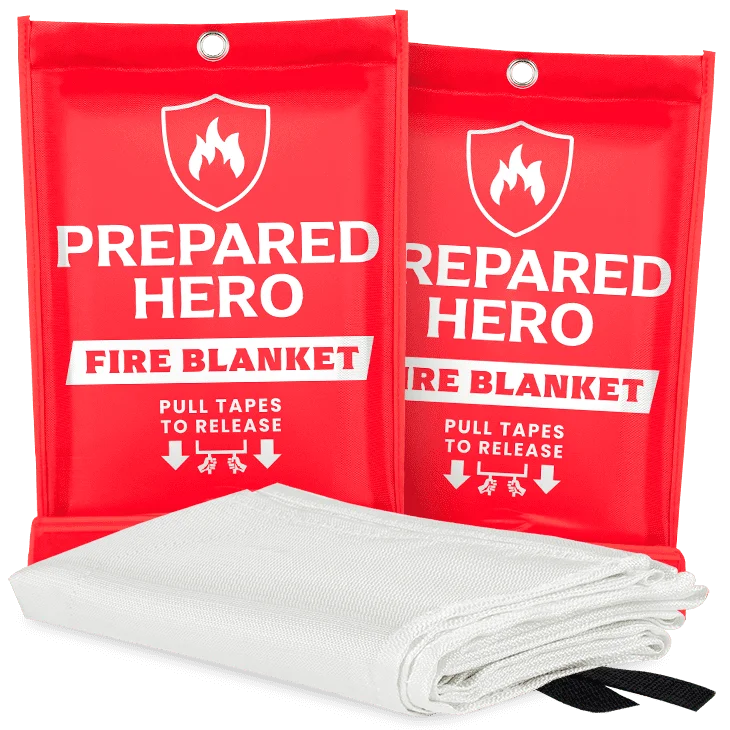
Marketing photos that show a calm adult draping a small pan are the intended use case. Photos are not measurements. Size callouts on the spec imagery are the brand’s. This page does not invent extra inches. If the live listing shows a dimension, believe that listing over a memory of a photo. If it does not, do not guess. A cloth that is smaller than the pan is a miss by the product’s own rule.
Reusable-if-undamaged is a cost argument: you may not buy a new chemical extinguisher after one small incident. It is also a judgment call you make with your eyes after the pan cools. When the judgment is fuzzy, replace the blanket. The October 2 unit prices are low enough that hesitation should favor a new pouch, not a heroic reuse of a scorched film.
What a smoke alarm still has to do that a pouch cannot
A fire blanket does not sound. It does not phone anyone. It does not survive a house-wide fire as a strategy. Smoke alarms, carbon monoxide alarms, and a meeting place outside are still the household system. Pair the pouch with a tested alarm. Test monthly, change batteries on the schedule the alarm maker prints, and replace units that have passed their own expiry. Those are alarm-maker rules, not Prepared Hero rules.
Night fires and closed bedroom doors are a USFA theme: working alarms in sleeping areas, doors that can close, a practiced exit. A kitchen pouch does nothing for a dryer fire at 2 a.m. if nobody is in the kitchen. Do not let a red pouch on a cabinet door become the entire plan. It is a specialized tool for a specialized minute.
Extinguishers still have a place next to the pouch if someone in the house will maintain them. This review is not a ranking of those two objects as enemies. They do different jobs. Powder makes a mess and can handle a different set of starts. A blanket is quiet and local. The failure mode they share is the same: a person who stays too long. Leave when the room is telling you to leave.
Apartment buildings and HOAs may have rules about extinguishers in units. They rarely ban a wall pouch, and this page does not invent a bylaw. If you rent, a command strip or a screw in a cabinet door is a conversation with the lease, not with this review. Do not disable a building alarm to hang a pouch. That sentence should not need to exist. It exists.
Leaving the cloth down until the metal is dull
The product page’s wait instruction is the part people skip. Adrenaline says lift and look. Air says thank you and the fire returns. Leave the cloth until the pan, the grate, or the small appliance is no longer a heat source you can feel from a safe distance. Then turn off gas or unplug if that was not already done. Then, and only then, think about lifting an edge.
Vent the room after, from a position that does not walk you back into smoke. Open a window on your way out if the fire is out and the air is merely dirty. If the air is not merely dirty, you should already be outside. A covered pan can still off-gas. Treat the kitchen as occupied only when it is obviously boring again.
Call emergency services if you had any doubt, if smoke went to other rooms, or if anyone has chest pain or burned skin. Firefighters would rather check a covered pan than meet a rekindle. That is not a Prepared Hero slogan. It is how emergency systems work. Pride about “I handled it” is how small kitchen events become structure fires in NFPA statistics.
Dispose of oil and damaged cloth as waste, not down the drain for the oil, and not back into the kitchen drawer for a holey sheet. Local waste rules vary. This page does not invent them. A damaged blanket is not a picnic blanket, not a moving pad, and not a welding drape. Throw it away.
If nothing happened and you only practiced grabbing the tabs, fold the sheet so the next grab still works. Tabs out. Pouch closed enough to stay clean, open enough that you are not fighting a zipper in the dark. There is no zipper on the unit as described — it is a pouch with tabs. Keep it that simple.
PASS on a canister and cover on a cloth
Fire-extinguisher education in the United States often uses the PASS mnemonic: pull the pin, aim at the base, squeeze, sweep. That sequence belongs to a pressurized canister with a nozzle. It does not belong to Prepared Hero. The cloth sequence on the product page is grab both tabs, shield, cover, wait. Mixing the two in your head is how someone aims a blanket like a hose or tries to sweep powder with fabric. Keep the mnemonics in separate rooms.
PASS still matters in a house that also owns an extinguisher. This review is not telling you to throw the canister away. It is telling you that the red pouch is not a silent PASS device. There is no pin. There is no gauge. There is no sweep. If you have both tools, the small pan that still has a rim is the cloth’s job when you can reach it. The spreading fire, the electrical panel, the fuel spill — those are either the extinguisher’s job, if you are trained and the class matches, or they are an evacuate job. Training is a fire-department class, not a landing page.
Powder extinguishers leave a corrosive mess on ovens, laptops, and pets. That mess is a real reason people shop blankets. It is not a reason to pretend the blanket covers every fire class the canister did. Trade-offs are allowed. Magical overlap is not. If the household will not maintain a gauge, a blanket plus alarms is a coherent smaller kit. If the household will maintain a gauge, keep both and assign each a minute: cover the pan, or PASS at the base, never both on the same object in a panic.
Aim-at-the-base is the opposite of drape-over-the-top. A person who last took a workplace extinguisher drill may default to aiming. Pause. You are holding tabs, not a handle and a hose. If that pause is too slow because the fire is already large, you should already be leaving. The drill is for the still-small pan. It is not a personality test.
Children old enough to be in the kitchen should know two words first: out, and 911. A pull-tab pouch is a later lesson, if it is a lesson at all. Practice on a real unit ruins the fold. A fire-department open house is a better classroom. This site will not publish a kid-friendly pan-fire game. The NFPA cooking page is written for adults who cook. Start there.
Workplace kitchens, church kitchens, and food trucks live under different codes. A home pouch is not a Type I hood, not an Ansul pull, not a K-class extinguisher. If you cook for the public, ask the inspector what the room already requires. Then, if you still want a blanket for a staff pan, treat it as extra, labeled, and trained. Extra is the word. Required is a different word the inspector owns.
Apartment hoods, rental rules, and a cabinet-door screw
Renters often cannot drill a tile backsplash. A cabinet-door interior is the usual compromise: a screw into painted wood, tabs facing you when the door opens. If the lease bans extra holes, command-style strips may or may not hold a one-pound pouch next to a steamy kettle. This page does not sell hardware. It notes that a pouch you cannot mount is a pouch in a drawer, and a drawer is decoration. Ask the landlord in writing. Keep the email with the smoke-alarm request you should also be making.
Range hoods in apartments are often recirculating filters, not true exhaust. They do not make a grease fire smaller. They can spread smell. They do not replace a lid or a blanket. If the hood filter is a greasy fleece, clean it on the schedule the appliance maker printed. A filthy filter is fuel. The blanket does not cancel that fuel. NFPA’s cooking education is still: stay in the kitchen, keep the area clear. A recirculating hood is not a suppression system.
High-rise alarms and stair plans dwarf a kitchen pouch. Know the stair. Know whether the fire tower is pressurized. Do not pack a blanket as if it were an escape hood. Escape hoods are a different product this review is not selling. If smoke is in the hallway, the USFA logic is stay or go based on conditions at the door — not based on a fiberglass sheet in a cookie cabinet.
HOA rules sometimes fuss about extinguishers in hallways. They rarely write novels about a cabinet pouch. Still, if you live under a board that loves bylaws, a one-line email prevents a fine for a screw. This is social, not thermal. The fire does not read the bylaws. The board might.
Insurance inventories sometimes ask what fire equipment you keep. A dated photo of the mounted pouch, the alarm, and the extinguisher if you have one is more useful than a receipt in a box. This review is not an insurance advisor. It is a reminder that a tool you cannot prove you had is a tool an adjuster never saw. Photograph the tabs hanging out. That is the ready state the brand describes.
Shared kitchens in dorms and co-living spaces multiply cooks and subtract ownership. A pouch with no name on it walks. A pouch with a name still needs everyone to know the cover-and-wait rule. If you cannot train the room, you cannot deploy as a room. Put the money toward a lid that stays on the stove and an alarm that is not disabled because someone burned toast. Disabled alarms are a USFA villain for a reason.
RV and boat mounting adds vibration. A pouch that rattles off a screw on a washboard road is not mounted. Use a fastener that matches the wall type. Keep tabs clear of a coat hook. Outdoor UV on a pouch left in a cockpit is not a condition the spec sheet discussed in the excerpt we used. If the red fabric chalks and cracks, replace the unit. “No expiry” is not “immune to sun.”
Rekindle, grease trays, and why peeking feeds air
Rekindle is the quiet failure after a “successful” cover. Oil is still above flash point. Air returns at the first lifted corner. The flame is back, sometimes larger, because the kitchen is now messier and the person is now braver. The product page’s wait-until-cool line exists to prevent that story. Cool is not “less orange.” Cool is dull metal you can approach without flinching. If you cannot tell, wait longer. If you already left the house, let firefighters tell you.
Grease trays under grills and broiler drawers collect the same fuel in a different shape. A tray fire can still fit under a cloth if the tray is small and you can reach it without a sleeve in the flame. A tray under a roaring gas grill in wind is not that tray. Lid the grill if the maker’s instructions say so and if you can. If you cannot, back away. Propane valves are not cloth work. Those sentences are already in the grill section. They belong next to rekindle so a reader does not “check” a tray at minute two.
Oven fires are a lid-and-door problem more than a blanket problem. Opening an oven door feeds air. A cloth cannot be draped well on a rack in a box. Turn the oven off. Keep the door shut. Get out if smoke is moving. This is USFA-style oven advice, not a Prepared Hero mode. Do not invent a technique where you reach a blanket into a 400°F cavity. The product is a wall pouch for a pan-scale event.
Electrical-once-power-is-off is on the listing. The order of operations is power, then cover, if you can do both without crossing heat. A toaster, a cheap hot plate, a space heater too close to a curtain — unplug from a position that is not in the plume. If the outlet itself is arcing, that is a panel-and-evacuate problem. A fiberglass sheet on an outlet is not a listed use this review will endorse. The listing’s electrical clause is for a fire that has a footprint you can cover after the breaker is down.
Peeking is a human reflex. Count it as a mistake in advance. If you must look, look at smoke in the rest of the room, not at the edge of the cloth. Smoke that is layering at the ceiling is your cue to leave even if the pan is covered. A covered pan in a room that is already a smoke event is not a win. It is a delay. Delay is for getting out, not for filming.
After the event, oil in a covered pan is still hot waste. Do not pour it down a drain. Do not set the pan in a plastic sink. Do not put a lid in a freezer as folklore. Let it cool on a stove that is off. Then dispose of oil per local rules. The damaged cloth, if it was used, is trash if it is damaged. Reuse only matches the brand’s undamaged sentence. When the film is cloudy or holed, the sentence does not match.
Smoke-alarm day is still the day you glance at the tabs
Pick the same calendar moment you already use for alarms — a monthly test, a time change, a birthday — and look at the pouch. Tabs out. Pouch not painted over. Nothing hanging on it. Cloth not damp with cooking film. That glance is not a lab. It is how a no-expiry product stays a product. A blanket that failed the glance belongs in the trash, and a new unit from the October 2 pack math is cheaper than a story about a pouch you could not pull.
Write support@preparedhero.com if you need a replacement fold explained. Call +1 888-457-2672 if you need current return steps before a 12-pack. Those contacts are on the listing. Use them for logistics. Use 911 for fire. Do not reverse those numbers in a smoky room. The 4.5 on this page assumes you will hang the tool and you will still own an alarm. If you will only do one, do the alarm. Then hang the pouch.
Photograph the mount once. Keep it with the alarm photo. If you move house, the pouch moves with the knives, not with the forgotten drawer. A 12-pack only justifies itself as twelve mounts, or as gifts that also mount. Shrink wrap in a closet is not a fire plan. It is inventory. The NFPA cooking page does not score inventory. It scores whether someone was in the kitchen and whether they could get out. This review scores a cloth that might help in the remaining minute. Keep the minute small. If the tabs ever feel glued by grease, that unit is already late for a replacement, even though the brand names no expiry date — film and fold still age in a kitchen.
The 4.5 we publish for this pouch
We give the Prepared Hero Emergency Fire Blanket 4.5 / 5. Pull tabs, a named fiberglass stack, no chemical powder, no expiry date, and a $15.99 / $12.99 multi-pack on that October screen are the part a reader can check. Mounted next to a stove, it is a coherent add-on to smoke alarms.
The score is not a 5 because the cloth stops at its own footprint, fiberglass can irritate skin, and EN-1869 is a manufacturer claim on this page. Evacuate when the fire is already larger than the blanket. That boundary is the whole product. The methodology page is document research, not a burn lab.
Points stay on the board for stating a smothering method instead of pretending to be an extinguisher, for naming a temperature figure on a spec sheet, and for a checkout that sold extra wall units at a lower per-piece rate. Points come off for paperwork that is cited rather than shown, and for a tool that does nothing if it is in a drawer. Hang it or do not buy it.
Kitchen-cloth questions the listing still leaves
Answers below follow the spec sheet, the October 2, 2026 checkout, and public NFPA and USFA cooking-fire education. They are not a live-fire result. If the fire is already larger than the cloth, the answer is outside, then 911.
No. It is a woven fiberglass sheet in a wall pouch. Prepared Hero describes it as cutting off oxygen, not as a chemical or pressurized agent. There is no gauge and no recharge. It does not replace a maintained Class A/B/C extinguisher or a commercial kitchen system. The National Fire Protection Association’s cooking-fire education pages still treat getting out and calling emergency services as the priority when a fire is growing.
Fires smaller than the blanket itself, including grease, wood, paper, and electrical fires once the heat or power is off. Cover the whole pan. Leave the cloth in place until the surface cools. Evacuate if flames climb, smoke is heavy, or you cannot approach safely. Deep-fryer oil you cannot reach is outside that limit.
The checkout we recorded listed a $29.99 list price. Two-packs and four-packs were $15.99 each. The 12-pack was $12.99 each. Promoted tiers included free US shipping that day. A 30-day satisfaction window is named; contact support@preparedhero.com or +1 888-457-2672 to confirm current return steps.
From the brand’s spec sheet, which also names 550°C as the same rating. This page does not reprint a laboratory certificate. Treat 1022°F as a manufacturer figure attached to two layers of woven fiberglass plus an inner fire-retardant film. It is not a field measurement this publication took, and it is not permission to stand over a fire that has already left the pan.
Prepared Hero names EN-1869:1997 and CE HS&E on the spec sheet. Those are the brand’s citations. This review does not reprint a certificate or an independent test report. A named standard is not the same object as a PDF of a test in your browser tab. Ask the manufacturer if you need the paperwork behind the letters.
The brand says the cloth has no expiry date and can be reused if it is undamaged — wipe soot, inspect for holes, fold it back with the tabs hanging out. A hole, a melted film, or a frayed edge is not “undamaged.” Do not fold a damaged sheet back into the pouch and call it ready. The listing also says the cloth contains no PFOAs and weighs under one pound.
Grab both tabs, hold the sheet as a shield, kill the burner if you can reach it without crossing flame, then lay the cloth flat over the whole area. Leave it until the metal cools. Lifting early can let air back in. Woven glass can irritate skin; handle the edges, not a loose fringe. This is the manufacturer’s deployment copy, not a live drill this site ran.
Where a person can reach it without hunting: inside a cabinet door by the range, near a grill, in a garage or RV. Tabs should stay visible. A blanket in a basement drawer is decoration. Pair it with a tested smoke alarm. US shipping is described as USPS from US warehouses, typically 2–4 business days.
No. A pouch does not wake anyone. A working smoke alarm is still the device that buys time to get out. U.S. Fire Administration cooking pages at usfa.fema.gov treat prevention and evacuation as the core home-fire messages. The blanket is a second move for a fire that still fits under the cloth.
Public fire-safety education says no. Water on burning grease can spread the fire. That is general NFPA and USFA guidance, not a product test of Prepared Hero. The brand’s method is to cover a fire smaller than the blanket. If you cannot cover it, leave and call 911. Do not carry a flaming pan outdoors. Do not use flour or a wet towel as improvisation when the listed tool is a dry fiberglass sheet.