
The film is passive — no cell, no app
The choice is a 1.1 mm film in the wallet you already carry, or a sleeve on a single card. If you only tap one chip, the sleeve may already be the whole purchase. Cardian does not add a battery or a subscription for the core job. It is a thin insert the manufacturer says creates a passive RFID and NFC interference field around cards stored beside it. Centre it in the compartment that holds tap-to-pay cards and ID — not an outer pocket. Blocking, on that copy, runs while the wallet stays closed.
Passive is the important adjective. There is nothing to charge, nothing to pair, nothing that dies at 4 percent on a Sunday. A blocking film that needs power would be a different product — and a worse one for a wallet you forget in a drawer. The manufacturer lists about 1.1 mm of thickness and no power. Those two facts are the form-factor pitch: sit among cards without turning a slim bifold into a brick, and without another USB cable in the junk drawer.
Intentional tap-to-pay, according to the same pages, still works when you remove a card or hold it at the terminal. The film is not a switch you flip. Opening the wallet or pulling a card is the switch. If you wanted tap-through a closed bifold, this insert — on the manufacturer’s closed-wallet sentence — is the wrong tool. Keep a transit card in an outer sleeve if the gate is daily.
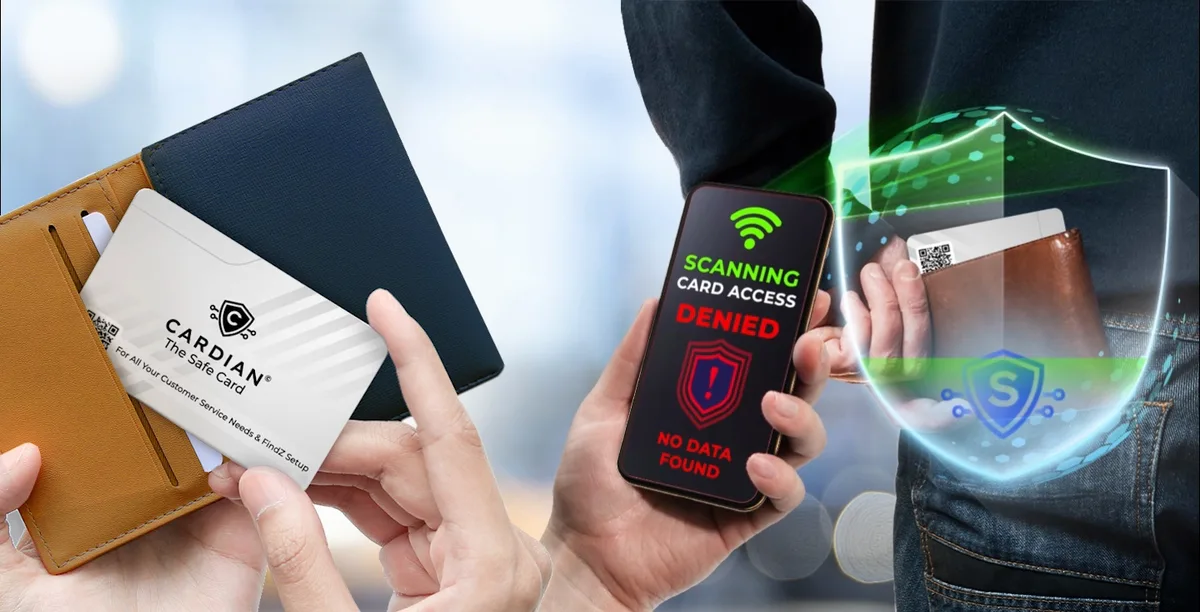
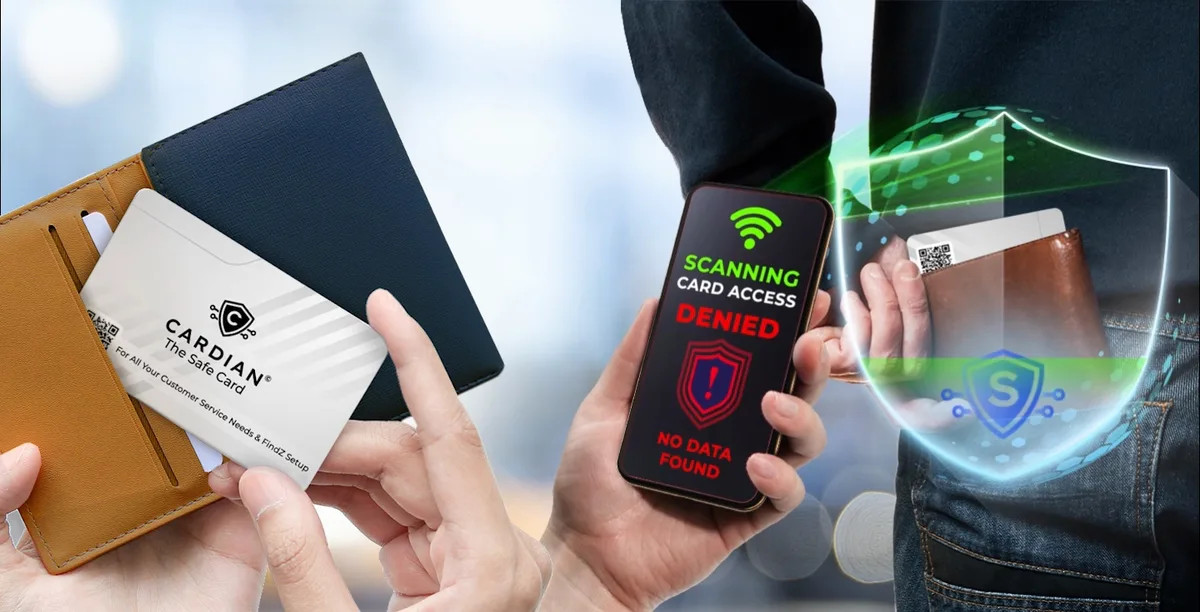
Unauthorized-read blocking within about 5 cm is a manufacturer claim. This review does not treat it as a lab result. 5 cm is also roughly the distance a payment terminal expects for an honest tap, which is why a close-range skim and a legitimate payment live in the same physics. A film that interferes at that range while the wallet is closed is a plausible product category. A film that claims to stop a read from a metre away would be claiming a different physics. Cardian’s copy stays in centimetres. Keep it there.
Waterproof, tear-proof marketing for at least three years is also manufacturer language. There is no ASTM number on the page we read, no flex-cycle table, no photo of a torn control sample. Replace the insert if it is bent, cracked, or no longer sits flat. A warped film that leaves a gap beside a bank card is no longer the object in the diagram. Flatness is the spec you can check without a lab.
FindZ — pairing with an app or QR tag to locate a misplaced bag — is a separate lost-item option. Confirm what ships with the order. It is not the same as RFID blocking. A QR tag does not create an interference field. An app does not sit in the bifold at 1.1 mm. Do not let a lander merge those SKUs. The 4.3 we publish is for the passive film. Locating extras, if they appear on a later cart, are a different line and a different radio.
Keep the sleeve if you only carry one chip
A sleeve wraps one card. You already know which chip you tap. If that is the whole carry — one bank card, maybe a transit pass in another pocket — buying a whole-wallet film is extra plastic. The sleeve is enough. It also travels with the card when you hand the card over, which a wallet insert cannot do. When the plastic leaves the bifold, the film stays behind. That is the limit of every wallet-level blocker, Cardian included.

Skip the insert
- You only protect one or two cards and already have sleeves.
- You need a lab report, a test standard, or a measured frequency range before you pay.
- You want protection against phishing, terminal skimmers, or a stolen wallet. A film does not stop those.
The listing fits a bifold that already holds several RFID-enabled cards, IDs, or a passport in one compartment, and a buyer who does not want to replace the wallet. Multi-packs are for other wallets in the house, not because each credit card needs its own blocker. Bank alerts still matter more than any insert. Modern EMV contactless also limits replay; this product addresses a narrow, close-range read.
Two cards in two pockets are still a sleeve job: one sleeve each, or one card that taps and one that does not. The film’s value appears when the compartment is a stack you do not want to sleeve piece by piece. If you enjoy sleeving, keep enjoying it. Cardian is for people who stopped sleeving and still want a closed-wallet sentence. A nine-pack will not convert a one-chip household into a stack household. It will only multiply sleeves you did not need, except the films are not sleeves and will not travel with a handed-over card.
If you are unsure which household you are, count chips that tap, not cards that live in the bifold. Loyalty stamps without antennas do not join the count. Magstripe-only relics do not join the count. The insert cares about the radios beside it, on the manufacturer’s RFID-enabled sentence. Count those radios before you open a nine-pack. One chip still belongs in a sleeve you already own, not in a multi-pack of films you will store and forget. Keep counting. Photograph the insert on arrival for the thirty-day clock. Keep that photo.
Film, sleeve, and Faraday bag are three tools
A Faraday bag is a closable conductive pouch. You put a phone, a passport, or a fob in and you close the mouth. The interior is supposed to sit inside a continuous shield. Cardian is not that pouch. You do not put the wallet into Cardian. You put Cardian into the wallet. The wallet’s leather, stitching, and open edges are still there. The film is an interferer among cards, not a cage around the object.
A sleeve is a tiny Faraday-ish envelope for one card. It is the right size for one chip and the wrong size for a passport booklet. Cardian’s manufacturer sentence covers RFID-enabled cards, IDs, and passports in the same compartment. That sentence is how they justify one insert instead of a sleeve per item. Whether a 1.1 mm film actually quiets a passport chip in a leather pocket is a measurement they did not publish on the page we opened. Believe the category; demand the PDF if your threat model is a passport desk.
Metal trigger wallets, sold elsewhere in this catalog, try to make the chassis the shield. Cardian tries to leave your chassis alone. That is the bifold pitch. If you already like the wallet in your pocket, an insert is the smaller change. If you wanted a new metal fan, you are on the wrong page. If you wanted a phone pouch for a courthouse or a concert, you are also on the wrong page. Three tools. One job each.
Mixing tools is allowed. A film in the bifold plus a sleeve on the one card you often hand to a waiter covers the “card left the wallet” gap. A Faraday pouch in the bag plus a film in the pocket covers a phone and a stack. Landers hate this sentence because it makes the nine-pack optional. It remains true.
Do not stack three Cardian inserts in one compartment because more feels safer. The manufacturer markets one per wallet because a single card is meant to shield everything stored alongside it. Extra films are extra millimetres. 1.1 mm times three is a different bifold. Use the extras in other bags.
Five centimetres is a manufacturer radius
About 5 cm is two inches. ISO/IEC 14443 contactless payments are designed around a similar close range, which is why terminals have a tap zone rather than a room-sized field. A manufacturer that says it blocks unauthorized reads within about 5 cm is describing interference in that same neighbourhood. This review cannot convert that sentence into a plot of field strength versus distance. No standard, no antenna photo, no frequency (13.56 MHz is the usual payment band; the page did not print it) appeared on the documents we read.
If a skim requires a reader in the 5 cm bubble of a closed wallet, the attacker is already in your coat. That is a crowded-train story, not a rooftop story. EMV dynamic codes still limit what a captured tap is worth. The film, if it works as advertised, is trying to stop the tap from completing while the wallet is shut. It is not trying to encrypt your printed PAN. Look at the front of your card. Those numbers are still visible to a camera when the bifold is open.
We do not upgrade 5 cm to a certified radius. We also do not pretend 5 cm is meaningless. It is the scale at which NFC lives. A product in this category that claimed ten metres would be the one to laugh out of the cart. Cardian did not claim ten metres. Credit the narrowness, withhold the lab stamp.
Replace the insert if it no longer sits in the middle of the stack. A film that has migrated to the back of a stuffed pocket may not be “alongside” the tap cards in the sense the copy describes. Recentering takes two seconds. That is the maintenance. There is no firmware.
EMV already narrowed the skim
EMVCo contactless is the payment-industry document for tap. Dynamic cryptograms mean a copied tap is a weaker prize than a copied magstripe used to be. ISO/IEC 14443 is the radio document. FTC phishing guidance is still the theft document most households will actually meet. A film does not read your email.
Terminal skimmers that sit on a pin pad, and waiters who walk away with a card, are also outside the closed-wallet field. If the card is in someone else’s machine, Cardian is in your pocket, unemployed. Chip-and-PIN and bank alerts are the tools for those scenes. This insert is only for the scene where the stack is still on you and closed.
That scene is real and small. Crowd, coat, centimetres. Buy for that scene or do not buy. Do not buy because a lander said “identity theft” without splitting the crimes. Identity theft in the FTC’s world is mostly account takeover and breaches. A 1.1 mm film will not call Equifax.
Magstripes remain on many cards. A swipe copy requires the stripe, not the NFC antenna. The film does not wrap the stripe when the card is handed over. If you still swipe often, a sleeve that travels with the card is the more complete (still imperfect) companion. Cardian’s closed-wallet job and the stripe’s open-world job do not overlap much.
1.1 mm in the bifold you already own
At about 1.1 mm, the insert is meant to sit among cards without turning a slim wallet into a brick. That is the form-factor pitch against a dedicated blocking wallet, which replaces the whole carry, and against stacked sleeves, which add bulk per card. 1.1 mm is about the thickness of a credit card and a bit (ID-1 stock is about 0.76 mm). You will feel it. You should not feel a phone.

| Thickness | ~1.1 mm per manufacturer |
|---|---|
| Power | None — passive RFID/NFC film |
| Blocking claim | Unauthorized reads within ~5 cm |
| Coverage | RFID-enabled cards, IDs, and passports in the same compartment |
| Optional add-on | FindZ app / QR tag for lost-item tracking |
| Return window | 30-day money-back stated at checkout |
| Shipping cited | 7–14 business days, US warehouse, with tracking |
Airport queues and crowded transit are the scenes the manufacturer leads with. The insert does not replace a zippered inner pocket. International delivery times were not detailed on the page we read. Support is listed at 877-633-4331. The checkout page did not spell out who pays return shipping or the exact return portal.
Stuffed bifolds already fight 1.1 mm. If you carry receipts, loyalty stamps, and a folded timetable, the film is another layer in a stack that already opens like a sandwich. Thin the compartment first. Then add the insert. A nine-pack will not flatten a messy wallet.
One insert is meant for a whole compartment
The manufacturer markets one insert per wallet because a single card is meant to shield every RFID-enabled card, ID, and passport stored alongside it. Multi-packs are for other wallets, not because each credit card needs its own blocker. That is the opposite of the sleeve model, where each chip gets a jacket. It is also the claim that most needs a lab PDF this page does not have. One film versus six chips is a stronger assertion than one sleeve versus one chip.
Alongside matters. A card in a front slot and a card in a rear slot may not be in the same compartment. A hidden passport pocket in the back of a travel wallet may be a second compartment. Read your bifold the way the copy reads: one field, one stack, one insert. If you have two stacks, you have two purchases — which is why the six- and nine-packs exist as household math, not as a dare to fill one pocket.
Centring is the installation. There is no adhesive in the copy we read. Gravity and card friction hold the film. If the insert slides to the bottom, the top cards may be less “alongside.” Check after a week of sit-down pockets. Recentering is free.
Outer pockets are the wrong slot
The manufacturer says to centre the film in the compartment that holds tap-to-pay cards and ID, not an outer pocket. An outer pocket is where you put a transit card you want to tap without opening the wallet. Those two sentences cannot share a slot. If the insert is in the outer pocket with the transit card, you may be interfering with the tap you wanted. If the insert is in the inner stack, the outer transit card is unshielded, which is probably what you wanted for the gate.
This is ordinary placement, not a trick. RFID-blocking clothing and RFID-blocking wallets have always had the same conflict: shield versus convenience. Cardian’s copy picks shield for the closed compartment and leaves you to solve the gate. A sleeve on the transit card in a coat, film in the bifold for banks, is the mixed carry this review already endorsed.
Phone pockets are also the wrong slot. The film is not rated here as a phone Faraday. NFC payments from a phone use a different object. Do not slip Cardian behind a phone expecting to quiet Apple Pay. You would be experimenting. This page does not.
Passports and IDs share the compartment sentence
The manufacturer says one card shields RFID-enabled cards, IDs, and passports in the same compartment. e-Passport chips are a real 13.56 MHz family. Covering a booklet with a 1.1 mm film in a leather pocket is a thicker geometry than covering a CR80 bank card. The page we read did not show a passport test. If border radio privacy is the reason you are shopping, a dedicated passport sleeve or a zippered Faraday pocket is the tool with the matching shape. Cardian can sit in the same travel wallet. It should not be the only object you trust with a booklet unless a later document says so with a method.
Workplace IDs vary. Some are magstripe, some are LF, some are 13.56 MHz. The manufacturer’s RFID/NFC language is the 13.56 MHz neighbourhood. A 125 kHz fob may not care about this film. If the badge must read through a pocket to open a door, do not park the film on top of it. Clip the badge. Film the banks.
Driver licenses with RFID are uncommon in some regions and present in others. Do not assume a state ID is a tap card. If it has no antenna, the film is irrelevant to it and still relevant to the bank cards beside it.
FindZ is a lost-bag extra, not the film
FindZ — pairing with an app or QR tag to locate a misplaced bag — is a separate lost-item option. Confirm what ships with the order. A QR tag on a wallet is a label. An app is an account. Neither is a 5 cm interference field. Lost-bag location is useful and unrelated. If the nine-pack page photographs a phone map, look at the line items. The 4.3 on this review is for the passive film.
QR codes are public. Anyone who photographs the tag can open the URL the tag holds, unless the vendor’s system requires an account handshake. We did not receive a FindZ privacy white paper. If you add the extra, read that paper. If you skip the extra, you skipped the question.
A tracker that uses a phone network is a radio in the bag. The film is not a radio. Keeping those sentences apart is the whole point of this heading. Landers glue them together because “safe” is a wide adjective. This site keeps it narrow.
Tear-proof for three years is still marketing
Waterproof, tear-proof marketing for at least three years sounds like a warranty. On the page we read it was marketing. The checkout advertised a 30-day money-back path. Those clocks are not the same. Thirty days is the send-it-back clock. Three years is a durability adjective. If a film tears in month fourteen, the 30-day path is closed unless a separate warranty sentence exists that we did not capture. Call 877-633-4331 and ask, in writing, what happens when a film cracks after the month. Keep the answer with the order.
Waterproof as a wallet insert mostly means the film does not dissolve in a spilled drink. It does not mean the bifold is a dry bag. Cards still soak. Ink still runs. Dry the stack. Replace the insert if it warped in the drink. That is care, not a lab.
Bent, cracked, or not sitting flat: replace. Those are the visual fail states this review will name because they follow from a passive film that has to stay alongside the chips. A film folded into a triangle in the bottom of a pocket is no longer the product in the diagram. The nine-pack exists partly so a household can replace without another checkout, if you stored the spares.
Airport bins and commutes are the scenes they lead with
Airport queues and crowded transit are the manufacturer’s lead scenes. Bins are where wallets lie open next to phones. A closed bifold with a film is still a grabable object. The film does not hide it from a hand. It only, on the copy, interferes with a close radio while closed. Put the wallet back in a pocket. A zippered inner jacket pocket still beats an insert for the grab. Use both if you like both.
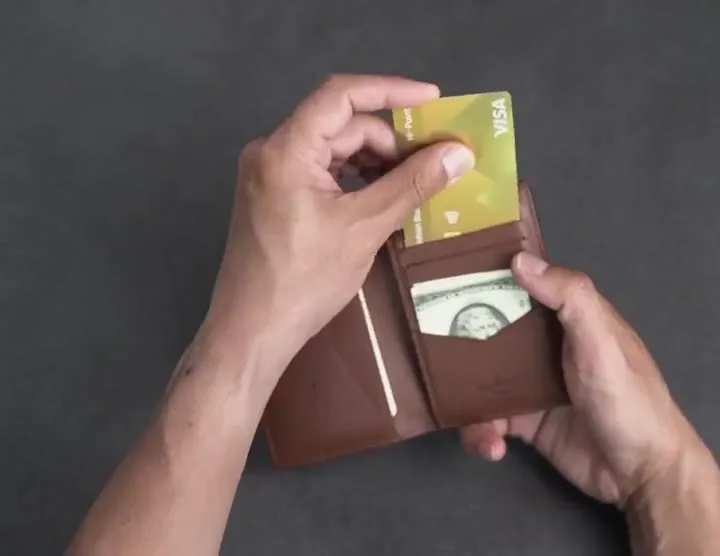
Commutes add repetition. The same coat, the same crowd, the same centimetres. That is the honest NFC-skim stage if you believe in it. It is also the phishing-text stage, which the film ignores. Set bank alerts on the commute as well. They are free and they catch charges the film would never see because the card was tapped with your thumb.
Hotels repeat the bin problem with a desk. Do not leave a closed wallet on a tray and call it shielded from staff. Staff have hands. The film is not a safe. The room safe is a safe. This distinction should not need a heading. Landers make it need one.
Multi-packs are other wallets, not other chips
Three, six, nine, twelve. Those steps are household counts: yours, a partner’s, a travel bag, a parent’s bifold. They are not a stack of twelve films in one leather sandwich. One per compartment, as marketed. If you open only one card from a nine-pack and want to return the rest, ask support in writing how that return works. The checkout we recorded did not reprint a partial-return clause.
Struck-through list prices on that screen — $329.97 beside the nine-pack — are list theatre. This review records them as what the page showed. It does not treat $329.97 as a price anyone pays. $118.99 was the nine-pack total on 6 October 2026. $13.22 each is that total divided by nine. $11.67 each is the twelve-pack story. Live figures move.
Gifts of a single insert need a sentence on the note: centre it with the tap cards, not in the outer pocket; it has no battery; it does not stop phishing. Recipients who expected a GPS wallet received the wrong product. FindZ was extra.
877-633-4331 is the missing policy archive
Support is listed at 877-633-4331. The checkout page did not spell out who pays return shipping or the exact return portal. Those two omissions are larger than they look. A 30-day money-back banner without a label-payer is a banner. Call the number, or better, email if a later page lists one, and ask: when does the 30 days start; who prints the label; can you return eight unused films from a nine-pack; what happens if a film arrives bent. Write the answers next to the order number.
7 to 14 business days from a US warehouse is the FAQ shipping line. Business days skip weekends. Fourteen business days is almost three calendar weeks. A Friday order can miss a trip that looked “two weeks away” on a calendar. If the film is for a flight, count business days backward from the flight, not calendar days forward from the click. Tracking was cited. Tracking is not a faster warehouse.
International delivery times were not detailed on the page we read. If the ship-to address is not the US warehouse’s country, you do not have a window from this review. Ask the number before you pay. Do not use a US 7–14 line as a proxy for a customs queue.
Restocking fees were not named on the Cardian checkout notes we kept. Absence is not proof of zero. ChargeCard’s manufacturer store, on a different product, did name a possible restocking fee. Different seller, different sentence. Ask Cardian’s number about Cardian’s cart. Do not import another brand’s policy.
Keep screenshots of the 6 October 2026 totals if that is when you paid, or of the live totals if you pay later. Direct-to-consumer pages change the struck-through theatre more often than they change the millimetres. The millimetres are the product. The theatre is the cart.
Open bifold, closed field
Blocking, on the manufacturer copy, runs while the wallet stays closed. Opening the bifold at a terminal is how you pay. That open moment is an unshielded moment for the card you present, and possibly for neighbours in the stack depending on how wide the leather opens. We do not have a measurement of a half-open bifold. We have the closed-wallet sentence. Treat open as pay mode. Treat closed as the mode the film was written for.
A waiter who takes the whole wallet away takes the film too, and then the film is in the wrong room. Hand over one card, or tap yourself. That habit is older than 1.1 mm films. The insert does not teach it. The insert does not survive it if the whole bifold leaves your hand.
Contactless terminals that sit at arm’s length still need the card in the 5 cm neighbourhood. You will open the wallet. You will present a card. You will close the wallet. The film’s job, if any, is the minutes on the platform before and after, not the second at the reader. Scoring a product on a job it does not claim to do — paying — is how reviews get silly. This 4.3 is for the closed minutes.
Some people leave wallets open on café tables. The film cannot help an open table. Close the bifold. That is the entire user manual besides “centre it.” There is no app because there is no cell. There is no LED because there is no cell. If you wanted a gadget, you are on the ChargeCard page. If you wanted a trigger, you are on the Code 118 page. If you wanted a film, stay here and close the leather.
Children’s wallets, if you use a multi-pack that way, fail closed-wallet discipline faster. A kid who fans cards to show friends has opened the field. The insert is not a babysitter. A sleeve on the one card they carry may be the better kid SKU. This review will not print a children’s finding the documents did not print.
Struck-through totals are theatre
The nine-pack sat against a $329.97 list on 6 October 2026. Twelve sat against a unit rate we recorded as about $11.67 on a $139.99 total. List prices on direct-to-consumer carts are often reference numbers that never appear as a payable amount. This site records them because they were on the screen. It does not treat them as discounts you “earned.” $118.99 is the nine-pack number that mattered that day. $45.99 is the three-pack number. Compare those to sleeves you can buy without a lander, if one-card carry is actually the job.
Unit rates fall as pack size rises: about $15.33 at three, $15.33 at six ($91.99 / 6), $13.22 at nine, $11.67 at twelve. Wait, $45.99 / 3 is $15.33, $91.99 / 6 is $15.33. The six-pack on that screen was not cheaper per film than the three-pack. The nine-pack was. That is cart design. If you need two wallets, two three-packs at $45.99 is $91.98, a penny off the six-pack’s $91.99. Need four wallets? The nine-pack leaves five spares or a messy split. Do the arithmetic for the number of compartments you have, not for the badge that said most popular if a later page adds one. The notes we kept did not record a “most popular” badge on Cardian. Do not invent one.
Gifts and spares are why twelve exists. Twelve films is a decade of replacements only if you store them flat and remember they exist. A junk-drawer nine-pack is how 1.1 mm products disappear. Put spares with batteries and stamps, not with cables you never sort.
Currency on that checkout was dollars as displayed. Tax and shipping settle live. The FAQ’s 7–14 business days is not a shipping-price sentence. We did not record a shipping dollar amount for Cardian. This review therefore prints none.
Flatness is the fail state you can see
Bent, cracked, or no longer sitting flat: replace. Those three states are the inspection. Hold the film up to a table. If it rocks, it will rock in the stack. If a corner is folded, that corner is a gap. If a crack runs across the middle, you no longer have one interferer; you have two flakes. The three-year tear-proof adjective does not override a crack you can see in month two. Use the 30-day path if the unit arrives that way. Use a spare from the nine-pack if it happens later and the 30 days are gone, then decide whether to call 877-633-4331 anyway.
Wallets flex. Sit-down pockets flex them more. A film that was flat in a new bifold can take a set in a worn one. Check at the same time you throw out receipts. That is the maintenance calendar: whenever the compartment is already open. There is no charge light to notice. There is only geometry.
Do not hole-punch the insert. Do not trim it to fit a tiny pocket. The 1.1 mm object has an area as well as a thickness. The manufacturer’s alongside sentence assumes a card-sized plate. A trimmed strip is an experiment. This page does not score experiments.
Heat in a parked car warps plastic. The documents did not print a storage temperature. Ordinary wallet caution applies: do not leave the bifold on a dashboard. If the film bows after a hot day, flatten it under a book only if it still looks like the product. If it does not, replace it. A bowed interferer is a gap factory.
Photographs of the film next to a ruler, on arrival, are how you prove a 30-day defect if the argument is warp. Support can argue with a memory. It has a harder time arguing with a dated photo. That is not cynicism. That is how missing return-portal copy gets resolved.
Bank alerts still outrank the film
Every closed-wallet insert, sleeve, or metal chamber in this catalog loses to a text from the bank that a tap happened in another city. Turn those alerts on. They are not a Cardian feature. They are the reason a 4.3 can stay a 4.3 without pretending the film is an identity-theft product. The insert addresses a narrow, close-range read while the bifold is shut. The alert addresses a charge after the fact, which is the more common document in the FTC’s world of phishing and account takeover.
Low tap limits, frozen cards in the app, and not storing PANs in random websites are the rest of that list. None of them require 1.1 mm of film. Buy the film if the centimetre-range closed-wallet scene is one you still want to shrink. Skip the film if you wanted a single object to “stop identity theft.” That object does not exist on this checkout, or on the Code 118 checkout, or in a Faraday pouch. The crimes are different.
EMV contactless already made the centimetre skim a smaller prize than it was when magstripes were the whole card. That is public industry history, not a Cardian talking point. It is why this score can be 4.3 for a coherent passive object without rising to 5 for a problem the networks already narrowed. A sleeve remains enough for one chip. The film remains a convenience for a stack. Convenience is allowed. Mythology is not.
If a charge you did not make appears, the film will not be the evidence. The bank will. Call the bank first. Call 877-633-4331 later if you think the insert is relevant, which it probably is not once the card has already been charged. Keep the product in its lane: closed stack, centimetres, no battery, 1.1 mm, 6 October 2026 pack math.
That lane is still a real lane. Crowded trains exist. Closed bifolds exist. NFC exists. A passive interferer is a reasonable category as long as the PDF stays honest about 5 cm and as long as the cart stays honest about FindZ being extra. Cardian’s documents are mostly in that lane. The 4.3 is the lane, not a halo.
Nine inserts at $118.99 on 6 October 2026
Checkout totals below match the order page on . One insert per wallet compartment. Struck-through figures on that screen were list prices.
Pack totals from that day
Three cards $45.99. Six $91.99. Nine $118.99 (~$13.22 each, listed against $329.97). Twelve $139.99 (~$11.67 each). The checkout advertised a 30-day money-back path. Allow the full 14-business-day shipping window if you need the card before a trip. Ask support in writing how a multi-pack return works if you open only one card.

7 to 14 business days from a US warehouse, with tracking, is the FAQ shipping line. International delivery times were not detailed. If a trip is in ten days, the late end of that window is a problem. Call 877-633-4331 before you pay if the date is tight. This review will not invent a faster SKU.
Who pays return shipping, and which portal you use, were missing from the checkout page we read. Those missing sentences can erase the difference between $45.99 and “free return.” Ask. Keep the email. Thirty days from which event — order or delivery — was also not spelled out in the notes we kept. Ask that too.
The 4.3 we attach to this card
We give Cardian The Safe Card 4.3 / 5. Passive film, no battery, and a 1.1 mm footprint are a coherent add-on for a slim wallet you already like. The 9-pack at $118.99 was the rate that page pushed. For a stack in one compartment, the object matches the job the copy describes.
The score is not a lab certificate. The 5 cm field is manufacturer copy. A sleeve already solves one-card carry. Phishing and stolen plastic sit outside the threat model. If you want a no-charge insert for a stack you already carry, the documents describe that object.
4.3 is editorial. See how we review. We compared the checkout, the manufacturer’s passive-shield language, and public contactless range. We did not measure 5 cm. We did not tear a film for three years. We did not treat FindZ as part of the score.
A later page that links a test standard, prints 13.56 MHz, and names who pays return postage would earn a cleaner document score. The hardware category would still be a 1.1 mm insert. This 4.3 is tied to 6 October 2026 and to the decision to leave the bifold in the pocket instead of replacing it with a metal fan. It is also tied to the sleeve remaining enough for one chip, which is why the skip box exists, and to bank alerts remaining the louder tool, which is why the film stays in a narrow lane.
Notes on a 1.1 mm film
No. The manufacturer describes a passive RFID and NFC shield, about 1.1 mm thick, with no charging. Blocking is meant to run while cards stay inside a closed wallet. Intentional tap-to-pay still requires you to remove a card or open the wallet at the terminal. There is no app for the film itself. FindZ, if you add it, is a separate lost-item extra.
The manufacturer markets one insert per wallet because a single card is meant to shield every RFID-enabled card, ID, and passport stored alongside it. Multi-packs are for other wallets, not because each credit card needs its own blocker. Two compartments means two inserts.
The order page listed $45.99 for 3 cards, $91.99 for 6, $118.99 for 9 (~$13.22 each against a $329.97 list), and $139.99 for 12. The checkout advertised a 30-day money-back path. The FAQ cited 7 to 14 business days for US warehouse shipping with tracking. International times were not detailed. Ask 877-633-4331 who pays return postage.
No. Unauthorized-read blocking within about 5 cm is a manufacturer claim. This review does not treat it as a lab result. The page we read did not link a test standard or a frequency range.
If you only carry one or two tap cards, a sleeve already covers the chip and travels with the card when you hand it over. The film stays in the wallet. Use Cardian for a stack in one compartment you do not want to sleeve piece by piece.
No. A closed-wallet interference field does not stop a fake-bank text, a data breach, a pin-pad skimmer, or a thief with hands. Bank alerts and EMV contactless rules are the wider documents.
FindZ is a separate lost-item option that pairs with an app or QR tag. Confirm what ships with the order. It is not the RFID film and it is not part of the 4.3 hardware score.
Centre it in the compartment that holds tap-to-pay cards and ID, not an outer pocket. Blocking, on the manufacturer copy, runs while the wallet stays closed. Replace the insert if it is bent, cracked, or no longer sits flat.
The manufacturer includes passports in the same-compartment sentence. The page we read did not show a passport test method. A dedicated passport sleeve matches a booklet’s shape more closely if that is the job you care about.
The checkout page we read did not spell out who pays return shipping or the exact return portal. Support is listed at 877-633-4331. Ask in writing, including how a multi-pack return works if you open only one card.
No. You place the film inside a wallet you already own. A Faraday bag is a closable conductive pouch you put a device into. Cardian is an interferer among cards, about 1.1 mm thick, with no battery. Leather edges and open pockets are still there. The film does not turn a bifold into a cage.
Not if you follow the manufacturer’s closed-wallet blocking sentence. Remove a card or open the wallet at the terminal for an intentional tap. Keep a transit card in a separate sleeve if you need pocket-tap at a gate.