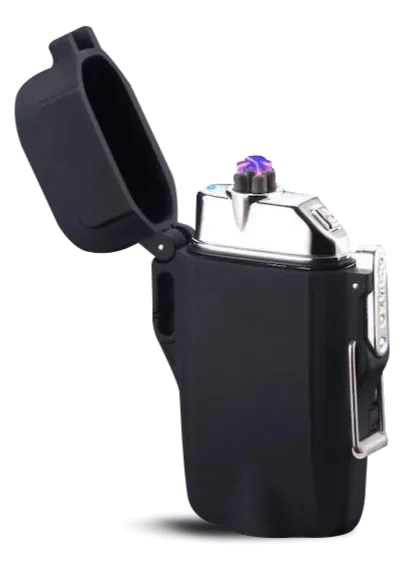
An arc between electrodes is not a butane flame
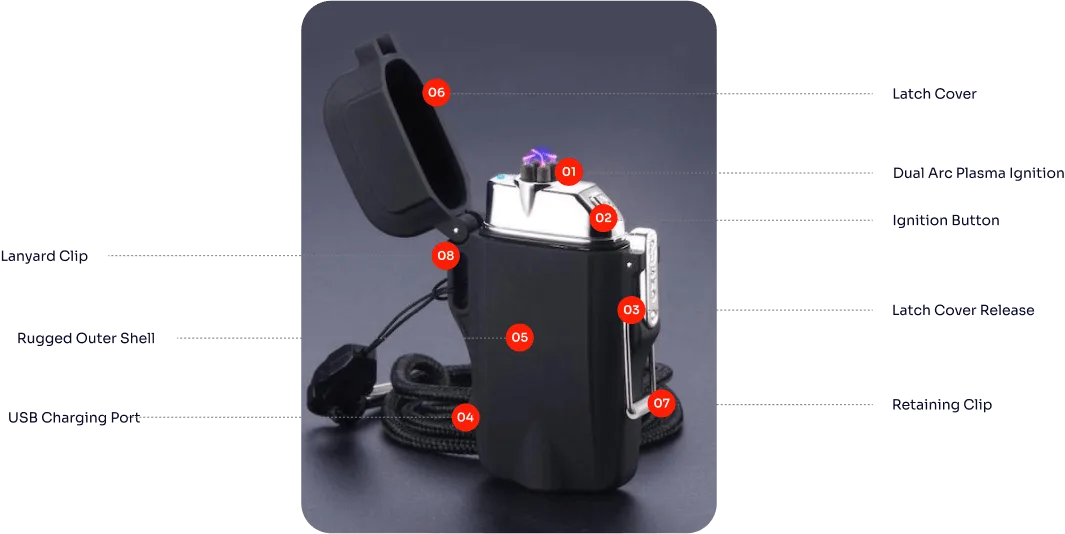
The choice is an electric arc you hold to dry tinder, or a butane flame you can reach into a deep wick. Black Lighter is only the first of those. Open the lid, press the button, and two electrodes throw a crossed plasma beam. There is no reservoir and no refill can. Heat lives in the gap. Hold dry paper, bark, or a wick against those points, or nothing lights.
A butane flame is combustion in air. Fuel mixes with oxygen and keeps burning as long as you feed it. An arc is a current jumping a gap. It is hot in a small volume and it stops when the button stops. That is why wind copy can say the beam is not blown out the way a flame is, and why a deep candle well still laughs at it. You cannot lean an arc into a well the way you lean a flame. You can only bring tinder to the electrodes or bring the electrodes to tinder that sits proud of a rim.
Seller copy cites an arc around 1,800°F. Treat that as a manufacturer figure. This page has no pyrometer reading. Advertorial lines about Tesla coils and military origins are stories, not a spec you can check. The housing is a camouflage ABS brick the seller lists at 2.8 × 1.9 × 0.75 inches, with a Micro USB port, a cable in the box, and a 17-inch lanyard.
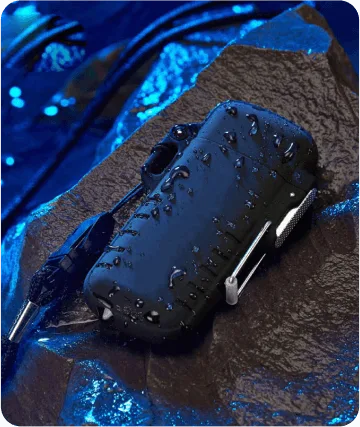
Dual arc means two points and a crossed beam, on that copy. Two points give you a slightly larger hot zone than a single-arc novelty lighter. They do not give you a torch. Wet wood and thick logs without prepared tinder stay a poor match, same as they would for most pocket ignitors. Prepare tinder as if you brought matches. The electronics replace the match head, not the bushcraft. A crossed beam photographs well and still needs fibre against the metal, not hope against a damp log, and not a ten-second hold that warms ABS for a photographer.
There is no fuel to leak in a bag. That is the honest advantage over a butane can that clicks empty at a trailhead. The honest cost is a lithium cell that needs a USB-A brick, a cable that is still Micro USB in 2026, and a habit of storing some charge if the unit will sit for months. Ordinary lithium-ion advice, not a unique warranty term. If you wanted zero cables and a can you can buy at a gas station, butane is still the aisle. If you wanted zero cans and a cable you already carry for older gadgets, the arc is the aisle. This page is the second aisle, scored 4.4 as a compact ignitor for dry tinder, and a miss if you need a visible flame.
Windproof and waterproof as the listing writes them
The product page calls the unit windproof and waterproof. Those adjectives need the sentences around them, not a leap to a dive rating or a gale table.
What the seller actually asserts
A latched ABS lid is said to keep water off the electronics in rain and after brief submersion. The arc is described as staying up in a breeze because it is not an open flame. A safety latch is said to block ignition while the cover is closed. Continued operation after a dunk is marketing language. We have no independent submersion result, and no seal-life test, on this page.
Leave this in the cart if you need a flame
- You light deep hurricane wicks, pipes, or anything that needs a sustained visible fire from a distance.
- Every other gadget you own charges on USB-C and you refuse another Micro USB cable.
- You plan to treat “waterproof” as a swimming spec. Close the lid, dry the body, then plug in — not the other way around.
A closer fit is a camp kit or glove box that already holds dry tinder, and a buyer who wants ignition without a butane can in a hot car. Rain on a closed lid is the story the seller wrote. Rain on an open lid while you hold the button is you pouring water toward electronics. Close it. Dry it. Then decide whether the tinder is still dry, because wet tinder is the usual reason an arc “failed,” not a missing military origin.
Windproof, on this listing, is “not a flame, so wind does not snuff a combustion column.” It is not a knot-rating. A gale that rips tinder out of your fingers will still win. Hold the work in a cup of your hand. That is matches advice. It remains arc advice.
The LED shares the same lithium cell
The same shell hides a water-resistant LED. That is one less short-range light in a small kit — finding kindling, reading a stake, checking a zipper. It is not a headlamp. Runtime is shared with the arc. A long night on the light means fewer button presses left for fire.
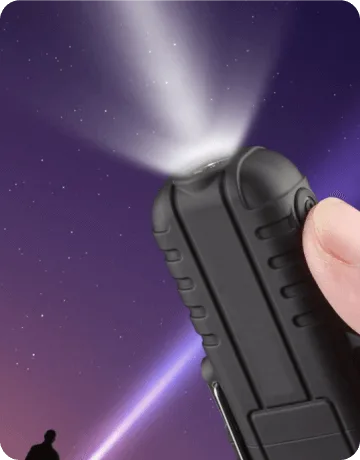
Water-resistant, on the LED, is the same family of seller adjectives as waterproof on the body. There is no lumen number, no IP code, and no runtime table on the pages we recorded. Treat the lamp as a pocket glow, not as a lighting plan. If you need to walk a trail, pack a light that publishes lumens. If you need to find a zipper, this LED is the extra the listing actually named.
Shared cells create a budget. Every second the lamp is on is a second the arc is not funded. The seller’s “up to 500 ignitions” line, discussed below, does not say how many of those remain after an hour of LED. We will not invent a split. Use the lamp briefly. Charge when you can. Store with some charge if the unit will sit.
The support address on the product page is support@electriclighters.com. Write that address if you need the LED and arc described as separate loads. A marketing page will not do that math for you.
1,800°F is a manufacturer figure
Seller copy cites an arc around 1,800°F. Electric arcs can be extremely hot in a tiny channel. A temperature on a lander is still a lander temperature. This review leaves it attributed. Do not read 1,800°F as “it will light anything.” Lighting is about heat transfer into tinder, not about a peak in the plasma. Fine dry fibre lights. A wet log does not. A butane torch with a lower advertised temperature can still light a well because the flame fills the well.
Paper, cotton ball, birch bark, commercial fire starter — those are the fuels that match a gap. Gasoline and stove fuel are not a lighting demonstration this page will describe. This is a pocket ignitor review, not a hazardous-materials card.
ABS plastic around a hot gap is a reason not to hold the button against a nylon tent floor. The listing does not print a maximum duty cycle. Short taps are how the 500-ignition marketing is even imaginable. Holding the beam open drains faster, on the seller’s own distinction. Use taps. Let the plastic be plastic.
Micro USB is the port in the box
Charge from a USB-A wall brick, laptop, or power bank with the included cable. Micro USB is the connector the listing names. In 2026 that is a legacy port. It still works. It is also easy to grab the wrong cable in a bag of USB-C leads. Pack the included cable with the lighter, or you will own a brick that looks charged in memory and is empty on a trip.
Close the lid, dry the body, then plug in. The skip box already said it. Water in a Micro USB jack is how ports die. Waterproof-as-written is a closed-lid story. Charging is an open-port story. Do not combine them.
There is no listed USB-C version on the pages we recorded. There is no listed charge time. FAQ silence is silence. Charge it the night before a trip the way you charge a headlamp you also failed to time. If a later listing prints hours, this paragraph should gain a number. Until then, there is none here.
Power banks that feed phones will feed this cable. A 2300mAh card-shaped pack elsewhere in this catalog could theoretically trickle it. We did not pair those SKUs. We note only that USB-A exists on many bricks. Match the cable you were given.
Five hundred ignitions is a seller count
The seller claims up to 500 ignitions on a full charge. Short taps count as one use; holding the beam open drains faster. “Up to” is doing the usual work. Cold, age, LED use, and how long you hold the button all sit under that ceiling. This page has no cycle test. Treat 500 as a marketing ceiling, then charge more often than your pride wants.
Store it with some charge if it will sit for months — ordinary lithium-ion advice. A cell stored empty can refuse to wake. A cell stored full and hot can age faster. A middle state in a cool drawer is the generic guidance. The listing does not print a storage voltage. Do not invent one.
500 taps is a lot of camp stoves if each stove is one tap. It is not a lot if you hold the button for ten seconds on wet cotton. Technique sets the count. Dry tinder sets the technique. The electronics cannot rewrite that.
The 17-inch lanyard is a leash, not a kit
A 17-inch lanyard is in the box, on the listing. That is a wrist or pack-loop leash so the brick does not vanish into snow. It is not a fire-starting kit. It will not hold tinder. It will not replace the dry fibre you still have to pack. Clip it if you drop things. Leave it off if you hate dangling plastic. Neither choice changes the arc.
Camouflage ABS is a finish. It photographs as outdoors. It does not make the unit a survival course. Kitchen drawers and glove boxes are as valid as camps. The use-case pictures on this page include home and camping because those files exist. They are not a finding that the lighter is a field stove.

Tesla-coil stories are not a spec
Advertorial lines about Tesla coils and military origins are stories. Nikola Tesla’s coils are high-voltage transformers. Dual-arc novelty lighters are consumer electronics in ABS. A lander that glues those sentences together is selling a mood. This review unglues them. The spec you can check is: dual electrodes, USB recharge, no butane, LED in the same shell, Micro USB cable, 17-inch lanyard, 2.8 × 1.9 × 0.75 inches, camouflage ABS. That list is already long enough without a war.
Military-origin copy is a common outdoor-product costume. Unless a NSN, a contract, or a named unit appears — none did on the pages we recorded — treat it as costume. The 4.4 we give is for a compact arc ignitor with a shared LED, not for a pedigree.
The lithium cell still belongs in the cabin
Spare lithium batteries belong in carry-on under FAA packing rules. A USB lighter is a small lithium device. The TSA lighters page is the public document for which lighters go in a cabin bag; rules distinguish installed fuel, spare fuel, and electric units, and they change. Read the current TSA item page before you fly. This review does not reprint a forbidden/allowed table that the agency can update.
Butane spare cans have their own limits. One reason people shop electric is to skip those cans. That reason is real. It does not make the lithium cell a non-battery. Keep the unit on you, not in checked luggage, unless a current agency page says otherwise for this exact category. When in doubt, cabin.
Airline operators can be stricter. A camouflage brick may still be asked about at a checkpoint because it looks like a novelty. Showing that it is a USB lighter, not a torch, is easier if the Micro USB port is visible. Do not argue physics with an officer. Follow the tray.
Dry tinder is the whole technique
Hold dry paper, bark, or a wick against those points, or nothing lights. That sentence from the opening is the manual. The arc is a match head you cannot drop. Tinder still has to take. Commercial fire cubes, cotton, and inner birch bark are the usual list. Wet leaves are not. A log is not. Build a little nest, light the nest, feed the nest. Boy Scout copy, still true.
Stoves with a proud wick or a gas jet you can reach with electrodes will light. Stoves with a deep well may not. Look at the well before you leave the butane torch at home. This product is a miss if you need a visible flame from a distance. The dek already said so. Camping photographs do not override a well.
Indoor use is candles, incense, and gas burners with accessible ports. Deep hurricane glasses remain a flame job. Pipes remain a flame job. If those are daily, keep a flame lighter and do not punish an arc for failing a job it cannot geometrically do.
Candle wells and pipes still want a flame
A butane flame still wins on deep candle wells, pipes, and any job that needs a visible fire you can hold a few inches away. The arc is a short, local hot spot. That is not a defect. It is the mechanism. Buyers who wanted a Zippo-shaped ritual will hate the tap-and-hold. Buyers who wanted no fuel smell in a bag will not.
Shared households should label the object so a guest does not treat it like a flame and wonder why a candle three centimetres down does not light. Guests are the unwritten skip box. Keep a cheap flame lighter in the drawer if guests light cakes. Use the arc for the kit you actually packed tinder into.
Visible flame is also how you know a gas burner is on. An arc is easy to miss in sun. Confirm the burner with the usual cues, not with faith in a beam you cannot see well outdoors. This is safety copy, not a lab.
Hot cars, butane cans, and this cell
A closer fit is a glove box that already holds dry tinder, and a buyer who wants ignition without a butane can in a hot car. Butane cans and heat are a known poor pairing. Lithium cells and heat are also a poor pairing. “Better than butane in a car” is not “happy on a dashboard in July.” Store the unit like a phone: out of direct sun, not on the dash. The listing does not print a car-interior rating. Ordinary lithium caution applies.
Glove-box duty also means months of sitting. Store with some charge. Check it when you check the spare tire. A dead glove-box lighter is a paperweight. A 30-day money-back window will be closed by then. The four-pack at $20.99 each on 3 October 2026 is how some buyers fund a house unit and a car unit. That is cart math, not a survival doctrine.
Cigarette use is a listed category for many arc lighters. This review does not score tobacco. If that is the job, the same geometry applies: hold the cigarette to the electrodes. Wind copy still means “not a flame column,” not “works in a convertible at speed without a cup of hand.”
ABS lid and the safety latch
A safety latch is said to block ignition while the cover is closed. That is the pocket-safety sentence. A butane lighter with a roll wheel can still fire in a bag. This lid-and-latch story, if the hardware matches the copy, is a real category advantage. We did not cycle the latch. If the latch arrives mushy, that is a 30-day issue, not a break-in.
ABS is tough enough for a pocket and soft enough to scuff. Keys will mark camouflage. Marks are not waterproof failures. Cracks at the hinge are. Inspect the hinge when you inspect the port. A cracked lid is no longer the sealed-lid story the wind/water copy needs.
Brief submersion, on the seller’s sentence, is not a swim. It is a drop in a puddle with the lid shut. Open-lid rinses are outside the sentence. Sand in the electrodes will also stop an arc without any water. Brush the points. Do not grind them on a rock. There is no listed replacement-electrode SKU on the pages we recorded.
support@electriclighters.com is the terms archive
Seller marketing cites a 30-day money-back window. Direct-to-consumer return rules move. Read the current checkout, and write support@electriclighters.com if you need the terms in writing before you pay. Ask who pays postage, whether a used unit returns, and whether a four-pack can be split. This review will not invent those clauses.
The crossed-out figure on the 3 October 2026 screen was $59.98 per lighter. Payable totals were $29.99, $53.98, $71.97, and $83.96 for one through four. List theatre is not a coupon you can take to a store. The payable column is the review’s column.
Matches still pack lighter than a brick
A matchbook weighs grams. This ABS brick is 2.8 × 1.9 × 0.75 inches. You pack the brick because you want reusable ignition without a butane can, not because it won a weight contest. Storm matches still exist. Ferro rods still exist. This review does not score those as worse. It scores a dual-arc USB unit as a dual-arc USB unit. If grams are the constraint, matches win. If “I am tired of empty butane” is the constraint, the arc is in the conversation.
Matches also fail wet. So does tinder. The listing’s waterproof sentence is about the electronics under a latched lid, not about the cotton in your kit. Waterproof-the-lighter plus soaking-the-tinder is a failed fire. Pack tinder in a dry bag whether the ignitor is electric or not. That advice is older than USB.
Reusable ignition is the actual category pitch. Five hundred seller-count taps, even discounted heavily, beat a 32-count matchbox on a long trip if the cell stays charged. The cell staying charged is the new failure mode matches do not have. Carry the Micro USB cable. Charge on the power bank you already carry for a phone. That loop is how the brick earns its inches.
Households that light one burner a day may never empty a butane can. They also may never need 500 taps. For them the arc is a gadget. Gadgets can still be 4.4 if they do what they say. They do not have to be essential. Essential is a camping-forum word. This site scores the object against its documents.
Kids and matches are a separate safety talk. An arc with a safety latch on a closed lid is a different pocket story than a strike-anywhere box. This review will not claim childproof. It will repeat the listing: latch blocks ignition while the cover is closed. Verify the latch. Do not treat camouflage as a toy finish.
Stove jets you can reach, wells you cannot
Canister stoves with a jet you can see will take an arc if you can get the electrodes next to the gas. Deep wells, enclosed burners, and hurricane glasses will not. Look at your stove before you leave a flame lighter at home. A photograph of camping on a sales page is not your stove. Your stove is the metal in the garage.
Charcoal chimneys want a flame under a column of paper. An arc can light the paper if you hold the paper to the electrodes first, then put the paper in the chimney. Lighting through the chimney’s holes is a flame job. Sequence matters. The electronics will not reach into the chimney for you.
Campfires want a nest. Build the nest, light the nest, feed the nest. The dual arc is the match. It is not the nest. Wet wood from a riverbank is not a product complaint. It is a woods complaint. Bring dry fibre. Repeat until it is boring.
Gas grills with accessible ports are a maybe. If the port is under a heavy grate, lift the grate or keep a long flame lighter for that job. Do not disassemble a grill because a lander showed a campfire. This 4.4 does not include grill design.
Incense and cotton wicks that stand up are easy. They meet the electrodes. That is the indoor job the home photograph implies. Deep jars remain the skip-box job. Keep both tools if your house has both jobs.
Taps, not a held torch
Holding the beam open drains faster. That seller distinction is the duty cycle. ABS around a gap will warm. Electrodes will warm. A novelty lighter used as a ten-second torch is how novelty lighters die. Tap, light tinder, release. If the tinder did not take, fix the tinder, do not lean on the button.
There is no listed cooldown, no maximum seconds, no thermal cutoff in the copy we recorded. Absence is a reason to be gentle, not a reason to invent a cutoff. If the body is uncomfortable to hold, stop. That is ordinary electronics caution. It is also how you keep the 30-day window from coinciding with a melted hinge.
Dual arc looks dramatic in photos. Drama is not a duty cycle. The crossed beam is two points. Two points still want a short press. Photographers hold buttons. Users should not copy photographers.
LED use during a long press is a double drain. Do not diagnose a “dead” lighter after a night of lamp-plus-arc without charging. The shared cell is the whole story in that sentence. Charge, then decide if the unit failed.
Winter cold reduces lithium delivery. The listing does not print a minimum temperature. Keep the brick in a pocket, not on a snowbank, if you care about the next tap. That is phone advice applied to a smaller cell. It is not a laboratory winter test.
Sand on the points will stop the beam
Electrodes need a gap. Sand, carbon crust, and melted plastic in the gap will stop an arc without any water. Brush the points. Do not grind them on a rock; you will close or widen the gap into something the circuit did not expect. There is no listed replacement-electrode SKU. If the points are bent, that is a support@electriclighters.com photo, not a field repair this page will invent.
Pocket lint is a milder version of sand. A latch that actually stays shut helps. A latch that pops in a bag collects lint. Inspect. The safety-latch sentence is about ignition. It is also, practically, about keeping the gap empty. Two jobs, one lid.
Carbon crust from holding the beam on synthetic tinder is a use pattern. Stick to paper, bark, cotton. If you melt packaging plastic into the gap, you built a insulator. That failure is not waterproof copy failing. It is chemistry you invited.
Salt spray on a boat is corrosion plus sand’s cousin. The listing’s brief-submersion sentence is not a marine rating. Rinse is not in the manual we have. Dry and brush is the conservative move. If you wanted marine, you wanted a printed IP code this page does not have.
Store the unit with the lid latched. Open-lid storage in a junk drawer is how keys kiss electrodes. Camouflage ABS will not warn you. The next tap will.
Four bricks can live in two rooms
Four at $20.99 on 3 October 2026 is a household rate: kitchen, glove box, kit bag, spare. It is not a finding that one person needs four arcs. It is cart design. One at $29.99 is enough to learn whether you will tolerate Micro USB and tinder-at-the-points. Learn on one. Split later if the motion fits your stove.
Gifts of arc lighters need a sentence: not a flame, hold tinder to the points, close the lid before charging, do not dunk. Recipients who wanted a Zippo ritual will return them inside 30 days if the terms still say 30. Include the dek in the note. You will save postage arguments with support@electriclighters.com.
Camouflage on a kitchen counter looks like a toy or a tool depending on the household. If it looks like a toy, the latch matters more. Verify it. If it looks like a tool, the Micro USB cable will still walk away unless you tape it to the brick. The cable is the actual consumable.
Two-packs at $26.99 were the middle rate. Three at $23.99. The drop from one to four is $9 per unit on that screen. Whether $9 buys you a glove-box spare is personal arithmetic. This review only prints the screen.
Do not store all four in a hot attic because a four-pack felt like a bulk buy. Lithium cells in attics age. Ordinary phone-battery caution, again. Drawer, cool, some charge, lid latched. Boring storage is how 500 seller-count taps remain imaginable a year later — still not a bench, still not a promise.
No fuel smell, still a battery smell of caution
No butane means no fuel smell in a camera bag and no hiss in a quiet tent. That is a real comfort. It is not a pass to ignore the cell. Swelling, heat, and a sweet electrolyte smell — if they appear — are lithium warnings, not arc features. Stop using the unit. Write support@electriclighters.com. This review will not print a repair. There is no user-serviceable cell listed on the pages we recorded.
USB lighters as a category dump cheap cells into ABS. This listing does not publish a cell milliamphour, a protection-circuit note, or a UN38.3 paper. Absence is normal on novelty pages and still a documentation gap. 4.4 withholds a higher mark partly because waterproof copy outruns evidence; the silent cell spec is cousin to that gap. We still score the mechanism as honest: it is an arc.
Charging unattended on a mattress is poor practice for any lithium brick. Charge on a hard surface. Unplug when done. That is phone advice. Apply it. The included Micro USB cable is not an excuse to leave the brick on a bedspread overnight because the lander said waterproof.
End of life is a cell that no longer holds a useful tap count. There is no listed battery-replacement program. Recycle it as small electronics where you live. Do not trash a lithium cell into household waste if your locality says otherwise. This page is not a municipal guide. It is a reminder that “no butane” did not mean “no hazardous battery.”
Compared with a disposable butane lighter, the environmental story is reuse versus fuel cans. We do not have a life-cycle study. We have a rechargeable category. Charge it until it dies, then recycle. Do not invent a carbon number.
Guests will treat it like a flame anyway
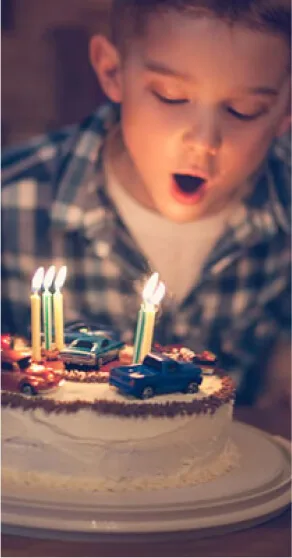
Put an arc lighter on a birthday table and someone will aim it at a deep frosting well. It will fail. They will click longer. The ABS will warm. The skip box already named this job as a miss. Keep a flame lighter for cakes if cakes happen in your house. The 4.4 does not rise if you hide the flame lighter. Cakes still want a flame, whether or not the arc brick is in the same room.
Label the drawer: “hold paper to the points.” Embarrassment is cheaper than a melted hinge inside 30 days — or outside 30 days when support@electriclighters.com asks whether the unit was held open as a torch. Seller distinction: short taps count; holding drains faster. Guests hold. You can tell them or you can keep the brick in the kit bag.
Camouflage finish reads as outdoor tool, which helps in a garage and confuses in a dining room. If the four-pack puts one in the kitchen, a plain explanation sticker beats a lander paragraph. This site will not sell you a sticker. It will tell you the geometry problem is unchanged by camouflage.
Pipes, cigars, and deep candles are the other guest jobs. They want a flame you can point. If those are the household ritual, this SKU is the kit-bag SKU, not the coffee-table SKU. The dek said only the first of those jobs. Repeat it at the table.
A 17-inch lanyard on a dining table looks like a joke. Leave the lanyard on the pack unit. The kitchen unit can live un-leashed in a drawer with the Micro USB taped to it. Two configurations, same arc. The documents allow both because they do not care about your table.
Tape the Micro USB to the brick or you own a paperweight
The included cable is the unlisted consumable. USB-C has eaten bags. Micro USB remains on this SKU. If the cable walks, the 500-ignition ceiling is a memory. Tape it, bag it, or park a USB-A brick in the same kit. A power bank with a captured cable is how travellers actually recharge novelty cells. This review does not require a particular power bank. It requires a cable that still exists on day thirty and day three hundred.
Adapters that swallow Micro USB to present USB-C add bulk and another failure joint. They are allowed. They are not in the box. The box has Micro USB. Plan from the box, then adapt if you must. Do not write support@electriclighters.com that the unit “will not charge” until you have tried the included lead on a known-good USB-A port. Many “dead” bricks are wrong cables. That is not a lab finding. It is how USB-A died in drawers.
Charge time remains unprinted. Night-before charging is the plan that does not need a number. If you remember the brick at the trailhead, you are already late. The glove-box unit should have been charged at the last oil change. Calendar the cell the way you calendar wiper fluid. Boring. Effective. Still not a 500-tap certificate.
Laptop USB-A ports vary in power. Some sleep and cut accessories. A wall brick is the boring charger. The listing allows laptop and power bank too. If a laptop port is flaky, that is the laptop. Try a wall cube before you declare the lighter dead inside the 30-day window. Photograph the port. Support sees a lot of cables. Help them.
Four-packs times one cable each is four cables to lose. Bundle them. The $20.99 unit rate on 3 October 2026 does not include a spare-cable SKU we recorded. The cable in the box is the cable in the box. Treat it as if it were the last Micro USB in the county, because in your bag it might be.
October checkout: one at $29.99, four at $20.99
We recorded these totals on the partner checkout on . The crossed-out figure on that screen was $59.98 per lighter.
Figures from that cart
One unit $29.99. Two at $26.99 each ($53.98). Three at $23.99 each ($71.97). Four at $20.99 each ($83.96). Seller marketing cites a 30-day money-back window. Direct-to-consumer return rules move. Read the current checkout, and write support@electriclighters.com if you need the terms in writing before you pay.
Four at $20.99 is the rate that makes a house-and-car split look cheap. One at $29.99 is the rate for a single kit. Live figures move. The date on this block is 3 October 2026. Shipping and tax were not recorded as a dollar line in the notes we kept, so they are not printed as numbers here.
The 4.4 we give this plasma unit
We give Black Lighter 4.4 / 5. The mechanism is honest about being an arc, not a flame. There is no butane to leak. The flashlight is a real second tool in the same brick. The four-pack on that October screen cut the unit price to $20.99.
The score stays under 4.5 because waterproof copy outruns what we can confirm, the port is still Micro USB, and 500 uses is a manufacturer count. Pack dry tinder. Do not expect a candle-lighter’s reach.
4.4 is editorial, not a user average. The methodology page is the note. We compared the listing’s arc language, the LED-sharing cell, the October 3 totals, and public lithium/cabin context. We did not dunk the unit. We did not count 500 taps. We did not treat Tesla-coil copy as a spec. The score is for a compact dual-arc ignitor with a shared lamp, sold that day at $29.99 or $20.99 in four, with wind and water words left on the listing where they belong. Pack tinder. Close the lid. Keep the cable. Write the support address if the thirty-day window is unclear on the live cart before you pay.
A later listing that prints an IP code, a charge time, and USB-C would be a cleaner document set. The mechanism would still be an arc that needs tinder. This 4.4 is tied to that mechanism being honestly an arc. It withholds a half point because waterproof language outruns a dunk result we do not have, because 500 ignitions is a seller ceiling, and because Micro USB is a cable you can lose. Pack dry fibre. Close the lid before you charge. Write support@electriclighters.com if the live 30-day sentence is unclear.
What the product page still has to answer
No. The seller describes a battery-powered dual arc between two electrodes. There is no fuel to refill. The arc heats dry tinder held close to the points. It is not a sustained visible flame. Deep candle wells and pipes still want a butane or wax flame you can point from a distance.
Those words are seller claims. The copy says a sealed ABS lid keeps water off the electronics in rain or after brief submersion, and that the arc is not blown out the way a butane flame is. This page does not verify submersion or seal life. Dry the unit and close the lid before charging. Open-lid rain and swimming are outside the sentences we recorded.
The checkout we recorded listed a $59.98 list price. One unit was $29.99. Two were $26.99 each ($53.98). Three were $23.99 each ($71.97). Four were $20.99 each ($83.96). Seller marketing cites a 30-day money-back window; confirm the current terms before you pay. Shipping and tax were not a recorded dollar line in our notes, so they are not printed as amounts here.
No. The water-resistant LED shares the same lithium cell as the arc. A long night on the light means fewer ignitions left. There is no lumen or runtime table on the pages we recorded. Treat the lamp as a zipper glow, not as a trail plan, and charge the shared cell before you need either job.
Use the included Micro USB cable on a USB-A wall brick, laptop, or power bank. Close the lid and dry the body before you plug in. Charge time is not printed on the listing we recorded.
It is a seller claim of up to 500 ignitions on a full charge. Short taps count as one use; holding the beam open drains faster. This review does not treat 500 as a bench result.
Usually no. The arc is a short, local hot spot. Deep hurricane wicks and pipes want a sustained visible flame you can hold a few inches away. Hold dry tinder against the electrodes instead.
The seller lists a camouflage ABS brick at 2.8 × 1.9 × 0.75 inches, with a Micro USB port, a cable in the box, and a 17-inch lanyard.
No. Treat 1,800°F as a manufacturer figure. Lighting still depends on dry tinder at the electrodes, not on a peak temperature in a plasma channel.
support@electriclighters.com is the address on the product page. Ask who pays postage and whether a four-pack can be split. Seller marketing cites 30 days; live checkout terms can move.
Spare lithium devices generally belong in carry-on under FAA packing pages. Read the current TSA lighters item page before you fly. Operator rules can be stricter. This review does not reprint a table the agency can change.
No. Advertorial Tesla-coil and military-origin lines are stories. They are not a spec this review will cite. Dual electrodes, no butane, shared LED, and Micro USB are the checkable list.