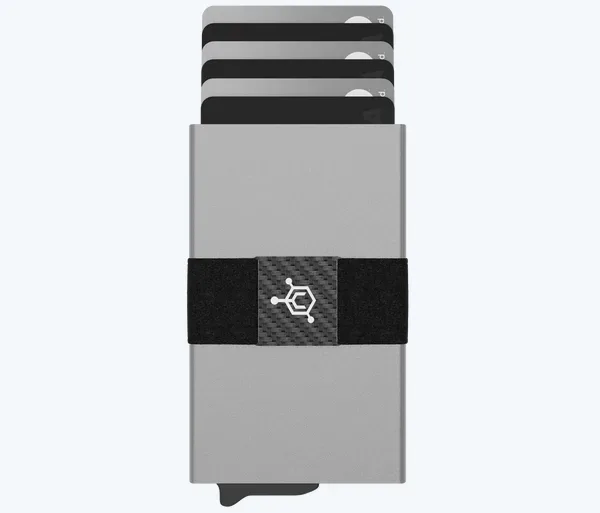
The slide fans the stack; it is not a Faraday bag
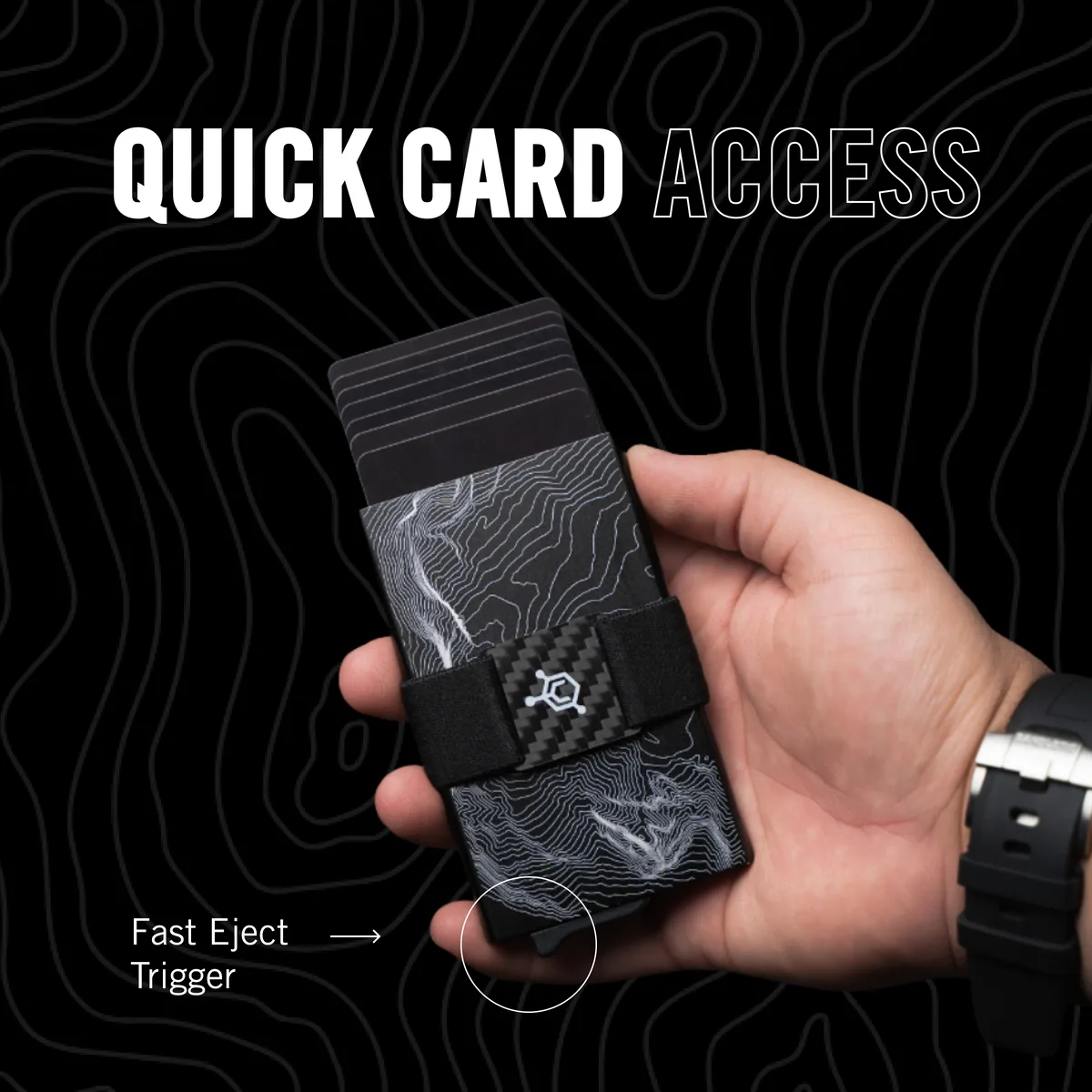
The choice is a metal trigger that fans a short stack, or a sleeve that only covers one chip. This wallet is the first of those. It is not a Faraday bag. People buy a metal cardholder for one motion at a checkout. The manufacturer describes a slide that fans the cards, and a push that seats them. Cards go in through the opening on top. That trigger is the product. RFID language on the sales pages is a different claim.
A Faraday bag is a continuous shielded pouch you drop a device into. Michael Faraday’s cage is a closed conductive shell that redistributes an external field around the interior. A trigger wallet with a metal body and an opening on top is not that shell. You cannot drop a phone into this chamber. You cannot treat the open slot as a faraday pouch for a passport on a hotel desk. Blocking a contactless read while cards stay inside — if the metal does what the manufacturer says — is a narrower job than stopping a stolen card, a phishing text, or a skimmed magstripe.
When you eject a card to pay, it is unshielded for that moment, which is also when the terminal needs to see it. That is not a contradiction. It is the point of a trigger: cards are quiet in the stack and loud at the reader. A sleeve works the same way with more sliding and less theatre.
The manufacturer’s own wording is narrow: “The metal chamber blocks RFID signals around the cards inside.” The spec table says it blocks RFID to prevent card theft. Checkout copy calls the wallet lab tested. The product page we read does not link a laboratory report, a test standard, or a frequency range. We do not treat “lab tested” as a result we can cite. Frequency matters because tap-to-pay and many IDs use 13.56 MHz (ISO/IEC 14443), while older access badges sometimes use other bands. A sentence that says “RFID” without a band is a category label, not a measurement.
Metal around a stack can attenuate a field. Attenuation is not a cage. Gaps, the top opening, and a card sitting high in the fan all change how much signal gets through. This review has no chamber measurement of its own. It has the manufacturer’s sentence, the missing lab PDF, and the mechanical fact of a slide that is designed to present a card to a reader. If you needed a documented Faraday pouch for a phone or a passport, you would be shopping in a different aisle — typically a bag with a conductive fabric and a closeable mouth, sold with that vocabulary on the label.
Theft of the wallet itself is also outside the chamber claim. A metal body does not stop a pickpocket. It does not stop a waiter who walks away with the card you already ejected. Bank alerts, a low daily tap limit, and not handing the card to a stranger still do more against those stories than any trigger. The manufacturer is not claiming otherwise. Advertorials sometimes inflate “lab tested” into a lifestyle of invulnerability. The spec table does not.
A sleeve already covers a single tap card
If the only job is keeping one contactless card quiet in a crowd, a simple RFID sleeve does that job without a trigger, a cash strap, or a multi-pack. You slide one chip in. You slide it out to tap. There is no 20-card banner to decode. Sleeves are thin, cheap, and boring. Boring is a feature when the threat is a centimetre-range read of one chip.
Leave this in the cart
- You want to tap a transit or bank card through a closed wallet.
- You think GPS is built in. It is not. FindZ on checkout and the Tracker Card are separate add-ons.
- You carry coins in the chamber. The manufacturer sells a separate tray for coins and keys.
- You need more than a short daily stack and you are not buying the backplate.
A closer fit is someone who keeps 1–7 daily cards in a pocket, wants a metal shell and a fan trigger, and will eject a card before tapping. Cash and a couple of extras can sit under the silicone strap. The standard wallet does not snap onto a phone; MagSafe is a separate type on the same product page. If your daily carry is one debit card and a state ID, the sleeve argument is strong. If your daily carry is a fan of badges, hotel keys, and two banks, the trigger argument is at least a real mechanism.
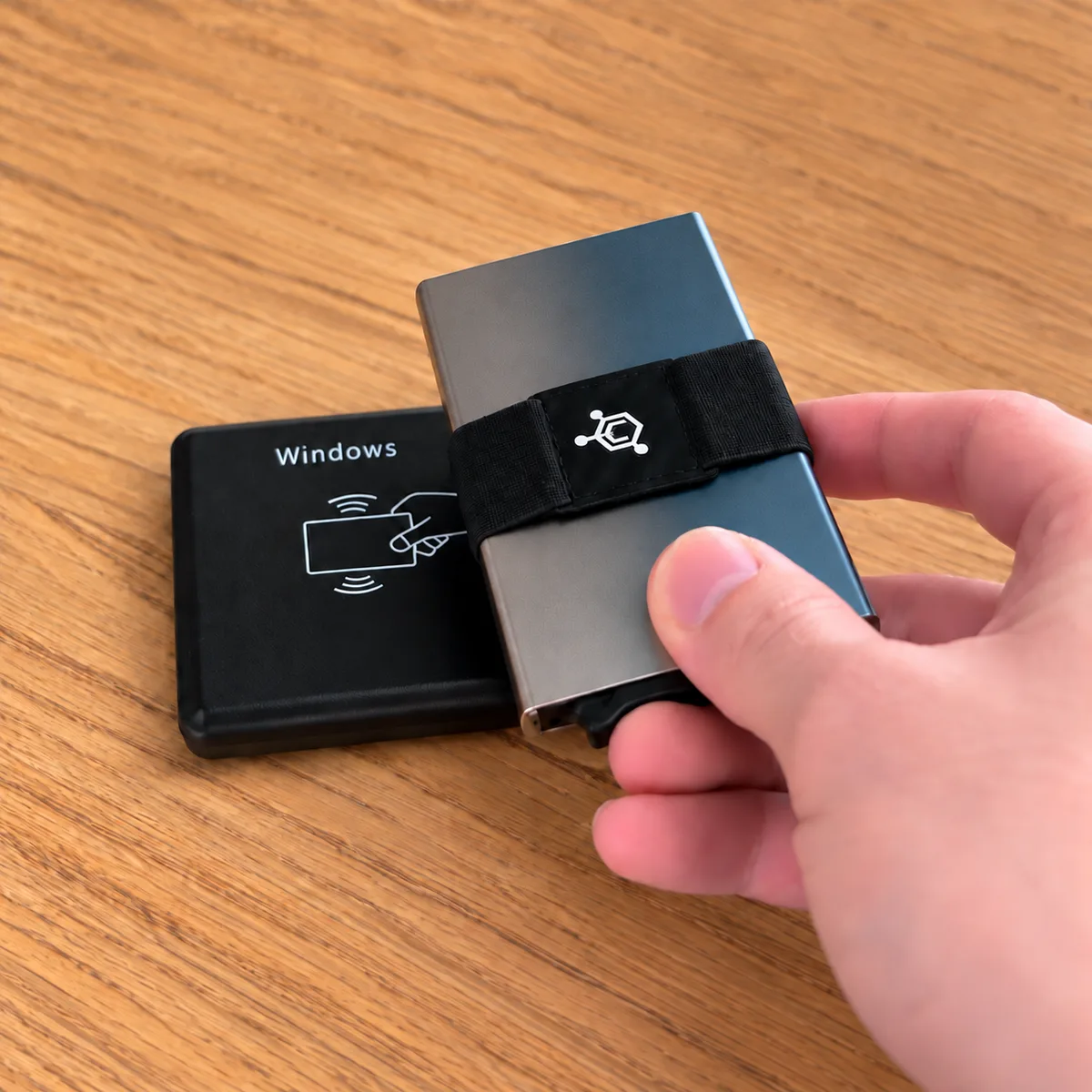
Closed-wallet tap is a different design. Some fabric wallets are sold specifically so a transit card can stay in a pocket and still hit a gate. This metal chamber, on the manufacturer’s blocking sentence, is the opposite of that design. You should not expect a closed Code 118 to pay a subway reader. Eject, tap, seat. If that extra motion is annoying at a gate you use twice a day, a sleeve on the transit card in an outer pocket is simpler, and you can still put bank cards in a trigger if you want the theatre for those. Mixing a sleeve and a trigger is allowed. The lander does not mention it because the lander is selling a chamber, not a commute.
One-chip households should stop at the sleeve. Multi-card commuters who already eject cards at grocery readers are the people the slide was drawn for. Everyone in between can wait until they know which group they are in. A four-pack will not decide it for them, and neither will a limited colorway on the cart. Count the stack first. Then decide if you wanted a trigger at all. Keep the box nearby until day thirty.
13.56 MHz tap dies in centimetres, not city blocks
Contactless payment cards that follow ISO/IEC 14443 talk to readers at 13.56 MHz over a short range — typically a few centimetres, which is why you have to hold the card near the terminal. EMVCo’s contactless specification is the payment-industry document for that tap. Dynamic cryptograms on modern EMV contactless cards limit replay of a captured tap. That does not make skimming impossible in a carefully staged close-range attack. It does make “someone read my card from across the train car” a poor default story.
The FTC’s phishing guidance is the more common identity-theft document: fake banks, fake shipping texts, data breaches. Those attacks do not care whether your wallet is aluminum. A blocking chamber, a sleeve, or a Faraday pouch will not stop a text that asks you to “verify” a card. Put the Code 118 claim in that context or the lander will over-teach the threat.
Older magnetic stripes are still on many cards and are still readable by a swipe skimmer when you hand the plastic over. The chamber does nothing once the card is in someone else’s machine. Chip-and-PIN and tap-to-pay were the industry’s answers to magstripe copies. This wallet is not those answers. It is a metal stack with a slide.
NFC also covers more than banks. Hotel keys, some workplace badges, and passport chips use related 13.56 MHz families. The manufacturer says the chamber blocks RFID around cards inside. It does not publish a list of which card types it measured. A passport is thicker than a CR80 bank card and may not even fit the chamber; the spec table we recorded does not list passport carry. If passport shielding is the job, a dedicated sleeve or a zippered inner pocket is the documented tool, not an assumption about this trigger.
Range claims on advertorials sometimes jump from centimetres to “anywhere in a crowd.” Physics does not jump with them. Power, antenna size, and orientation set the read distance. Payment terminals are designed to work when you intend a tap. A hidden reader in a backpack would have to get close, stay close, and still face EMV’s dynamic codes. That is a narrower risk than the banner’s “prevent card theft” line, which also covers pickpockets the metal cannot stop. This review keeps the risk statement narrow on purpose.
Twenty on the banner, fewer in the chamber
The partner checkout advertises a slim profile that holds 20 cards plus cash. Embossed cards are thicker than flat ones. A metal chamber fills faster than a number on a banner. Count the daily stack before you pick a bundle. Unembossed contactless cards are thinner; loyalty stamps and hotel keys are often thicker; a transit card with a worn sleeve is thicker still. Twenty is a maximum in a sales sentence. It is not a promise that twenty embossed bank cards will fan cleanly.
0.29 inches is the depth the spec table listed on 6 October 2026, on a body 3.9 × 2.3 inches. That is a slim metal wallet, not a bifold. Slim is why the twenty-card headline is the first number to distrust. You can physically compress a stack. You cannot compress metal walls. When the stack hits the wall, the trigger either strains or the last cards stay home. This site did not load cards into a chamber. The geometry is visible in the published depth.
Each bundle included matching free expansion packs — one with the solo wallet, two with the duo, three with the best-deal pack, four with the ultimate pack. The order summary did not spell out what is inside each pack. Finishes from slate grey through limited colors are a cart choice. They do not change the chamber count. If the pack is extra cards, a second shell, or a strap, the live listing has to say so. This review will not guess.
A short daily stack of 1–7 cards is the range this review already named as a closer fit. That range is not a manufacturer spec. It is an editorial reading of a 0.29-inch chamber and a twenty-card banner that cannot both be taken at face value for embossed plastic. If you already carry twelve cards every day, look at the backplate accessory or a different form factor. If you carry three, the banner’s twenty is marketing air.
6061-T6 and 3K carbon are a chassis, not a pouch
On 6 October 2026 the spec table said 3.9 × 2.3 × 0.29 inches, 6061-T6 aluminum and 3K carbon fiber, a quick-deploy trigger, and a silicone strap for cash, extra cards, or receipts. Included with the wallet: the cash strap. Tracker, backplate, multi-tool, leather case, coin tray, and AirTag strap were listed as extras. The advertorial’s “quarter inch” and “5X lighter and stronger than steel” lines are not on that table, and the table does not list a weight.
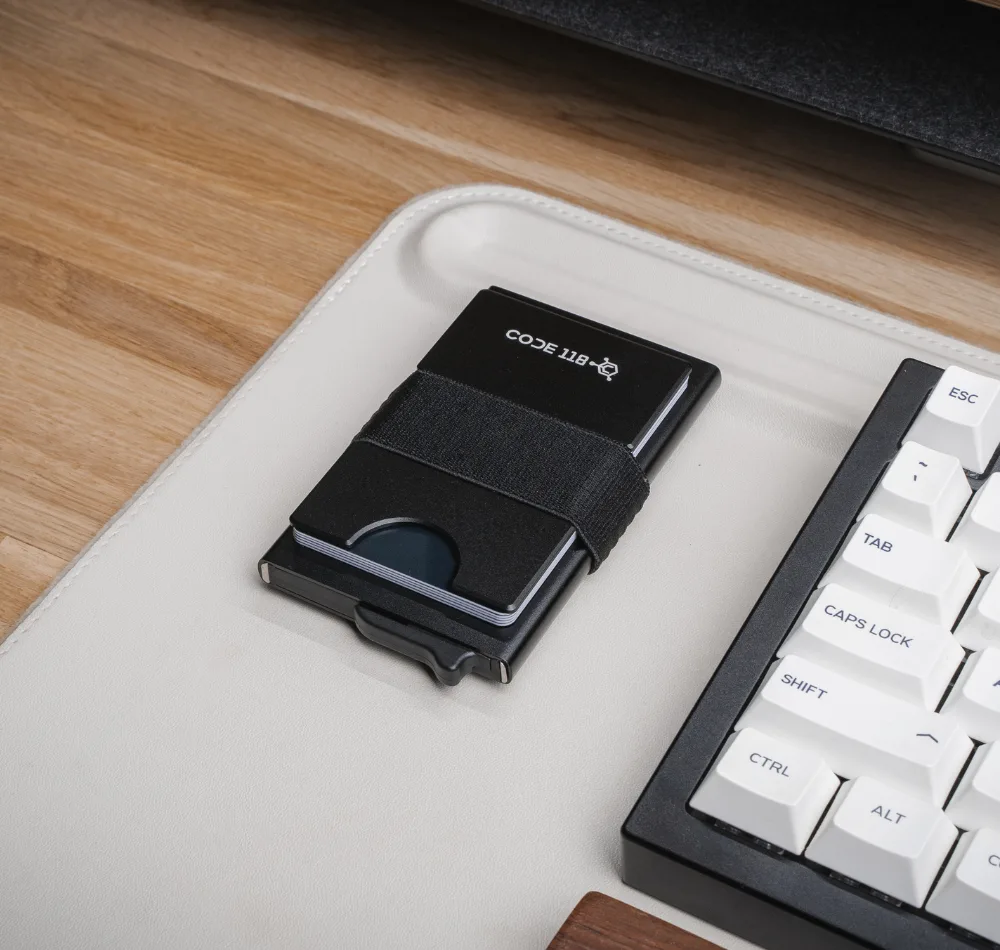
6061-T6 is a common heat-treated aluminum alloy used in bicycle parts and machined plates. 3K carbon fiber describes a tow size in a decorative or structural weave. Together they make a rigid chassis. Rigid is why the fan motion can be a single slide instead of a leather fold. Rigid is also why dropped corners ding, and why sitting on a rear pocket is a harsher idea than it is with a bifold. The spec table does not list a drop test. Do not invent one from the alloy name.
Advertorial “5X lighter and stronger than steel” is the kind of comparison that needs a density table and a strength test to mean anything. The spec table does not provide either. Aluminum is lighter than steel. Carbon fiber can be stronger than some steels in some directions. “5X” on a lander is not a citation. This review ignores it. Quarter-inch on an advertorial versus 0.29 in on the table is at least in the same neighbourhood; 0.29 in is 0.29 in, not a rounded quarter used as poetry.
No weight on the table is a real omission for a pocket object. Stainless cards, aluminum wallets, and carbon clips all feel different in a front pocket. We cannot print ounces we were not given. If weight is why you buy or skip, weigh the unit when it arrives and use the 30-day path if the number is wrong for your pocket. That is the same advice this site gives when campaign pages disagree on mass.
Carbon fiber on a wallet is often a veneer. The spec table names 3K carbon fiber without saying whether it is the structure or a plate on aluminum. Either way, the blocking sentence is about the metal chamber, not about the weave’s resin. Do not read carbon fiber as an RFID feature. Read it as a finish and, possibly, a stiffener.
Cash lives under the silicone strap
Included with the wallet: the cash strap. The spec table says the silicone strap is for cash, extra cards, or receipts. That is an exterior band, not a billfold pocket. A few folded notes will sit. A night’s worth of mixed bills and receipts will sit less happily. Rubber stretches and eventually creeps. The table does not list a replacement strap SKU. If the strap is why you skip a conventional billfold, inspect it when the box opens and decide whether it is a band or a gimmick for your actual cash habits.
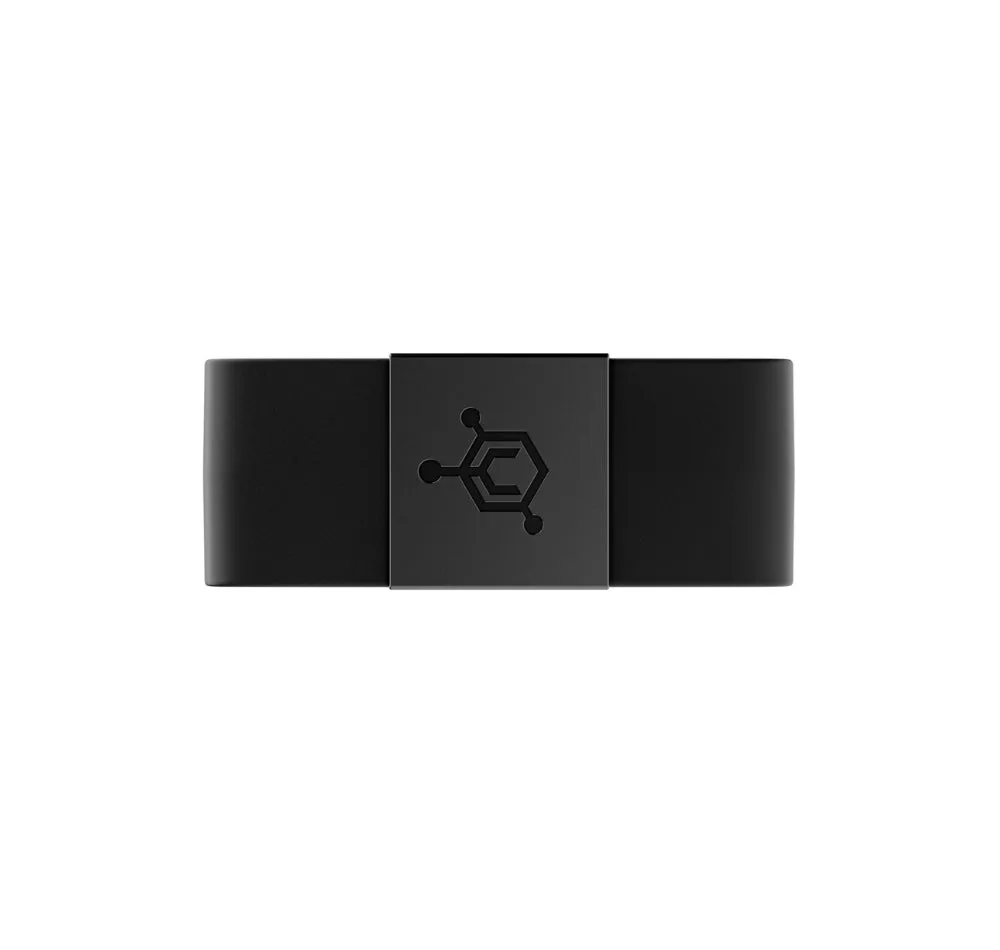
Extra cards under the strap are outside the metal chamber. They are therefore outside the manufacturer’s “blocks RFID signals around the cards inside” sentence. A contactless card under the strap is as tap-able as a card in a shirt pocket. That can be useful for a transit card you want to tap without ejecting. It is the opposite of a blocking claim. Do not mix those jobs without noticing.
Receipts under silicone will curl and transfer ink. That is paper, not a defect. If you keep receipts for expenses, a phone photograph still beats a stretched band. The strap is a clip for things you already decided are temporary.
GPS is an add-on, including FindZ
The checkout offered an optional FindZ tracking add-on. A Tracker Card that pairs with Apple Find My or Google Find Hub is sold separately. Buying the wallet alone does not put a tracker in your pocket. Landers that talk about never losing the wallet are talking about an extra SKU, an extra battery or tag, and an extra privacy surface. This review scores the trigger wallet, not the tracker.
Apple Find My and Google’s Find Hub networks are public products with their own account rules. A third-party card that “pairs with” those networks still has to be set up in those apps. This page is not a Find My manual. Confirm on the Tracker Card listing which network, which phone OS, and whether the card has a replaceable cell. None of those answers were on the wallet order summary we recorded on 6 October 2026.
FindZ on the checkout was a checkbox, not a chip in the aluminum. Optional Lifetime Protection sat beside it and mentioned loss, damage, porch theft, and FindZ alerts. That checkbox was not required to complete the order. Protection plans are contracts. Read the contract. Do not treat a pre-checked box as GPS in the chassis.
A tracker card also needs a slot. If the chamber is already at the banner’s “twenty,” adding a tracker card is twenty-one. If the chamber is honestly a short stack, the tracker is one of the 1–7. Either way, it is thickness the 0.29-inch body has to swallow, and it is a radio you chose to carry. Radios that help you find a lost wallet can also be a beacon. That trade is yours. It is not bundled.
MagSafe, the coin tray, and the AirTag strap are other SKUs
The product page lists extras: tracker, backplate, multi-tool, leather case, coin tray, AirTag strap. MagSafe is a separate type on the same page. The standard wallet does not snap onto a phone. If a photograph shows the wallet on the back of an iPhone, look at which SKU the photograph is selling. Accessory sprawl is how a $34.99 four-pack unit rate becomes a different cart.
Coins in the card chamber are a scratch and a jam. The manufacturer sells a separate tray for coins and keys because the chamber is for cards. Keys against 3K carbon and 6061 aluminum will mark both. If coins are daily carry, you needed a coin pocket before this page. The tray is an admission of that, not a reason to force change into the fan.
An AirTag strap is for Apple’s tag, which is another radio, another battery, and another object on the outside of the wallet. It is not the Tracker Card. It is not FindZ. Three locating stories on one product page do not mean any of them ship in the base bundle. Count the line items.
The leather case, if you add it, puts a sleeve around a metal wallet. That can soften the pocket and hide the carbon. It can also add the very bulk the 0.29-inch pitch was written to avoid. This review has no measurement of the case. It has the fact that the case is an extra.
Expansion packs the order summary did not open
Matching free expansion packs scaled with the bundle: one, two, three, or four. The order summary did not list contents. Until a packing list or a live bullet names the parts, treat “expansion pack” as an unopened box inside the box. It might be straps. It might be a second shell. It might be card sleeves. Guessing would violate the rule this site writes under.
Multi-pack math is clearer than pack contents. Four wallets at $139.98 was $34.99 each on 6 October 2026. That rate is why the four-pack exists as a headline. It is a household or gift rate, or a “one in each bag” rate. It is not evidence that one person needs four chambers. One wallet at $49.99 is the rate for a single daily carry. Two at $99.99 is the same unit rate as one. Three at $119.98 is $39.99 each. The discount, on that screen, lived in the three- and four-packs.
Colorways — slate grey through limited colors — do not change RFID language, trigger geometry, or chamber depth. Limited colors are a scarcity costume. If a finish sells out, the mechanism is supposed to be the same. If a listing ever ties a finish to a different interior, that would be a new document. It was not the document on 6 October 2026. Photograph the finish you were charged for; limited names on a lander sometimes outlive the SKU in the warehouse.
Theft on the banner is several crimes at once
The spec table says the chamber blocks RFID to prevent card theft. “Card theft” is a bundle of crimes. A pickpocket takes the wallet. A table-thief takes the card you set down. A skimmer copies a magstripe you handed over. A phisher talks you into typing a number. A close-range NFC read, if it happens, is one more item on that list — and it is the only item a metal chamber even pretends to address, and only while the card stays inside.
Bank and network rules already push contactless payments toward single-use cryptograms. That is why a stolen tap snapshot is a weaker prize than a photographed PAN, expiry, and CVV from a phishing kit. The chamber does not hide the number printed on the front of the card. If you fan the stack under a camera, the camera can see what the radio cannot. Privacy at a checkout is still a hand over the plastic, not an alloy name.
Lost-wallet stories are why FindZ and the Tracker Card exist as extras. Locating a bag is not blocking a tap. Do not let a lander merge those sentences. A tracker helps after the theft of the object. A chamber sentence, at best, is about a radio while the object is still in your pocket. After the wallet is gone, the chamber’s claim is over, and the bank’s freeze line is the tool.
None of this is an argument that blocking film or metal is useless. It is an argument that the banner’s theft word is larger than the mechanism. Buy the trigger for the trigger. If you buy it as an anti-theft amulet, you will still need alerts, PINs, and the habit of not handing cards to strangers. Those habits are free and older than 6061-T6.
Workplace badges add a second radio story. Some offices still use low-frequency fobs. Some use 13.56 MHz. The spec table does not say which it measured. If a badge must be readable through a pocket to open a door, this chamber — on the manufacturer’s inside-the-metal sentence — is the wrong pocket. Keep the badge in a clip. Keep bank cards in the fan if you want the fan.
The open top is not a closed cage
Cards go in through the opening on top. That opening is how the product works. It is also why Faraday-bag language fails. A cage with a mouth still leaks at the mouth. How much it leaks is a measurement this page does not have. The manufacturer did not publish that measurement either. What we have is geometry: an open slot, a fan that raises cards toward that slot, and a slide you operate at a terminal.
TSA bins and hotel desks are the scenes where people put a wallet down. An open-top metal stack in a bin is visible and grabable. It is not stealth. A Faraday pouch with a zipper is a different object in that bin: the phone or passport is out of sight and, if the pouch is honest, out of radio. This wallet is a shiny brick. Treat airport and hotel set-downs as ordinary wallet hygiene. Do not expect the carbon weave to hide the object.
Rain, pockets, and lint go in the same opening cards use. The spec table does not list an IP rating. Silicone strap and aluminum will shrug off a splash better than an unlined cloth bifold, but the chamber is still a slot. If you dump the wallet in a wet jacket, dry it open. That is care, not a warranty term we were given.
Because the top is open, a thin card can ride high enough that a close reader might see it even when you did not eject — or might not. We will not pretend to know which. The manufacturer’s instruction implied by the blocking sentence is still: cards inside are the shielded set; cards presented are the paying set. If a card sits half-out, it is neither. Seat the stack after every tap.
Children, bag dumps, and inverted pockets will empty an open-top holder faster than a zippered coin pocket. The trigger that makes checkout fast also makes spill easy. If you carry over a boat dock or a subway grate, a zippered pouch is the boring backup. The Code 118 listing does not replace it.
0.29 inches versus a bifold you already own
0.29 in is about 7.4 mm. A stuffed bifold can be thicker than that and still feel like a wallet because leather flexes. Metal at 7.4 mm is a block. Front-pocket denim will show it. Rear-pocket sit will announce it. The slim-profile banner is relative to a fat leather billfold, not relative to nothing in the pocket.
3.9 × 2.3 in is close to ID-1’s 3.37 × 2.13 in outline, plus the extra the mechanism needs. The wallet will not disappear under a smaller card. It will occupy a phone-sized patch of pocket. If the reason you left leather was bulk, measure this block against the bifold you actually carry, not against an empty photo of a slim wallet. Loaded leather versus empty metal is a dishonest photograph on every site that sells either.
A backplate accessory, listed as an extra, exists because some buyers want more capacity than 0.29 in. Adding a backplate is how a slim pitch becomes a sandwich. We do not have the backplate’s depth. We have the fact that it is not in the base bundle. If your stack already wants a backplate, you are not the 0.29-inch customer. You are the “I still want a trigger” customer, and the cart will be larger.
Household four-packs at $34.99 each make more sense if the 0.29-inch object is a one-bag tool: gym, travel, everyday, spare. They make less sense if you intend to fill all four with twenty cards. Four stuffed chambers is a lot of plastic and a lot of missed banners. Count cards per human, not cards per headline.
The trigger motion is the whole product
Everything else on the page — RFID verbs, GPS checkboxes, carbon photographs — orbits a slide that fans cards and a push that seats them. If that motion is satisfying and reliable with your stack, the wallet has done the job this review can verify from the documents. If the motion bites a knuckle, drops a card, or refuses embossed plastic, no alloy name will save it. The 30-day path is for that discovery.
Mechanical wallets fail at springs, slides, and corners. The spec table does not list a cycle rating. There is no published number of fans before the action loosens. Machined 6061 can last a long time or loosen at a set screw we cannot see in a hero image. Keep the box. If the slide is gritty on day two, that is a return, not a break-in story you owe the brand.
Checkout speed is the honest pitch. One-handed fan at a grocery reader is the demo. Gloves, rain, and a bus lurch are the real demo. This site did not stand in a bus. You will. Try the motion where you actually pay before the 30 days are a memory.
A sleeve has no motion to fail. A bifold has a fold. This product has a trigger. Buy a trigger only if you wanted one. That sentence is the whole review in miniature. RFID and GPS are the ornaments the lander uses to keep you scrolling. The manufacturer still described a slide first.
If you already own a metal trigger wallet you like, this page is not a reason to replace it. If you own a sleeve and one card, this page is not a reason to graduate. If you want a short stack in aluminum with a strap for a few notes, and you accept that twenty is a banner, the 6 October 2026 checkout at least sold that object — with extras clearly listed as extras, which is more than some landers manage. Keep the receipt. Load the cards you actually carry. Fan them at the reader you actually use. That sequence is the review the documents cannot finish for you, and it still is not a lab, a Faraday certificate, or a GPS radio in the chassis.
Find My is a network, not a chip in the aluminum
Apple Find My and Google Find Hub are account-based networks. A third-party Tracker Card that “pairs with” them still has to be added in those apps, kept charged or cell-replaced, and allowed to use Bluetooth and location permissions you already decided to grant. None of that is in the Code 118 base wallet. The aluminum does not join a network by being aluminum.
Lost-item networks also create a privacy surface. A tag that helps you find a wallet is a radio other people might scan with the same network’s “unknown item” warnings. Apple and Google publish their own anti-stalking notes for that reason. This review is not a stalking guide. It is a reminder that buying a tracker card is a radio decision, and that the wallet checkout’s FindZ checkbox is a second radio decision, and that neither ships because you wanted a trigger.
Lifetime Protection copy that mentions FindZ alerts is blending a paid plan with a locating extra. Read whether alerts require the add-on, an app, and a subscription. The 6 October 2026 summary did not reprint that contract. Absence here is not proof the plan is empty. It is proof we will not summarize clauses we did not save.
If you already carry an AirTag on a key ring, an AirTag strap on this wallet is redundant unless you want the tag on the wallet instead of the keys. Moving a tag you own is free. Buying a second tag because a lander photographed one is not. The extras list is a menu. It is not a packing list for the $49.99 single.
Base-wallet buyers who never touch those extras still get the slide, the strap, and the chamber sentence. That is the SKU this 3.9 describes. Tracker photography on a product page is how a 3.9 object is sold as a 4.5 story. Stay with the SKU.
Eject, tap, seat is a habit, not a setting
There is no app that puts the wallet in “pay mode.” The habit is mechanical. Eject the card you mean. Tap. Seat the stack so nothing rides high in the open top. If you share the wallet with a partner, both of you need that habit. A card left fanned in a restaurant is an ordinary lost-card story with a more expensive prop.
Transit gates that expect a pocket tap will punish this habit. You will miss a train once, then you will keep a sleeve in the coat for the transit card and the metal wallet for the banks, or you will stop using this wallet on that commute. Either outcome is fine. Pretending the chamber is a pocket-tap wallet is not fine. The manufacturer’s blocking sentence already told you.
Contactless limits on the bank side — dollar caps, online alerts — remain the useful settings. They live in a banking app, not in 3K carbon. Set them whether you buy this wallet or a paper sleeve. This review will not print a cap we were not given by a bank. It will say the wallet does not replace one.
Embossed numbers and raised holograms catch on metal edges. If a card scrapes every time it fans, that card may want to live under the strap or in a sleeve. The twenty-card banner will not sand the hologram down. Your stack will teach you which cards are trigger-friendly. Use the 30 days for that lesson, not for a second unused wallet in a drawer.
Gifts complicate the habit. A four-pack at $34.99 each is a gift-shaped rate. Recipients who wanted a bifold will not magically want a trigger. Include the eject-tap-seat sentence on the note if you give one. Include the “not a Faraday bag” sentence if the lander they saw used that word. You will save a return.
Four wallets at $34.99 on 6 October 2026
Checkout totals below match the partner order page on , before shipping and tax. Each bundle included matching free expansion packs.
Figures from that order page
One wallet $49.99. Two $99.99. Three $119.98 ($39.99 each). Four $139.98 ($34.99 each). The checkout advertised a 30-day “love it or return it” path that day, plus an optional Lifetime Protection checkbox (loss, damage, porch theft, FindZ alerts) that was not required to complete the order. Read the current terms before you pay.
Documents this review used
- Partner checkout and spec table on 6 October 2026 — dimensions, materials, trigger, strap, extras, bundle totals.
- Manufacturer wording that the metal chamber blocks RFID around cards inside.
- ISO/IEC 14443 and EMVCo contactless for the centimetre-range tap context.
- FTC phishing guidance for the theft stories a chamber does not stop.
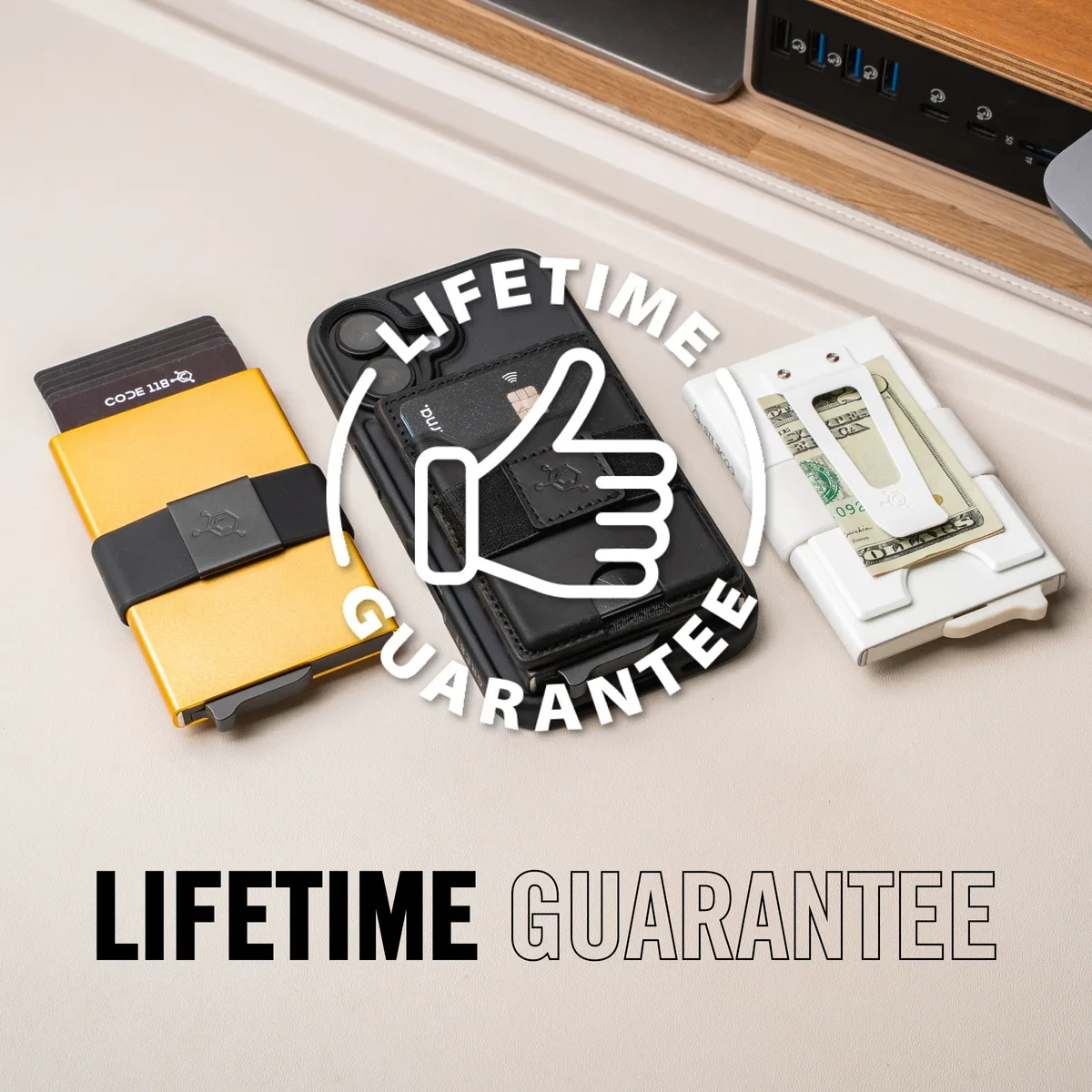
“Love it or return it” is a slogan until you read whether return shipping is paid, whether used wallets come back, and whether a four-pack can be split. Those sentences were not fully reprinted on the summary we captured. Ask in writing. Thirty days is short if the wallet is a gift in transit. It is long enough to load your actual stack and see whether twenty was a banner or a count.
The 3.9 we print for this trigger
We give the Code 118 Wallet 3.9 / 5. The trigger, the aluminum-and-carbon body, and the cash strap are a real cardholder. $34.99 each on the 4-pack is the lowest rate we recorded. For a short daily stack and a buyer who will eject before tapping, the object matches the job.
The score stays under 4 because the 20-card headline overreaches, GPS is an upsell, and RFID copy is not a Faraday bag. If a sleeve already covers the one chip you care about, you do not need this chassis. If you want a metal fan at checkout and you will count your cards, the listing at least describes a trigger.
3.9 is editorial. It is not a user average. The methodology page is the scoring note. We compared the checkout, the spec table, and the manufacturer’s chamber sentence with public contactless range and phishing context. We did not open a lab report because the product page did not link one. “Lab tested” remains a phrase. It is not a frequency, a millimetre of attenuation, or a card-count for embossed plastic, and this score does not pretend it is.
A later listing that publishes a frequency range, a chamber card-count for embossed plastic, a weight, and tracker-in-box clarity would be a different document set. This score is tied to 6 October 2026 and to the extras staying extras. It is not a finding that tap-to-pay is unsafe without a metal wallet. The centimetre-range, EMV-backed tap is a narrower risk than the banner implies. Phishing, magstripe skimmers, and pickpockets remain the louder documents, and they do not live in 6061-T6.
Before you eject — notes from the Code 118 pages
No. The useful mechanism is a slide that fans cards out of a metal body. The manufacturer says the chamber blocks RFID signals around cards inside, which also means you should eject a card before a terminal can read it. That is not a Faraday pouch you drop a phone into. A Faraday bag is a closable conductive shell. This wallet has an open top on purpose.
The checkout advertises up to 20 cards plus cash. Embossed cards are thicker than flat ones, so the metal chamber fills faster than the banner. Each bundle included matching free expansion packs; the order summary did not list what is inside each pack. A short daily stack is the honest fit for a 0.29-inch body. Count the cards you actually carry before you trust a headline.
No. The checkout offered an optional FindZ tracking add-on. A Tracker Card that pairs with Apple Find My or Google Find Hub is sold separately. Buying the wallet alone does not put a tracker in your pocket. Those extras are radios and accounts, not properties of the aluminum chassis.
Not if you take the manufacturer’s blocking sentence seriously. Cards inside the metal chamber are the ones the copy says are shielded. Eject the card, tap, then seat it. A contactless card under the exterior silicone strap is outside that chamber sentence.
For one tap card, yes. A sleeve covers a single chip without a trigger or a multi-pack. The Code 118 chassis is for a short stack you want to fan, not for a one-card problem.
3.9 × 2.3 × 0.29 inches, 6061-T6 aluminum and 3K carbon fiber, a quick-deploy trigger, and a silicone strap. The table did not list a weight. Advertorial “quarter inch” and “5X lighter and stronger than steel” lines are not on that table.
Four were $139.98, or $34.99 each, before shipping and tax. One was $49.99. Two were $99.99. Three were $119.98 ($39.99 each). Expansion packs scaled with the bundle; contents were not itemized on the order summary.
No. The optional checkbox mentioned loss, damage, porch theft, and FindZ alerts. It was not required to complete the order. The checkout also advertised a 30-day love-it-or-return-it path. Read both before you pay.
The manufacturer sells a separate tray for coins and keys. The chamber is described for cards. Coins will scratch and jam a fan trigger. Keep change out of the stack.
No. MagSafe is a separate type on the same product page. The standard wallet does not snap onto a phone.
No. A chamber sentence about RFID around cards inside does not stop a fake-bank text, a data breach, a magstripe skimmer you handed the card to, or a pickpocket. EMV contactless already limits replay of a tap. Phishing remains the common document.
No. The silicone strap is exterior. Extra cards, cash, and receipts there sit outside the manufacturer’s “cards inside” blocking sentence. That can be useful for a transit card you want to tap without ejecting.