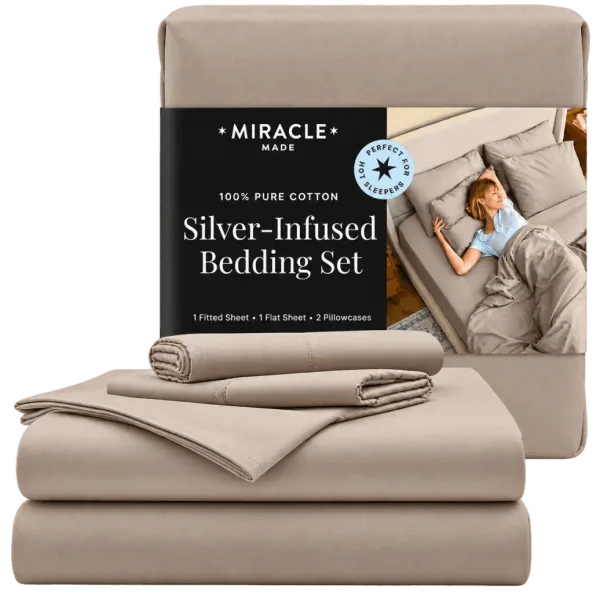
Silver is described as spun into the yarn
Miracle Brand’s pitch is not a rinse-on finish. The listing says pure silver ions go into long-staple cotton while the yarn is made, so the metal is inside the fiber rather than sitting on top. When the cloth gets damp from sweat or humidity, that copy says the ions disrupt bacterial cell walls and slow odor-causing microbes. That is the mechanism as the brand wrote it. This page does not publish an independent test of that mechanism, a kill-rate protocol, or a residual-silver measurement after fifty washes.
Sprayed-on silver and woven-in silver are different manufacturing stories. A spray can wear off. A yarn that includes metal is the story this listing wants you to remember, because the wash interval they sell — two to three weeks — depends on the metal staying put. “Stays in the fiber” is their sentence. A lab report that would let this review repeat it as a finding is not on this page.
Odor-causing microbes are a freshness claim. Infection-causing microbes are a medical claim. The listing talks about the first. It does not turn the sheet into a treatment for the second. Keep those nouns apart when a banner says 99.9%.

What antimicrobial labeling does not prove here
The same page uses “self-cleaning,” a 99.9% figure, and “fresher up to three times longer.” Those are brand lines. This review has no independent kill-rate study and no medical indication. A silver-ion sheet remains a sheet. It does not treat infection, eczema, or allergies, even though the listing mentions sensitive skin and dust-mite food sources. If new bedding irritates your skin, stop using the set and use the 100-night return window.
Dust-mite food sources show up in bedding ads because mites eat skin flakes, and a story about fewer microbes is easy to stretch into fewer mites. This review will not complete that stretch. A sheet is not a mite protocol. Encasing, washing, and a clinician’s advice for allergic asthma sit in a different column. If the listing mentioned mites as a reason the silver matters, read it as marketing adjacency, not as an allergist’s handout.
Sensitive skin is the other adjacency. OEKO-TEX Standard 100, named on this listing, is a chemical screen. Hypoallergenic is a brand word. Neither one is a dermatology visit. If you react to new cotton, dyes, or finishes, the 100-night window is the undo. Do not keep sleeping on a rash because a banner said antimicrobial.
500-thread sateen is the cloth, not a clinic label
The documented fabric is long-staple cotton in a 500-thread sateen weave. Sateen is a smooth, slightly lustrous face. It is not flannel and not a jersey knit. If you want a winter nap or a t-shirt hand, this listing is the wrong cloth. Long-staple is a fiber-length word: longer cotton fibers can make a smoother yarn. It is not a farm name, and this page does not have a country-of-origin or gin-to-mill trail to add.
Five hundred threads is a mid-to-upper count in the consumer sateen aisle, not a 1,200-thread race. Thread count without yarn ply can be gamed. This listing gives you 500 and sateen and long-staple and does not give ply. That is enough to know the intended hand: smooth, slightly shiny, cotton. It is not enough to call the sheet a lab textile. It is certainly not enough to call it a clinic product.
OEKO-TEX Standard 100 is named. The Standard 100 explainer is the public document: a list of harmful substances, a product class, a certificate. This listing names the standard and does not print the certificate number. Ask if you want to look it up. Hypoallergenic remains a brand word beside it.

Colors on the spec table are White, Sand, Sky Blue, and Stone Grey — solids only. An older FAQ line also said “and more,” so confirm the swatch on the checkout. Deep pockets are listed at up to 18 inches. A mattress plus topper thicker than that is outside the claim. Fitted sheets that pop off a tall pillow-top are a sizing miss, not a silver miss.
Sateen pills, snags, and shines according to use. Pets, zippers, and toenails are ordinary sateen enemies. The listing does not publish a pilling test. Gentle wash and low dry are the care settings they did publish. If you wanted a rustic linen slub, this face will look too polished. If you wanted a matte percale crunch, sateen is the other weave. Buy the cloth you actually like to sleep under. The silver story is an add-on to that cloth, not a reason to sleep under a hand you hate.
Two-to-three weeks is the brand's laundry interval
Care is two settings: machine wash cold, tumble dry low. Because the silver is described as inside the yarn, that wash is not framed as rinsing a coating off. The listing does not publish a cycle count, a detergent ban list, or bleach rules. If you bleach whites as a household habit, ask the brand before you pour. This review will not invent a bleach permission slip.
The advertised interval is every two to three weeks instead of weekly. That is a freshness claim. A spill, an illness, or a bed that smells off to you is still a reason to wash sooner. The listing does not say a weekly wash harms the silver. It only says you can go longer — and that water, detergent, and dryer time are the extras the brand is selling back. If you like weekly sheets, you can still wash weekly. You will use the silver story less and the sateen more.
This set is the wrong buy if
- You want a medical antimicrobial product, a night-sweat treatment, or a sheet that treats eczema.
- You need flannel, jersey, or a printed pattern. Sateen solids are what is sold.
- Your mattress stack is thicker than the 18-inch pocket on the listing.
- A Twin at $109 is more than you will spend on bedding.
Illness in the bed is the case banners skip. Vomit, fever sweat, or a contagious rash is a wash-now case in every ordinary household. A 99.9% freshness line does not make a sheet a quarantine protocol. Wash. Dry hot if your clinician says heat matters for a particular germ — and ask the brand whether high heat is allowed, because the care line this review used says tumble dry low. Low is the published setting. High is your question.
Detergent choice is unpublished beyond the absence of a ban list. Mild, no bleach, no fabric softener is the conservative habit for any finish you want to keep. Softener coats fibers and can flatten sateen’s face. This page will not invent a brand-name detergent. If they sell a paired wash, that wash is not in the recorded cart and is not part of the score.
Two to three weeks also assumes one bed, one sleeper habit, and no pets in the sheets. Two people, a dog, and summer humidity are a different freshness clock. Trust your nose over the banner. The brand is selling fewer laundry days. You are the one who sleeps there.
Treated-article labeling is not an EPA clinic claim
In the United States, a product that claims to kill microbes on or in the body, or to protect people from bacteria as a health benefit, generally sits in pesticide-regulation territory. The EPA’s public pages on antimicrobial pesticides are the starting documents. A “treated article” — a textile with a preservative meant to protect the article itself from odor-causing growth — is a narrower idea. The treated-article exemption is about protecting the product, not about treating the person. This review is not a legal memo and will not declare where Miracle Sheets sits in that filing system. It will say the obvious consumer thing: self-cleaning, 99.9%, and fewer laundry days are brand labeling on a sheet. They are not a clinic note, and they are not a reason to skip medical care.
If a banner reads as if the bed were sanitizing you, read it back as a freshness claim about the cloth. The listing’s own mechanism sentence is about ions and bacterial cell walls when the cloth is damp. That is a description of a textile story. It is not a diagnosis, not a wound dressing, and not an EPA-registered hospital disinfectant this page has a registration number for. We do not have an EPA Reg. No. on the copy we used. If that number exists, the brand can show it. If it does not, do not invent a hospital use.
FTC advertising rules are the other public rail. Health and antimicrobial claims in consumer ads are supposed to match competent evidence. This review is not an FTC complaint. It is a reminder that a 99.9% figure without a linked method is a figure you should leave in quotes. “Up to three times longer” is an “up to.” Self-cleaning is a metaphor for a sheet you still wash. Wash it.
Silver as a metal in textiles has a long industrial history — odor control in socks, wound-dressing research in clinics, and consumer bedding that borrows the shine of the clinical work. Borrowing is the problem. A sock that smells less is not a diabetic-foot treatment. A sateen sheet that the brand says stays fresher is not an infection treatment. This page will keep the clinical work in the clinic and the sateen in the bedroom.
Twin billed at $109, Split King at $149
Seven mattress sizes sit on the listing. Twin includes one pillowcase. Every larger size includes two, plus a fitted sheet, a flat sheet, and a free 3-piece towel set. Queen is marked most popular on the checkout we recorded. Those are the contents. A free towel set is a promotion. It is not a reason to score the sateen higher, and a third-party seller may not repeat it.
Size totals on that listing
Twin and Twin XL $109 (shown against $204). Full $119 (against $214). Queen $129 (against $224). King and Cali King $139 (against $235). Split King $149 (against $250). The 100-night window is a product return in your own bed, not a clinical trial. Third-party sellers may not repeat the towel set or that window — read the current checkout.
Twin and Twin XL share a $109 line. Full is $10 more. Queen is $10 more than Full. King and Cali King share $139. Split King is $149. The jumps are small relative to the Twin entry. If you are on the fence between Queen and King, the recorded gap is $10. If you are on a split-king adjustable base, $149 is the SKU that names that mattress, not a King you hope will drape. Split King means two twin-long fitteds in most bedding aisles; confirm that the listing’s Split King is two fitteds before you pay. This page does not reprint a piece-count table beyond fitted, flat, pillowcases, and towels.
Strike-through “was” numbers — $204 through $250 — are list-price theater. The paid totals are $109 through $149. Confirm the current screen. Tax was not recorded here, so it is omitted. Shipping was not a separate paid line on the copy we used; if freight appears at checkout, believe the checkout.
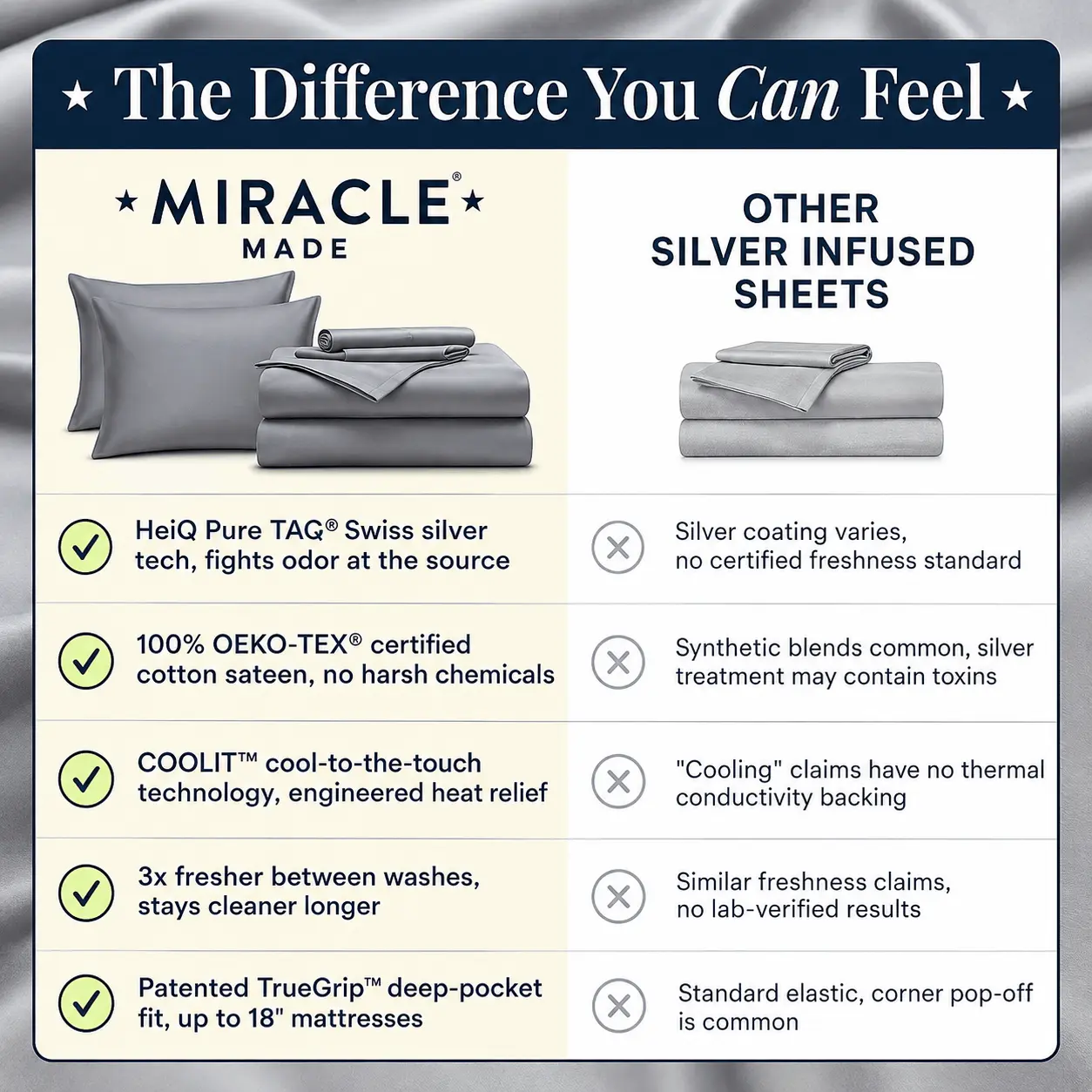
Deep pockets, towel set, and the 100-night window
Deep pockets are listed at up to 18 inches. Up to is the hedge. A 16-inch mattress plus a 3-inch topper is already outside 18. Measure the stack, not the mattress SKU on the box. Extra-deep aftermarket bands exist because brands print a number and tall beds ignore it. If your stack is 20 inches, this set is the wrong fitted sheet. Silver in the yarn will not make a short pocket taller.
The towel set is free and 3-piece on the listing. Piece names beyond “towel set” are not broken out on the copy this review used — bath, hand, and wash is the usual 3-piece, and this page will not invent those labels if the brand meant something else. Treat the towels as a promo bundle. They are not sateen sheets. They are not part of the 500-thread story unless the brand says the towels also carry silver, which this page does not document. Wash them as towels.
One hundred nights is a product return in your own bed. It is not a clinical trial, not a sleep study, and not a finding that the silver worked. It is a long comfort window. This page does not say whether the clock starts at order or delivery, who pays return postage, whether washed sheets are accepted, or whether the towel set must come back. Ask those questions before night 99. Keep the carton if you can. Photograph the fitted sheet on the mattress if pocket depth is the complaint.
A long window is useful for sateen, which can feel slick the first week and ordinary the fourth. It is also useful for a freshness claim you can only judge after you skip a wash. If you get to night 40 and the bed smells like a bed, you have learned something the banner cannot tell you. If you get a rash on night 3, stop. The window is still there. Skin first.
Third-party sellers may not repeat the 100 nights or the towels. A marketplace copy at a different total is a different policy. This score attaches to the listing we recorded. Read the seller you are paying.
Solids only: White, Sand, Sky Blue, Stone Grey
Four named solids sit on the spec table. White is the hotel-photo default. Sand is a warm neutral. Sky Blue is the cool named color. Stone Grey is the darker neutral. An older FAQ line said “and more,” which is how colors come and go on a direct-to-consumer cart. Confirm the swatch before you pay. This review will not invent a seasonal fifth color.
Prints, stripes, and kids’ patterns are not on that table. If you wanted a patterned set, this listing is the wrong cloth. Dyes on sateen can look different in warm bedroom light than on a calibrated screen. Sand and Stone Grey are the ones that shift most on phones. White shows wear and bleach spots. Sky Blue shows fade if you ignore the cold-wash line. None of that is a lab result. It is how solid bedding behaves.
Matching the towel set to the sheet color is unpublished. The towels may be white regardless of sheet color. If a matched bath is the reason you clicked the bundle, ask. This page will not invent a towel dye list. The sheets are the scored object. The towels are the promo.
White is also the color people buy when they want to see cleanliness. A freshness claim plus a white sheet is a strong ad. It is also how coffee drips become a 100-night question. Cold wash, low dry, and a stain treat the brand allows — if they allow one — are the care path. Do not assume chlorine on a silver-yarn white is allowed. Ask.
Cooling copy without a temperature study
Cooling copy — moisture-wicking, heat leaving the bed, cool to the touch — is fabric language. There is no temperature study on this page, and the set is not sold as a treatment for night sweats. Sateen can feel cool when you first slide in and then hold heat the way any dense cotton can. Percale is the weave people name when they want a drier crunch. This listing is sateen. Believe the weave more than the adjective.

Night sweats that soak a shirt are a clinician topic — infection, medication, hormones, sleep apnea. A sheet that wicks, if it wicks, is still a sheet. Do not delay care because a banner said heat leaves the bed. If you run warm and you like sateen anyway, you can like this cloth and still wash it when it is damp. The two-to-three-week interval is a freshness claim, not a permission to sleep in a wet sheet.
Moisture-wicking on cotton is a finish or a knit story more often than a sateen story. This listing uses the phrase. This review does not have a wicking test. Cool to the touch is how a lot of sateen feels in a showroom. In a closed bedroom in July it may feel like cotton. Your thermostat is still the cooling product you already own.

Layering a wool blanket over sateen will undo any cool-to-the-touch first impression. The sheet is one layer. The room is the rest. This review will not score a bedroom. It will say the documented cloth is 500-thread sateen with silver described as part of the yarn, and that cooling remains copy without a study here.
Cold wash, low dry, and the habits the care line skips
Machine wash cold, tumble dry low: two settings, no cycle count, no detergent ban list, no bleach rule. That is the entire published care card this review used. Conservative habits fill the blanks. Mild detergent. No fabric softener, because softener coats fibers and can flatten a sateen face. No chlorine on white unless the brand says yes — and this page will not invent that yes. Ask before you pour. Silver described as inside the yarn is their reason a wash is not framed as rinsing a coating off. A harsh bleach habit is still a way to weaken cotton.
Weekly wash is allowed even though the banner sells two to three weeks. The listing does not say a weekly wash harms the silver. It says you can go longer. If you like weekly sheets, wash weekly. You will use the freshness story less and the sateen more. If you go three weeks, trust your nose. Two people, a dog, and July humidity are a different clock than one sleeper in a cool room. A spill is a wash-now case. Illness in the bed is a wash-now case. A 99.9% line does not make a sheet a quarantine protocol.
High heat is the question this care line leaves open. Tumble dry low is the published setting. Clinicians sometimes want heat for a particular germ on cloth. If that is your instruction, ask the brand whether high heat is allowed. This review will not tell you to ignore a clinician, and it will not tell you to ignore the printed low setting. That conflict is a brand email, not a guess on this page.
Fitted sheets with 18-inch pockets take a long time to dry on low. Do not ball the set in a small dryer and call it done. Damp sateen in a closed closet is how cotton smells. The two-to-three-week interval assumes you started from a dry set. If the set never fully dried, you did not buy fewer laundry days. You bought a mildew experiment. That experiment is not a silver finding.
Closer fits and the beds that skip this sateen
A closer fit is someone who already likes sateen, wants a cotton set with a named Standard 100 mark, is curious about silver described as part of the yarn, and will use a 100-night window as a real undo — including sending the set back if the freshness claim does not match the bed. Twin from $109 on the recorded listing is the entry. Queen at $129 was marked most popular. Split King at $149 is the adjustable-base SKU if the listing’s Split King is truly two fitteds. Confirm that piece count.
Leave it if you want a medical antimicrobial, a night-sweat treatment, or a sheet that treats eczema. Leave it if you need flannel, jersey, or a print. Leave it if the mattress stack is thicker than 18 inches. Leave it if $109 for a Twin is more than the bed is worth to you. Those skips are already in the box above. They are the whole audience filter. The 4.7 is not a reason to talk yourself past them.
Kids’ beds, bunks, and dorm twins are Twin and Twin XL at the same $109 line. One pillowcase on Twin is the contents. A second case is your extra. Deep pockets help on a cheap tall mattress. They do not help if the student will bleach whites in a shared laundry. Ask the brand about bleach before that first Sunday. This review will not invent a dorm protocol.
Hot sleepers who already hate sateen will hate this sateen. Cooling copy without a temperature study will not convert them. Percale is the weave they usually want. This listing is sateen. Buy the hand you like. Silver in the yarn is an add-on to that hand, not a reason to sleep under a cloth you already know you kick off.
People with open wounds, post-surgical beds, or a clinician’s instruction for sterile linen are in a medical column. A consumer sateen set with antimicrobial labeling is not hospital linen this page has a registration number for. Stay with the linen the clinician named. The 100-night window is a product return, not a wound protocol.
What ships in the box besides the named weave
Every size includes a fitted sheet and a flat sheet. Twin includes one pillowcase. Every larger size includes two. A free 3-piece towel set rides along on the listing we recorded. Piece names beyond “towel set” are not broken out here. Bath, hand, and wash is the usual three, and this page will not invent those labels if the brand meant something else. The towels are a promo. They are not documented as 500-thread sateen, and they are not documented as silver-in-yarn. Wash them as towels. Do not assume they match Sand or Sky Blue. They may be white regardless of sheet color. Ask if a matched bath is why you clicked.
Split King is the SKU that most often surprises people. In most bedding aisles it means two twin-long fitted sheets plus one oversized flat. This page does not reprint a piece-count table that confirms that split. If you sleep on an adjustable base with a gap down the middle, write the brand before you pay $149. A single King fitted at $139 will not cover two moving halves. The $10 gap between King and Split King is the recorded step for that question. Use it only after the piece count is clear.
Cali King and King share the $139 line. They do not share dimensions. A California King is longer and narrower. The fitted sheet is not interchangeable. If your mattress is Cali, buy Cali. If you guess King because the price is the same, you will own a fitted sheet that fights the corners. The 100-night window can undo that guess if they accept a used, washed miss. Ask before you guess.
Eighteen-inch pockets are “up to.” Measure the stack: mattress plus topper plus pad. A 14-inch mattress looks safe until the 4-inch topper goes on. Extra-deep aftermarket straps exist because this miss is common. Silver in the yarn will not lengthen a short pocket. If the fitted pops off on night two, that is a sizing complaint to photograph on the bed, not a freshness complaint.
Self-cleaning, 99.9 percent, and other banner math
Self-cleaning is a metaphor. You still wash the set. The brand’s interval is two to three weeks instead of weekly. That is fewer laundry days, not zero. A sheet that never meets detergent will meet skin flakes, sweat, and whatever you ate in bed. The silver story, as they wrote it, is about ions and bacterial cell walls when the cloth is damp. It is not a dishwasher. It is not an autoclave. Keep the metaphor in quotes when you decide when to wash.
Ninety-nine point nine percent is a figure that needs a method: against which organism, on which surface, after how many hours, after how many washes. This page does not have that method. Leave the number in quotes. “Fresher up to three times longer” is an “up to.” Best case in a banner is not a typical night in your room. This review will not convert either figure into a finding.
The EPA’s antimicrobial pesticides page is the public rail for products that claim to kill microbes as a health benefit. A treated article meant to protect the cloth itself is a narrower idea. This review will not file Miracle Sheets into either bin. It will say we do not have an EPA Reg. No. on the copy we used. If the number exists, the brand can show it. If a banner reads as if the bed were sanitizing you, read it back as a freshness claim about the cloth.
OEKO-TEX Standard 100 is the mark that is actually named and actually checkable if they send a certificate. It screens for a list of harmful substances. It does not mean the set treated your eczema. Hypoallergenic remains a brand word. Sensitive skin and dust-mite food sources on the listing are adjacency, not a handout from an allergist. If the set itches, stop. Use the 100 nights. See a clinician if the skin does not settle. This site is not a clinical source.
Miracle, as a brand name, is a mood word. The documented object is 500-thread long-staple sateen with silver described as spun into the yarn, seven sizes, an 18-inch pocket claim, a towel promo, and Twin from $109. Stay inside that object and the review stays honest. Step into miracle-as-verb and you are writing a treatment outcome this page will not print.
The long send-back without a clinic script
One hundred nights is a product return in your own bed. It is long enough to feel sateen after the slick first week, and long enough to judge a two-to-three-week wash interval more than once. It is not a sleep study. It is not a finding that silver worked. Write the delivery date on the carton. Ask whether the clock starts at order or delivery, who pays return postage, whether washed sheets come back, and whether the towel set must return. Ask those questions before night 10, not night 99.
If the fitted pops off, photograph it on the mattress with a tape on the stack. Eighteen inches “up to” is a hedge you can measure. If the color is wrong, say so early — Sand and Stone Grey shift on phones. If the cloth itches, stop. Skin first. The window is still there. If the bed smells like a bed at day 21, you have learned something the banner cannot tell you. That lesson is a keep-or-return fact, not a 99.9% fact.
Third-party sellers may not repeat the 100 nights or the towels. A marketplace copy at a different total is a different policy. This score attaches to the listing we recorded. Read the seller you are paying. Keep the carton if you can. A set stuffed into a shopping bag on night 98 is a harder conversation than a set in the box it arrived in.
Do not stretch the window into a medical trial. Infection, eczema, night sweats, and allergic asthma stay with a clinician. A sheet does not treat them. If a banner made you hope otherwise, the 100 nights are how you undo the purchase, not how you prove a treatment. This site is not a clinical source. If you kept the set through a rash because you wanted to “give the silver time,” you gave a textile time on irritated skin. Stop. Write the brand. See a clinician if the skin does not settle. The window is a return clock, not a protocol, and a clock does not diagnose a rash. Keep the towels in the same file if the listing made them part of the box. A missing promo set can turn a clean return into an argument. This page does not say the towels are required back. Ask. Bag them with the sheets if you are unsure. The 3-piece set is free on the listing we recorded. Free is still inventory on their side of the desk.
A bedroom textile is still a bedroom textile
Long-staple cotton, 500-thread sateen, silver described as spun into the yarn, OEKO-TEX Standard 100, seven sizes, an 18-inch pocket claim, a towel promo, Twin from $109, Split King at $149, a 100-night return — that is the documented object. Self-cleaning, 99.9%, fresher up to three times longer, moisture-wicking, heat leaving the bed, cool to the touch — that is labeling and fabric language. This review scores the object. It leaves the labeling in quotes.
Hospital disinfectant, wound dressing, sterile linen, and EPA-registered antimicrobial products are other objects. We do not have an EPA Reg. No. on the copy we used. We do not have a kill-rate paper. We do not have a residual-silver measurement after fifty washes. Asking the brand for those documents is fair. Inventing them on this page is not. The EPA antimicrobial pesticides page is the public rail if you want the category language for products that claim to protect people from microbes. A freshness claim about cloth is the narrower read this review will keep.
White, Sand, Sky Blue, and Stone Grey are the solids on the spec table. “And more” was an older FAQ hedge. Confirm the swatch. Prints are not sold. Flannel is not sold. Jersey is not sold. If you wanted those hands or those patterns, this listing is the wrong cloth. If you wanted sateen with a silver-in-yarn story and a long return, this is the listing we recorded.
Queen marked most popular is a checkout badge, not a quality finding. Twin and Twin XL share $109. Full is $119. Queen is $129. King and Cali King share $139 and do not share dimensions. Split King is $149 if the piece count is truly a split. Strike-through list prices from $204 to $250 are theater. Paid totals are $109 to $149. Confirm the current screen. Tax and freight, if they appear, were not recorded here and are omitted.
Seven mattress names and the corners that still have to fit
Twin and Twin XL share $109 and do not share length. A Twin XL fitted on a short Twin mattress will pool. A Twin fitted on a Twin XL mattress will fight the last inches. Full at $119 is the next rectangle. Queen at $129 was marked most popular on the checkout we recorded — a badge, not a quality finding. King and Cali King share $139 and must not be swapped: Cali is longer and narrower. Split King at $149 is the adjustable-base question. Confirm two fitteds before you pay. This page does not reprint a piece-count table that settles that split.
Every size includes a fitted sheet and a flat sheet. Twin includes one pillowcase. Larger sizes include two. A free 3-piece towel set rides along on the listing we recorded. Towels are a promo. They are not documented as 500-thread sateen and not documented as silver-in-yarn. They may be white regardless of Sand, Sky Blue, or Stone Grey. Ask if a matched bath is why you clicked. Third-party sellers may skip the towels and the 100-night window entirely.
Pockets up to 18 inches are the other fit. Measure mattress plus topper plus pad. A 16-inch mattress plus a 3-inch topper is already outside the claim. Photograph a pop-off with a tape on the stack if that is the return reason. Silver in the yarn will not lengthen a short pocket. Extra-deep aftermarket straps exist because this miss is common. They are not in the recorded cart and are not part of the score.
Strike-through list prices ran $204, $214, $224, $235, and $250 against the paid $109, $119, $129, $139, and $149 lines. Theater. Paid totals are the ones this page will repeat. Tax and freight, if they appear at checkout, were not recorded and are omitted. Confirm the current screen. Queen at $129 and King at $139 are a $10 gap if you are choosing between those two rectangles only. Cali and Split are name questions, not $10 questions.
A Twin XL dorm bed and a home Twin are the pair people mix up at $109. The price is the same. The length is not. If the fitted fights the last inches, that is a size miss, not a silver miss. A Full bought for a Queen mattress is the other common miss, and $10 more for Queen on the recorded cart is cheaper than a return you have not confirmed. Measure the mattress. Then pick the name. Then pick White, Sand, Sky Blue, or Stone Grey. Then read the 100-night questions before the first wash if unused returns are the only kind they take — this page does not say they are, and it will not guess.
Deep-pocket fitteds also wrinkle differently than shallow ones. Extra fabric under an 18-inch claim can bunch on a 10-inch mattress. That bunch is not a defect in the silver story. It is a pocket-to-stack mismatch in the other direction. If you wanted a tight hotel tuck on a thin mattress, a deep pocket can look sloppy. The 100-night window can undo that if they accept a washed miss. Ask. Photograph the bunch if that is the complaint. Do not bleach the white set to “fix” a wrinkle unless the brand said bleach is allowed. The care line this review used did not.
The 4.7 attached to this sateen set
We give Miracle Sheets 4.7 / 5. Long-staple cotton, a 500-thread sateen weave, silver described as woven into the yarn, OEKO-TEX Standard 100 on the listing, seven sizes, an 18-inch pocket, a towel set, and Twin from $109 are facts a reader can check. The score lives on our methodology page as an editorial mark, not as a user average.
Self-cleaning, 99.9%, and a two-to-three-week laundry interval stay in quotes. If you want sateen with that silver story and a 100-night return, the set is coherent. If you want a clinical antimicrobial, this listing is not that. Infection, eczema, and night sweats stay with a clinician. A sheet does not treat them.
What the 4.7 is not: an EPA registration we have in hand, a kill-rate paper, or a finding that skipping the wash for three weeks is required. Confirm the current totals. Confirm the 100-night clock and whether washed sheets can return. Confirm the pocket against your mattress stack. Those checks are the purchase.
Questions the yarn label leaves open
The manufacturer says pure silver ions are woven into the cotton during manufacturing, not sprayed on as a coating, and that the metal stays in the fiber. When sweat or humidity is present, the listing describes ions that disrupt bacterial cell walls. This page does not publish an independent test of that mechanism.
No. Self-cleaning, 99.9%, and fewer laundry days are brand claims. The set is still a sheet. It is not a treatment for infection, eczema, night sweats, or allergies. OEKO-TEX Standard 100 and hypoallergenic are listing labels, not a diagnosis.
Twin and Twin XL $109, Full $119, Queen $129, King and Cali King $139, Split King $149. Each set includes a fitted sheet, a flat sheet, pillowcases (one on Twin, two on larger sizes), and a free 3-piece towel set. Deep pockets are listed at up to 18 inches. A 100-night return window is named.
Long-staple cotton in a 500-thread sateen weave. Sateen is a smooth, slightly lustrous face. It is not flannel and not a jersey knit.
The advertised interval is every two to three weeks instead of weekly. That is a freshness claim from the brand. A spill, an illness, or a bed that smells off to you is still a reason to wash sooner. Care is machine wash cold, tumble dry low.
OEKO-TEX Standard 100 is named on the listing. It is a textile screen for a list of harmful substances. It is not an allergy diagnosis and not an antimicrobial lab report.
Deep pockets are listed at up to 18 inches. A mattress plus topper thicker than that is outside the claim.
White, Sand, Sky Blue, and Stone Grey — solids only. An older FAQ line also said “and more,” so confirm the swatch on the checkout.
A fitted sheet, a flat sheet, pillowcases (one on Twin, two on larger sizes), and a free 3-piece towel set. Queen is marked most popular on the checkout we recorded.
The 100-night window is a product return in your own bed, not a clinical trial. Third-party sellers may not repeat the towel set or that window — read the current checkout.